 California Accident Attorneys Blog


|
⚡ Quick Answer If you were hit by a car while walking anywhere in California, you can pursue compensation for your medical bills, lost income, pain and suffering, and other losses. California law gives pedestrians the right of way in marked and unmarked crosswalks, and the state’s pure comparative fault rule lets you recover even if you were partly at fault. You generally have two years to file a claim — and as little as six months if a government entity was involved. An experienced California pedestrian accident lawyer can prove the driver’s negligence, identify every source of insurance, and stop the insurer from shifting blame onto you. |
Being struck by a vehicle while on foot is one of the most frightening, life-altering things that can happen to a person. In a single moment, you go from an ordinary walk to a hospital bed — facing surgeries, mounting bills, lost paychecks, and the fear that your life may never feel the same. Whether you were hit in a Los Angeles crosswalk, on a San Diego sidewalk, at a busy Inland Empire intersection, or anywhere else in the state, you do not have to face the insurance companies alone. This guide explains your rights under California law, the regions where these crashes happen most, what your claim may be worth, and how an experienced California pedestrian accident lawyer can help you recover everything you are owed.
Why Pedestrian Accidents Are a Statewide Crisis in California
California regularly records more pedestrian fatalities than any other state in the country, with hundreds of deaths and many thousands of injuries every year. The reasons are structural: dense urban cores, wide high-speed arterials, year-round walking weather, heavy tourism, and a growing population of people who walk, jog, and use scooters and skateboards alongside fast-moving traffic.
Because a person on foot has no protection against the mass and speed of a vehicle, pedestrian collisions tend to produce the most catastrophic injuries in all of personal injury law. The most common include:
- Traumatic brain injuries (TBI), skull fractures, and concussions
- Spinal cord injuries, herniated discs, and partial or complete paralysis
- Multiple fractures of the legs, hips, pelvis, and arms
- Internal organ damage and internal bleeding
- Permanent scarring, disfigurement, and amputations
- Fatal injuries that give surviving family members the right to bring a wrongful death claim
Pedestrian Accidents by California Region
Although the law is the same statewide, the danger zones, local agencies, and crash patterns vary widely across California. Understanding where and how these collisions happen in your area strengthens your claim.
Los Angeles County
Los Angeles is consistently one of the deadliest places in the country to walk. Major surface arterials like Wilshire, Ventura, Vermont, and Figueroa carry heavy traffic through dense pedestrian zones, and many large intersections lack protected left-turn signals. Our Los Angeles Pedestrian Safety Report tracks the city’s deadliest corridors year over year, and the data on Los Angeles pedestrian injuries and fatalities shows just how concentrated the risk has become. We also represent injured pedestrians throughout the county, from the Westside in Santa Monica to the South Bay in Torrance and the Antelope Valley in Palmdale and Lancaster.
Orange County
Orange County’s mix of beach towns, tourist districts, and high-speed boulevards creates persistent danger for people on foot — especially near the coast in cities like Huntington Beach, where heavy summer foot traffic meets congested roadways. Crosswalk and parking-lot collisions are common, and resort-area visitors unfamiliar with local streets add to the risk.
The Inland Empire (Riverside & San Bernardino)
The Inland Empire’s rapid growth has outpaced its pedestrian infrastructure. Wide arterials built for cars, long distances between signalized crossings, and rising traffic volumes make cities across the region especially hazardous. Our Riverside pedestrian accident attorneys handle cases throughout Riverside and San Bernardino Counties, where above-average pedestrian injury rates are a recurring problem.
Northern California and the Rest of the State
Pedestrian danger is not limited to Southern California. San Francisco’s dense downtown, Sacramento’s wide one-way corridors, San Diego’s urban neighborhoods, and the high-speed roads of the Central Valley all generate serious pedestrian collisions every year. The same California Vehicle Code protections and the same two-year filing deadline apply no matter where in the state you were hit.
California Pedestrian Right-of-Way Laws
California gives pedestrians strong legal protections. Under the state’s pedestrian right-of-way laws (Vehicle Code § 21950), drivers must yield to pedestrians crossing in any marked or unmarked crosswalk — and an unmarked crosswalk exists by operation of law at virtually every intersection, even without painted lines. Drivers must also exercise due care for the safety of anyone on foot at all times, reducing speed or stopping as needed.
Pedestrians carry some responsibility too. Under Vehicle Code § 21954, a person crossing mid-block outside a crosswalk must yield to vehicles. But this duty does not give drivers a free pass: a motorist who was speeding, distracted, or impaired can still be held liable even when the pedestrian was crossing outside a crosswalk. The precise location of the collision — and the conduct of both parties — often decides the entire case.
Common Types of California Pedestrian Accidents
Most pedestrian claims fall into a handful of recurring fact patterns. Identifying which applies to you shapes the evidence and the liability theory your attorney will pursue:
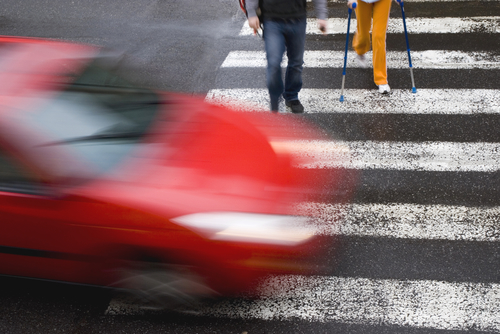
- Crosswalk and intersection turning collisions — a driver turning left or right fails to yield to a person lawfully crossing. These are among the most common and most clearly established under CVC 21950.
- Mid-block and “dart-out” crashes — where comparative fault is most heavily contested by insurers.
- Backing and parking-lot accidents — drivers reversing out of spaces or driveways who never see the pedestrian behind them.
- Hit-and-run collisions — where the driver flees; recovery may come through your own uninsured motorist (UM/UIM) coverage.
- Bus, transit, and rideshare-related strikes — which can involve commercial insurance policies and government entities.
Who Can Be Held Liable for a California Pedestrian Accident
Pedestrian cases are not always as simple as “the driver did it.” An experienced attorney investigates every party whose negligence contributed to the crash, because additional defendants often mean additional insurance coverage. Potentially liable parties include:
- The driver who struck you — for speeding, distraction, impairment, or failing to yield.
- The driver’s employer — if the driver was working at the time, such as a delivery, rideshare, or commercial driver.
- A government entity — when a dangerous road design, missing crosswalk, broken signal, or poor lighting contributed to the collision. These claims carry a much shorter deadline.
- A vehicle or parts manufacturer — in the rare case a defect (such as failed brakes) played a role.
Identifying every responsible party is one of the most valuable things a lawyer does, because the at-fault driver’s policy limits are frequently far too low to cover a serious pedestrian injury.
How Comparative Fault Affects Your Recovery
Insurance companies almost always try to blame the injured pedestrian — arguing you “darted out,” crossed against the signal, were looking at your phone, or wore dark clothing at night. California, however, follows a pure comparative fault rule, which is among the most plaintiff-friendly standards in the nation. You can recover damages even if you were partially at fault; your compensation is simply reduced by your percentage of responsibility.
For example, if your total damages are $300,000 and a jury finds you 25% at fault for crossing mid-block, you still recover $225,000. Do not let an adjuster convince you that sharing some blame means you have no claim — that is exactly the misconception insurers rely on to close cases cheaply.
Compensation You Can Recover
California law allows injured pedestrians to recover two broad categories of damages. Economic damages cover quantifiable losses: emergency and ongoing medical care, future medical and life-care costs, lost wages, and diminished earning capacity. Non-economic damages compensate for pain and suffering, emotional distress, loss of enjoyment of life, and permanent disability or disfigurement — and in serious cases these often exceed the economic losses.
There is no single “average” pedestrian settlement, but the average pedestrian accident settlement values in California generally fall into broad ranges based on injury severity. The benchmarks below are general guidance only — not guarantees — and your case may resolve higher or lower depending on liability, the available insurance limits, and the strength of your evidence.
| Injury Category | Typical California Settlement Range |
| Minor injuries | $10,000 – $75,000 |
| Moderate injuries | $75,000 – $250,000 |
| Severe injuries | $250,000 – $1,000,000+ |
| Catastrophic injuries | $500,000 – several million |
| Wrongful death | $500,000 – several million |
Insurers typically value claims using either the multiplier method — totaling your medical bills and lost wages, then multiplying by a factor (commonly 1.5 to 5) based on severity — or the per-diem method, which assigns a daily dollar value to your suffering. Adjusters push these calculations as low as possible; an experienced attorney pushes back with thorough documentation, expert testimony, and, in catastrophic cases, a life-care plan projecting decades of future cost.
California Filing Deadlines: Do Not Wait
In most cases you have two years from the date of the accident to file a pedestrian injury lawsuit in California. If a government entity was involved — a city bus, a municipal vehicle, or a dangerous roadway condition — you may have as little as six months to file a government tort claim. Missing these personal injury filing deadlines almost always means losing your right to recover permanently, so it is critical to speak with an attorney as soon as possible after your injury.
What to Do After Being Hit by a Car in California
- Call 911 and report the collision so police document the scene and note any traffic violations.
- Seek immediate medical attention — adrenaline can mask serious injuries like TBI and internal trauma, and gaps in treatment are used against you.
- Photograph the scene, your injuries, the vehicle, and any crosswalk markings, signals, or signs.
- Collect the driver’s information and contact details for any independent witnesses.
- Do not give a recorded statement to the driver’s insurer before consulting an attorney.
- Contact a California pedestrian accident lawyer to preserve evidence and handle the insurance company on your behalf.
Why Hire a California Pedestrian Accident Lawyer
Insurance companies have one objective: to pay you as little as possible. An experienced pedestrian accident attorney levels the playing field by investigating exactly how the collision happened, identifying every source of insurance coverage, building the medical and expert evidence needed to prove your damages, and dismantling the comparative-fault arguments insurers use to cut payouts. Represented claimants consistently recover significantly more than those who negotiate alone — and most pedestrian accident attorneys, including our firm, work on a contingency basis, meaning you pay no fee unless and until you recover.
Frequently Asked Questions
How much is my California pedestrian accident case worth?
It depends on the severity of your injuries, the available insurance coverage, how clear the driver’s liability is, and the strength of your evidence. Cases range from a few thousand dollars for minor injuries to several million for catastrophic harm or wrongful death.
Can I still recover if I was jaywalking or partly at fault?
Yes. Under California’s pure comparative fault rule, you can recover even if you were partially responsible — your award is reduced by your percentage of fault. A driver who was speeding, distracted, or impaired can still be held liable for a mid-block crash.
What if the driver fled the scene or had no insurance?
You may be able to recover through your own uninsured/underinsured motorist (UM/UIM) coverage. An attorney can identify all potential sources of compensation, including hit-and-run protections.
Who pays my medical bills while my case is pending?
Options may include your health insurance, MedPay coverage, or treatment provided on a lien basis until your case resolves. An attorney can help you arrange care so you are not forced to settle prematurely.
How long does a pedestrian accident case take?
Straightforward claims may resolve in a few months; serious-injury and disputed-liability cases often take one to two years, particularly if litigation is required. Rushing to settle before you reach maximum medical improvement is usually a costly mistake.
How much does a pedestrian accident lawyer cost?
Most California pedestrian accident lawyers work on contingency — you pay no attorney fees unless and until they recover compensation for you.
Speak With an Experienced California Pedestrian Accident Lawyer
If you or someone you love was hit by a vehicle while walking, the team at Steven M. Sweat, Personal Injury Lawyers, APC has spent more than 30 years fighting for injured pedestrians across California. We know how insurers operate, we know the local roads and agencies, and we do not back down. Consultations are free, and you owe nothing unless we win. Call 866-966-5240 or contact us online to discuss your case today.
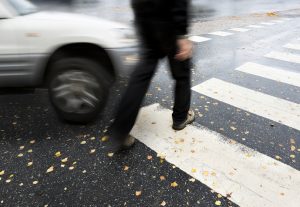

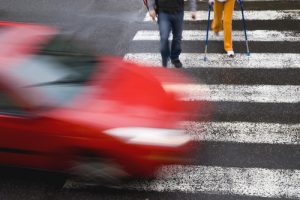 Employers may be liable for the negligence of their employees when their employees injure others during the course and scope of their employment. Employers hold vicarious liability for the negligent acts of their employees while they are acting in the course and scope of their jobs. In Jay H. et al. v. John Keith Bullard, Waterfront Enterprises, Inc., dba Newport Landing Restaurant and Oyster Bar, et al., Orange County Superior Court Case No. 30-2014-00718428-CU-PA-CJC, the limits of the employer’s vicarious liability were explored.
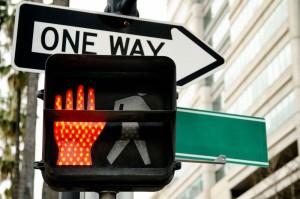 The City of Los Angeles is installing 15 new pedestrian signals in the downtown area to reduce the risk of accidents while people cross the street. The signals belong to a new class of traffic-safety devices called headstart signals or leading pedestrian intervals, which are especially helpful in protecting pedestrians from vehicles attempting to make right-hand turns. The headstart signals allow people to begin crossing the street at intersections a full four seconds before motor vehicles receive a green light.