 California Accident Attorneys Blog


Article Summary: Navigating a Budget rental car accident involves managing complex claims for vehicle damage, third-party liability, and personal injuries. Understanding the difference between Budget’s internal damage waivers and personal insurance is crucial to avoid unexpected costs. Immediately following a collision, drivers must prioritize safety, contact law enforcement for a police report, and thoroughly document the scene with photographs and witness information. Reporting the incident to Budget within twenty-four hours via their dedicated claims line or website is a contractual necessity to prevent liability shifts. Additionally, renters should activate personal auto insurance and credit card benefits to provide supplemental coverage for repair costs and administrative fees like loss of use or diminished value. When Budget eventually sends an itemized damage bill, it is essential to review each charge for accuracy and formally dispute any unsupported fees through certified mail. While Budget handles vehicle-related issues, personal injury claims require a separate legal approach to recover compensation for medical bills and lost wages. Engaging an experienced personal injury attorney ensures that your rights are protected against insurance companies seeking to minimize payouts, especially when dealing with the unique intricacies of rental car litigation and corporate claims departments.
Getting into an accident while driving a Budget rental car creates a uniquely stressful situation. Beyond the immediate shock and potential injuries, you’re suddenly dealing with a vehicle you don’t own, a rental company’s claims department, and possibly an insurance maze that looks nothing like a standard car accident case. Knowing how to handle budget rental car accident claims correctly from the start can mean the difference between a smooth resolution and months of frustrating back-and-forth over damage charges or denied injury compensation.
At Steven M. Sweat, Personal Injury Lawyers, APC, we’ve spent over 25 years representing accident victims across Los Angeles and throughout California, including clients injured in rental vehicles. We’ve seen firsthand how rental car companies protect their financial interests, often leaving injured renters to figure out the claims process alone. That experience is exactly why we put this guide together: to give you a clear path forward when Budget is involved.
Below, you’ll find step-by-step instructions for filing your claim, the specific forms and phone numbers you’ll need, how to handle damage bills, and when it makes sense to bring a personal injury attorney into the process to protect your rights.
What Budget accident claims cover
When you’re involved in an accident in a Budget rental, multiple overlapping claim types can come into play at once. Before you start making phone calls or signing anything, you need to understand exactly what Budget’s claims process addresses, what falls outside it, and who ultimately pays for what. Mixing these up early causes delays, disputes over bills, and gaps in your own injury compensation.
Damage to the rental vehicle
Budget will file a damage claim against you as the renter if their vehicle sustains physical harm in a collision, regardless of fault. This includes collision damage, theft, vandalism, and rollover incidents. If you purchased Budget’s Damage Waiver (DW) or Loss Damage Waiver (LDW) at the counter, that product waives Budget’s right to hold you responsible for most vehicle damage, provided you didn’t violate the rental agreement. Without that waiver, you’re personally on the hook for repair costs up to the full value of the vehicle.
Budget’s LDW is not insurance. It’s a contractual waiver that only applies when you comply with the terms of your rental agreement.
Your personal auto insurance policy or the credit card you used to rent may also cover rental car damage, but coverage varies significantly by policy and card. Check your declarations page and your card’s benefits guide before assuming you’re protected.
Third-party property damage and bodily injury liability
If you cause an accident that damages another person’s vehicle or injures someone else, Budget’s third-party liability coverage functions as a backstop. Under California law, rental companies must provide minimum liability coverage to renters. Budget’s Supplemental Liability Protection (SLP) product extends that coverage significantly, up to $1 million per occurrence in some cases.
Your own auto insurance liability coverage also applies in most situations if you carry it. The key distinction is that third-party claims (where someone else pursues you or Budget for their injuries or property damage) move through a completely different track than your own damage claim for Budget’s vehicle.
Loss of use, diminished value, and administrative fees
This portion of budget rental car accident claims catches most renters completely off guard. When a rental vehicle is damaged, Budget doesn’t just charge you for repairs. They also bill for three separate cost categories:
| Charge | What it means |
|---|---|
| Loss of use | The daily rental rate for every day the vehicle is out of service for repairs |
| Diminished value | The reduction in market resale value the vehicle suffers after an accident |
| Administrative fees | Internal processing costs Budget incurs to manage the claim |
These additional charges can add several hundred to several thousand dollars on top of repair costs alone. Budget typically sends these bills weeks after the accident, long after most renters believe everything is settled.
Personal injury to you and your passengers
Budget’s claims process does not handle your personal injuries or those of your passengers. That falls entirely outside the rental company’s damage claim system. Your medical bills, lost income, and pain and suffering are addressed through your own health insurance, the at-fault driver’s liability policy, your personal injury protection coverage if applicable, or a personal injury lawsuit when another party caused the crash.
Knowing which claim type applies to which loss keeps you from making the common mistake of waiting on Budget to resolve something they were never responsible for covering in the first place.
Step 1. Handle the crash and document everything
The first 30 minutes after a rental car accident set the foundation for every claim that follows. What you do at the scene directly determines how much leverage you have when Budget sends you a damage bill or when an insurance adjuster reviews your case. Skip the documentation steps here, and you’re left arguing your version of events without any supporting evidence.
Immediate actions at the scene
Your first priority is safety and medical attention. Move to a safe location if you can, check everyone involved for injuries, and call 911. Even when damage looks minor, a police report creates an official third-party record of how the accident happened, which is critical for both Budget’s claims process and any injury claim you pursue later. Never leave the scene before law enforcement arrives and provides you with a report number.
A police report is one of the strongest pieces of evidence you can collect at the scene, so always request one regardless of how minor the accident appears.
Document the damage and gather information
Once the scene is safe, start collecting information as thoroughly as possible. Photograph everything from multiple angles: all four sides of the rental vehicle, the point of impact on every car involved, skid marks, road conditions, traffic signs, and any visible injuries on yourself or passengers. Use your phone’s timestamp feature so the photos carry automatic date and time metadata.

You also need to exchange specific information with the other driver and gather details from any witnesses before anyone leaves. Use this checklist to make sure you don’t miss anything:
- Full name, address, phone number, and driver’s license number of every driver involved
- Insurance company name, policy number, and claims phone number for each driver
- Vehicle make, model, year, color, and license plate for every car involved
- Names and contact numbers of any witnesses
- Badge number and name of the responding officer
- Police report number
Beyond the other parties, document Budget’s vehicle directly: write down the rental agreement number, vehicle identification number (VIN) from the dashboard, license plate, and the mileage shown on the odometer. These details match your rental paperwork to the specific vehicle and prevent disputes about pre-existing damage later. Check your rental agreement for Budget’s emergency roadside number, typically printed on the contract itself, and call it to report the accident before leaving the scene.
Step 2. Notify Budget and file the report
Once you’ve left the scene with your documentation in hand, your next obligation is to contact Budget directly. Most rental agreements require you to report accidents within 24 hours. Missing that window can give Budget grounds to deny a damage waiver claim or treat the incident as a contract violation, which shifts more financial liability onto you. Don’t wait until you’re home and rested; make the call the same day.
Contact Budget’s claims department
Budget handles accident reporting through its damage claims line at 1-800-551-5998. This number connects you to the claims team, not general customer service. Have your rental agreement number, the police report number, and the accident details ready before you dial. If you rented through a third-party site like Expedia or a corporate account, you still call Budget directly for the damage report because Budget owns the vehicle and manages all physical damage claims regardless of where you booked.

Keep a written record of every call: the date, time, name of the representative, and a brief summary of what was discussed. This record protects you if Budget later disputes what was reported or when.
You can also submit an initial written notice through Budget’s website at budgetdirect.com under the contact or claims section, which creates a timestamped paper trail alongside your phone call. Some renters find submitting both a call and a written notice helpful for documenting their timely response.
What to include in your report
When you speak with the claims representative, stick to the factual details of the accident and avoid speculating about fault or estimating damage costs. Provide the following information clearly:
- Your full name and rental agreement number
- Date, time, and exact location of the accident
- A brief factual description of what happened
- Names and insurance details of any other drivers involved
- The police report number and the name of the responding agency
- Contact information for any witnesses you collected at the scene
When handling budget rental car accident claims, Budget will assign a claim number to your case after this initial report. Write that number down immediately and reference it on every future communication. The claims representative may also ask you to submit photos of the damage directly through a link or email address they provide, so have your documentation from Step 1 ready to upload.
Step 3. Start your insurance or card claim
Reporting the accident to Budget is only half of what you need to do in the first 24 to 48 hours. You also need to activate your own coverage independently, because Budget’s claims team works for Budget, not for you. Starting your personal insurance or credit card claim in parallel with the Budget report keeps your options open and prevents coverage gaps from developing while you wait for Budget’s process to move forward.
Contact your personal auto insurer
Call your personal auto insurance carrier and open a claim using the accident details and police report number you gathered at the scene. Most policies extend liability coverage and, if you carry comprehensive and collision coverage, physical damage coverage to rental vehicles as well. Check your declarations page to confirm the scope of your coverage before assuming your policy applies to the rental.
Do not assume your insurance automatically covers a rental. Confirm coverage in writing with your adjuster before declining any reimbursement options.
When you call, have the following ready so your adjuster can open the file efficiently:
- Your policy number
- The rental agreement number and Budget claim number
- Date, time, and location of the accident
- Police report number and responding agency
- The other driver’s name, insurance company, and policy number if another vehicle was involved
Your insurer will communicate directly with Budget’s claims department on damage disputes and repair costs once your claim is open. That coordination protects you from having to negotiate those costs alone.
Check your credit card rental benefits
Many major credit cards provide secondary or primary rental car damage coverage as a cardholder benefit when you pay for the rental in full with that card and decline the rental company’s own damage waiver. Visa, Mastercard, and American Express each offer this benefit on certain card tiers, though coverage limits and exclusions differ.
Call the benefits number on the back of your card and ask specifically about auto rental collision damage waivers. You typically need to file a notice of claim within 30 to 60 days of the incident, and the card issuer will request the Budget damage assessment, repair invoices, and your rental agreement as supporting documentation. Filing this claim early keeps the deadline from sneaking up on you while you’re still resolving other parts of the budget rental car accident claims process.
Step 4. Respond to damage bills and fees
Budget often sends damage bills weeks or even months after the accident, long after most renters assume the matter is closed. When that letter arrives, do not pay it immediately or assume the amount is correct. Budget rental car accident claims regularly include charges for loss of use, diminished value, and administrative fees that can be contested, reduced, or covered by insurance you already activated in Step 3. Your response to that first bill sets the tone for everything that follows.
Review the bill before paying anything
Read every line of the damage invoice carefully. Budget is required to provide an itemized breakdown of all charges, including the actual repair estimate or invoice, the daily rental rate used to calculate loss of use, and the number of days the vehicle was out of service. If the bill lacks that detail, request it in writing before you respond to any dollar amount.
Use this checklist when reviewing your Budget damage bill:
- Confirm that the vehicle description and VIN match the car you actually rented
- Verify the repair costs align with the damage documented in your scene photos
- Check the loss of use calculation: the number of days billed should match repair shop records, not an inflated estimate
- Confirm no pre-existing damage from before your rental is included in the repair line items
- Review administrative fees and ask Budget to explain each one in writing if they are not clearly described
If your personal auto insurer or credit card already opened a claim, forward the damage bill to both of them immediately so they can review and respond on your behalf.
Dispute charges you don’t recognize
Write a formal dispute letter to Budget’s claims department if any charges appear inaccurate, unsupported, or duplicative. Reference your claim number in the first line and attach your scene photos, the original rental agreement, and any repair documentation you’ve gathered. Be specific: identify the exact charge you dispute and explain briefly why the documentation does not support it.
Send your dispute via certified mail with return receipt so you have a delivery record. Keep a copy of every document you send. Budget typically has a set window to respond, and having your dispute in writing prevents the company from claiming it was never received or that you agreed to the charges by staying silent.
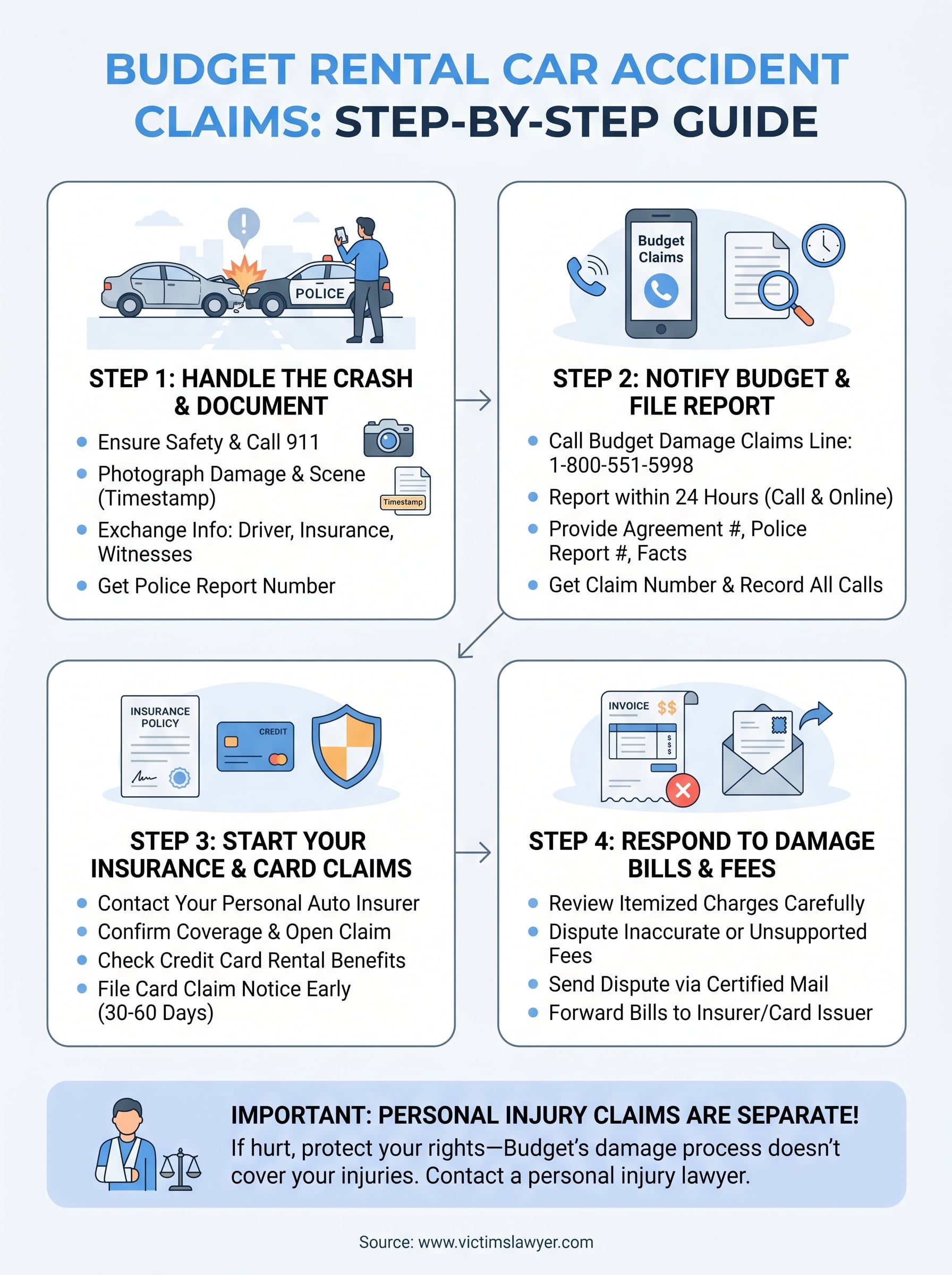
If you were hurt, protect your rights
The steps above walk you through property damage and billing disputes, but none of that process protects you as an injured person. If you or any passenger suffered injuries in the accident, budget rental car accident claims with Budget’s damage department are entirely separate from your right to pursue compensation for medical bills, lost wages, and pain and suffering. Budget’s claims team will not advocate for your injuries, and insurance adjusters from any party work to minimize what they pay out.
Serious injuries deserve serious legal representation. At Steven M. Sweat, Personal Injury Lawyers, APC, we represent rental car accident victims throughout California on a contingency basis, meaning you pay nothing unless we recover money for you. Our team handles the insurance negotiations while you focus on recovering. If another driver caused your accident or a defective vehicle contributed to your injuries, you may have significant legal options worth exploring. Contact our team for a free consultation today.