 California Accident Attorneys Blog


Emotional distress is real, but proving it in a courtroom is a different challenge entirely. Unlike a broken bone that shows up on an X-ray, anxiety, depression, PTSD, and other psychological injuries don’t come with neat, visible proof. That’s why so many claimants struggle with how to prove emotional distress in court, and why insurance companies routinely try to minimize or deny these claims. The truth is, emotional suffering can be just as debilitating as a physical injury, and California law recognizes your right to recover compensation for it.
At Steven M. Sweat, Personal Injury Lawyers, APC, we’ve spent over 30 years helping injured people across Los Angeles and throughout California build strong cases that account for the full scope of their harm, including the psychological toll. We know what judges and juries need to see, and more importantly, what evidence actually moves the needle on emotional distress claims.
This guide breaks down the specific types of documentation, expert testimony, and legal strategies you’ll need to substantiate emotional distress damages. We’ve organized it as a practical checklist so you can start gathering the right evidence now, whether your case involves a car accident, workplace injury, assault, or any other traumatic event. By the end, you’ll understand exactly what it takes to turn invisible suffering into a provable claim.
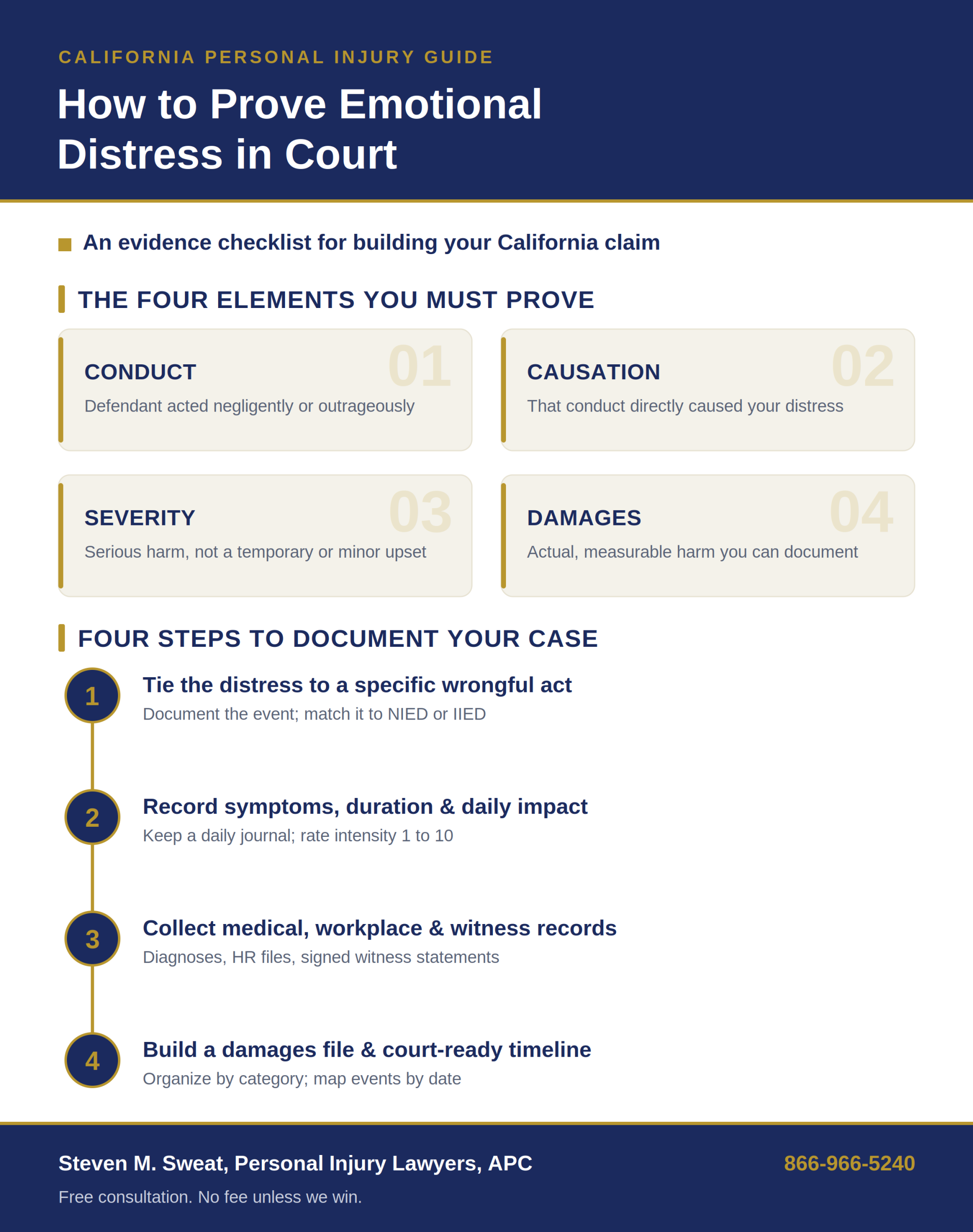
What you must prove for emotional distress in court
In California, emotional distress claims fall under two legal theories: negligent infliction of emotional distress (NIED) and intentional infliction of emotional distress (IIED). Understanding which one applies to your situation is the first step in knowing how to prove emotional distress in court. Each theory carries different requirements, different burdens of proof, and different potential damages, so getting this distinction right from the start shapes everything that follows in building your case.
The strongest emotional distress cases combine a clear legal theory with documented, ongoing psychological symptoms supported by professional evaluation.
Negligent vs. intentional infliction
NIED applies when someone’s careless conduct, such as a negligent driver or a property owner who failed to maintain safe premises, caused your psychological harm. IIED applies when the defendant’s conduct was outrageous and intentional, such as sustained workplace harassment or a violent assault. NIED is more common in personal injury claims, while IIED tends to appear in employment and assault cases. Knowing which theory fits your facts tells you exactly what evidence you need to gather before approaching a court.
The four elements you must establish
Regardless of which theory applies, California courts generally require you to prove four things:
- The defendant’s conduct: The other party acted negligently or outrageously.
- Causation: That conduct directly caused your emotional suffering.
- Severity: Your distress was serious, not a temporary or minor upset.
- Damages: You suffered actual, measurable harm as a result.
Each element needs supporting evidence. Courts don’t accept vague claims of feeling bad. You need documented proof that connects the defendant’s actions to a specific, serious psychological injury that measurably disrupted your daily life, relationships, or ability to work.
Step 1. Tie the distress to a specific wrongful act
The first thing a court will ask is: what specific act caused your distress? You cannot win an emotional distress claim by describing suffering in vague terms. Courts require a direct, documented link between the defendant’s conduct and the psychological harm you experienced. This connection is the foundation of how to prove emotional distress in court, and without it, the rest of your evidence won’t hold.
Document the triggering event immediately
Write down exactly what happened as soon as possible after the incident. Your written account should cover the date, time, location, and a precise description of the defendant’s conduct. Note any witnesses present and how you felt immediately afterward. A personal journal entry or a text message sent right after the event can serve as contemporaneous evidence that ties your emotional response to a specific moment in time.
The closer in time your documentation is to the triggering event, the harder it becomes for the opposing party to argue your distress was unrelated to it.
Match the act to your legal theory
NIED claims require proof that the defendant had a duty of care toward you and breached it. IIED claims require evidence of extreme, outrageous conduct that goes well beyond ordinary negligence. Collect every official record that documents the wrongful act directly:
- Police or incident reports
- Surveillance or dashcam footage
- Employer HR records or written complaints
- Written communications from the defendant
Step 2. Record symptoms, duration, and daily impact
Once you’ve tied your distress to the wrongful act, document your symptoms consistently over time. Courts want to see that your suffering is ongoing and serious. This is a critical step in how to prove emotional distress in court, because a documented pattern of symptoms is far harder to dismiss than a single report filed long after the fact.
Keep a daily symptom journal
A daily journal is one of the strongest tools you have. Write an entry every day, even on days when symptoms feel the same. Note the specific symptom, such as nightmares or panic attacks, rate its intensity on a 1-to-10 scale, and log how long it lasted. Use this template:
Short, honest, dated entries carry more credibility than lengthy, vague narratives written long after the fact.
Date: [MM/DD/YYYY]
Symptoms: [e.g., panic attack, insomnia]
Intensity (1-10): [number]
Duration: [e.g., 2 hours]
Activities affected: [e.g., missed work]
Track the impact on your daily life
Courts don’t just want a list of feelings. They need specific evidence that your distress disrupted real, measurable parts of your life. Record each disruption with a date so your attorney has concrete material for a damages argument. Track items like:
- Missed or reduced workdays
- Canceled social plans or family events
- Changes in sleep patterns or appetite
- Withdrawal from activities you previously enjoyed
Step 3. Collect medical, workplace, and witness records
Third-party documentation is the most persuasive evidence in how to prove emotional distress in court. Your journal entries establish a personal record, but medical records, workplace files, and witness statements give that record external credibility that courts and opposing counsel cannot easily dismiss.
Get your medical records in order
Your treatment history is your strongest asset. Request records from every provider you’ve seen, including primary care physicians, therapists, psychiatrists, and urgent care facilities. Ask each provider to document your diagnosis, the treatment plan, and any direct connection they note between your symptoms and the incident. Courts give significant weight to a licensed professional’s written opinion linking your distress to the defendant’s conduct.
Collect the following from each provider:
- Intake notes and initial diagnosis records
- Treatment plans and progress notes
- Prescription records for anxiety, sleep, or depression medication
- Any written referrals to mental health specialists
Gather workplace and witness evidence
Workplace records document the real-world consequences of your distress in a measurable way. Pull attendance logs, performance reviews, HR complaints, and any written communications about changes in your work output. These records turn your symptom journal into a verifiable story.
Witness statements from coworkers, family members, or friends who observed behavioral changes in you after the incident carry significant weight with a jury.
Ask each witness to write a dated, signed statement describing specific changes they observed in your behavior, mood, or daily functioning.
Step 4. Build a damages file and court-ready timeline
After collecting your evidence, you need to organize it into a single damages file that your attorney can use directly in court. This is the final organizational step in how to prove emotional distress in court, and it’s where scattered documentation becomes a coherent legal argument. A structured file shows the court that your claim is serious, systematic, and backed by real proof.
A well-organized damages file tells a clear story from the triggering event to your current condition, which is exactly what a judge or jury needs to see.
Assemble your damages file
Your damages file should contain every document you’ve gathered, organized by category. Use this structure to keep everything accessible:
- Incident records: police reports, photos, and your written account
- Medical records: diagnoses, treatment notes, and prescription history
- Symptom journal: dated daily entries with intensity ratings
- Workplace records: attendance logs, HR complaints, performance reviews
- Witness statements: signed, dated accounts from people who observed changes in you
Create a chronological timeline
Courts respond to timelines because they show causation visually and directly. Build a written timeline listing each key event with its date, attached evidence, and resulting symptom or impact. Start from the incident date and extend it through your most recent medical appointment.
| Date | Event | Evidence Attached | Impact |
| [Date] | Incident occurred | Police report, photos | Acute anxiety begins |
| [Date] | First therapy visit | Intake notes | PTSD diagnosis |
| [Date] | Missed work | Attendance log | Lost wages documented |
What to do next
You now have a concrete framework for how to prove emotional distress in court, from establishing the triggering wrongful act to building a court-ready damages file with a supporting timeline. The most important move you can make right now is to start documenting today. Every day that passes without a journal entry, a medical appointment, or a gathered record is a gap that the opposing side will use against you.
Emotional distress claims require consistent, layered evidence, and building that foundation alone is difficult, especially while you’re managing the psychological effects of the incident itself. An experienced personal injury attorney can identify which legal theory fits your case, guide you on which expert witnesses to retain, and organize your evidence into the strongest possible argument before a judge or jury.
If you’re ready to talk through your situation, our legal team is available 24/7 for a free consultation. Contact Steven M. Sweat, Personal Injury Lawyers, APC to get started with no upfront cost.