 California Accident Attorneys Blog


Article Summary: Distracted and drunk driving both pose catastrophic risks on California roads, where high traffic density increases the likelihood of preventable collisions. While drunk driving carries a significant social stigma and severe criminal penalties, including potential jail time and heavy fines, distracted driving is often dangerously normalized despite research showing it can impair a driver as much as a legal blood alcohol limit. California law distinguishes between the two, yet both behaviors degrade situational awareness and reaction speed, leading to thousands of annual fatalities. Legally, victims of both types of negligence have the right to pursue full compensation under California’s comparative fault system. Proving liability requires swift action to preserve evidence such as cell phone records, toxicology reports, and witness statements. Whether a driver was texting or intoxicated, the civil legal process allows injured parties to seek damages for medical bills and lost wages. Legal experts emphasize that because evidence fades quickly, securing professional representation is vital for building a strong case. Ultimately, both behaviors represent a breach of the duty of care, and understanding the specific legal nuances of each is essential for victims seeking justice and recovery after a serious accident.
Both behaviors kill thousands of people every year on California roads, yet the debate over distracted driving vs drunk driving often comes down to a misleading question: which one is “worse”? The reality is that both are preventable, and both devastate the lives of victims and their families in ways that statistics alone can’t capture.
What makes this comparison worth examining is the gap between public perception and actual risk. Drunk driving carries heavy criminal penalties and deep social stigma. Distracted driving, scrolling through a phone, typing a text, even glancing at a GPS, is something millions of drivers do daily without thinking twice. Yet research consistently shows that a texting driver can be as impaired as someone at or above the legal blood alcohol limit.
At Steven M. Sweat, Personal Injury Lawyers, APC, we’ve represented accident victims across Los Angeles who were struck by both drunk and distracted drivers. After more than 25 years of handling these cases, we can tell you that the injuries don’t discriminate based on what the at-fault driver was doing behind the wheel. This article breaks down the risks, the fatality data, the legal consequences, and what California law says about both, so you can understand how each behavior is treated and what your options are if you or someone you love has been hurt.
Why this comparison matters in California
California is one of the most heavily trafficked states in the country, with tens of millions of registered vehicles sharing freeways, surface streets, and highways every single day. When you look at the statewide crash data, the numbers behind the distracted driving vs drunk driving debate are not abstract. They represent real collisions that happen on the 405, the 101, and local streets in every county, affecting real families who did nothing wrong and had no warning before their lives changed.
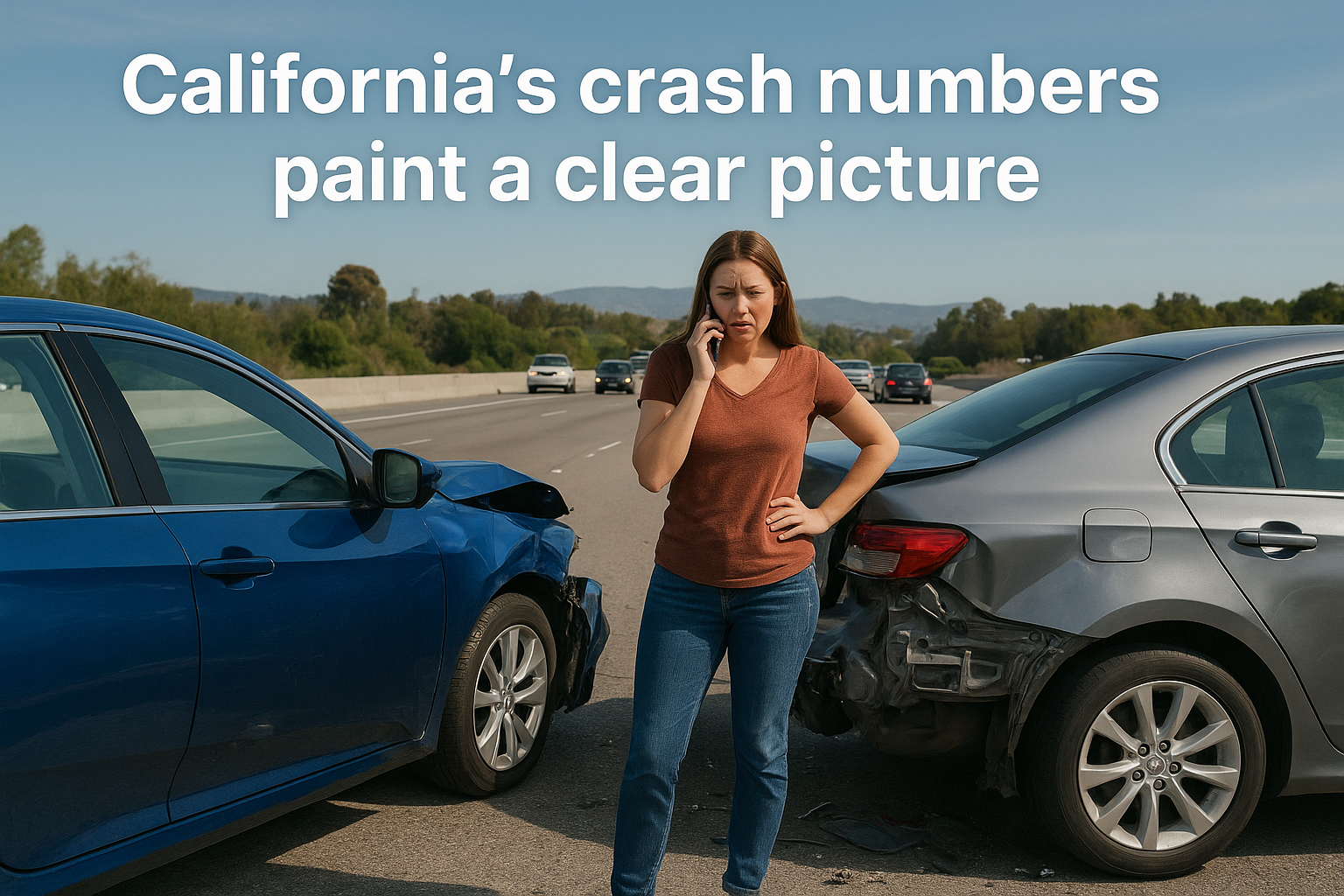
California’s crash numbers paint a clear picture
The California Office of Traffic Safety consistently ranks distracted driving as one of the top contributing factors in injury collisions across the state. In recent reporting periods, alcohol-involved crashes accounted for over 1,000 fatalities annually in California alone. At the same time, distraction-related crashes have grown year over year as smartphone use behind the wheel has become normalized, even though California Vehicle Code Section 23123.5 makes handheld phone use while driving illegal.
The National Highway Traffic Safety Administration (NHTSA) reported that distracted driving claimed 3,308 lives nationally in a single recent year, a figure that now rivals the death toll from alcohol-related crashes.
California’s population size means these national trends hit harder here than in most other states. Los Angeles County alone generates a disproportionate share of the state’s crash data, with dense traffic, extended commute times, and heavy rideshare activity all creating wider windows of exposure every time an impaired or distracted driver gets behind the wheel.
The legal stakes for victims are specific and serious
Understanding this comparison matters to you for a reason that goes beyond general road safety awareness. If you or a family member was hurt in a crash, the cause of that crash directly shapes how your legal claim is built. A driver who was legally drunk at the time of the collision may face both criminal prosecution and a civil lawsuit. A driver who was texting faces the same standard of civil negligence, but the evidence needed to prove distraction often looks very different from the breathalyzer results and field sobriety tests used in DUI cases.
California follows a comparative fault system, meaning the at-fault driver’s specific behavior, whether alcohol impairment or device distraction, directly influences how damages are calculated and how insurance companies respond to your claim. Knowing the distinction between these two forms of negligence helps you and your attorney build a case grounded in the right evidence and pursue the full compensation your injuries actually require.
What counts as distracted driving and drunk driving
Before comparing the two behaviors, you need to understand what each term actually covers under California law. Distracted driving refers to any activity that pulls your attention away from the task of operating a vehicle, while drunk driving specifically refers to operating a vehicle while impaired by alcohol or drugs beyond a legal threshold.
What distracted driving includes
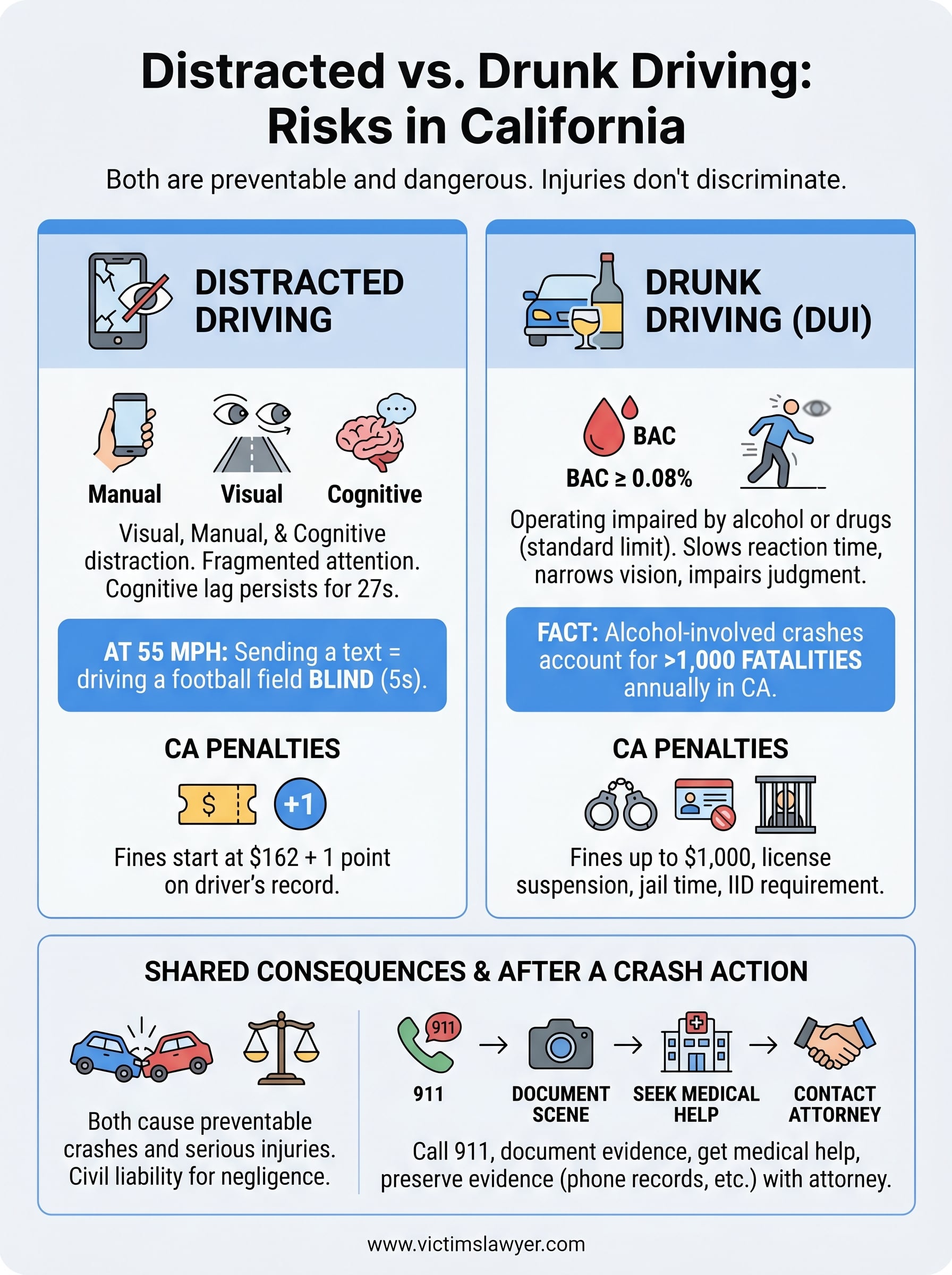
California law targets handheld device use as the primary form of distracted driving, but the behavior covers far more than texting. Distraction falls into three categories: visual (taking your eyes off the road), manual (removing your hands from the wheel), and cognitive (letting your mind drift from driving). A driver adjusting the radio, eating, applying makeup, or talking to a passenger can all qualify as distracted, depending on how that distraction contributed to a crash.
Sending or reading a text at 55 mph means your eyes leave the road for roughly 5 seconds, which is the equivalent of driving the length of a football field completely blind, according to the NHTSA.
What drunk driving includes
In the distracted driving vs drunk driving comparison, impaired driving carries a clearer legal boundary. California law defines driving under the influence (DUI) as operating a vehicle with a blood alcohol concentration (BAC) of 0.08% or higher for standard drivers, 0.04% for commercial drivers, and any detectable amount for drivers under 21. Impairment also extends to prescription drugs, marijuana, and other controlled substances that affect your ability to drive safely.
A driver does not need to appear visibly intoxicated to face a DUI charge. Reaction time, judgment, and coordination all degrade well before a driver reaches the 0.08% legal limit, meaning impairment can be present even when behavior looks completely normal from the outside.
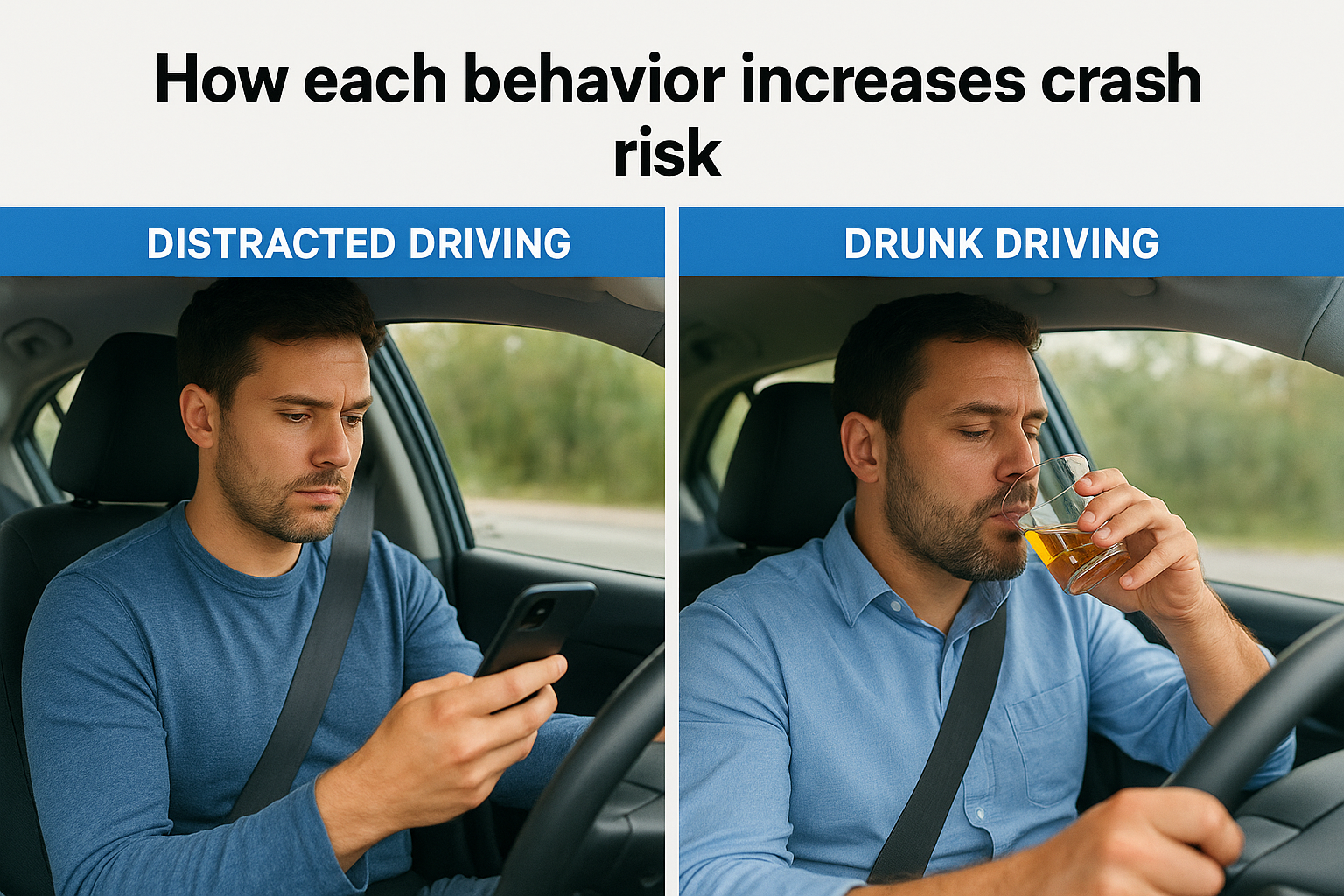
How each behavior increases crash risk
When you put distracted driving vs drunk driving side by side, the mechanisms of impairment differ, but the outcome on the road is often identical: a driver who cannot respond in time to avoid a collision. Understanding how each behavior degrades your ability to drive helps explain why both produce such serious injuries.
How distraction degrades driving performance
Distraction works by fragmenting your attention across multiple competing tasks at the same time. When you glance at your phone, your brain does not simply pause its awareness of the road and resume it a second later. Research from the AAA Foundation for Traffic Safety shows that cognitive distraction lingers for up to 27 seconds after you put a device down, meaning your reaction time stays compromised well after you think you’re focused again. Even hands-free calls create this lag, which is why simply holding the phone isn’t the only danger.
A driver traveling at highway speed who looks away for just two seconds covers roughly 176 feet with no visual awareness of what’s ahead.
How alcohol impairs your ability to drive
Alcohol attacks multiple driving functions simultaneously: vision narrows, reaction time slows, coordination weakens, and judgment deteriorates. At a BAC of just 0.05%, well below California’s legal limit, a driver already shows measurable declines in their ability to track moving objects and respond to unexpected hazards. By 0.08%, those deficits are significant enough that the law treats that driver as legally impaired.
Both behaviors strip away the same core abilities you need to drive safely: situational awareness and reaction speed. The difference is that alcohol impairs you from the moment it enters your bloodstream, while distraction can be intermittent but just as dangerous when it occurs at the wrong moment on a crowded freeway.
California laws and penalties for each
California treats both behaviors as serious violations, but the legal consequences differ significantly in severity. Understanding where distracted driving vs drunk driving falls under state law helps you grasp the full picture of what an at-fault driver faces, and how that affects your civil claim for damages.
Penalties for distracted driving in California
California Vehicle Code Section 23123.5 prohibits using a handheld device while driving, with base fines starting at $162 for a first offense and rising to $285 for each subsequent violation. While these fines feel minor compared to DUI consequences, California recently added one point to a driver’s record for handheld phone violations, which directly impacts insurance rates and can affect commercial driver licenses. Distracted driving is treated as a civil infraction in most cases, not a criminal offense, unless the distraction causes injury or death, at which point prosecutors can pursue charges including vehicular manslaughter.
Penalties for drunk driving in California
A standard first-offense DUI under California Vehicle Code Section 23152 carries consequences far more severe than a distracted driving ticket: fines up to $1,000, a six-month license suspension, mandatory DUI school, and up to six months in county jail. Repeat offenses escalate quickly, and a DUI causing injury or death can result in felony charges with multi-year prison sentences. California also requires ignition interlock devices for convicted DUI offenders in most counties, adding another layer of restriction after the sentence is served.
When a drunk driver injures someone, California law allows the victim to pursue punitive damages in a civil lawsuit, which go beyond standard compensation for medical bills and lost wages.
Both violations create civil liability for the at-fault driver, meaning you can file a personal injury claim regardless of whether criminal charges are filed. The strength of your claim, however, depends heavily on the evidence available, which is why working with an experienced attorney from the start gives you a real advantage.
What to do after a crash caused by impairment
Whether the driver who hit you was texting or drunk, the steps you take immediately after the crash directly affect your ability to recover compensation. In the distracted driving vs drunk driving context, evidence fades fast. Police reports get filed, witnesses leave, and phone records can be deleted or lost if no one formally requests them. Acting quickly and deliberately gives your case the foundation it needs.
Steps to take at the scene
Your first priority is your safety, but once you are physically able, document everything you can before leaving the scene. The actions you take in those first minutes create the evidentiary record your attorney will rely on.
- Call 911 immediately so law enforcement can conduct field sobriety tests or observe the at-fault driver’s behavior while evidence is still present
- Take photos of all vehicles, road conditions, traffic signals, and any visible injuries
- Collect the names and contact information of all witnesses
- Avoid discussing fault with the other driver or their insurance company at the scene
- Seek medical evaluation the same day, even if you feel fine, because many serious injuries take hours to surface
A police report that documents suspected impairment, whether from alcohol or a visible phone in the driver’s hand, becomes one of the most powerful pieces of evidence in a personal injury claim.
How a personal injury attorney builds your case
An experienced attorney knows how to preserve evidence that you cannot access on your own, including cell phone records, traffic camera footage, and toxicology reports. These records have strict preservation windows, and waiting too long to hire counsel often means that evidence disappears permanently.
Steven M. Sweat, Personal Injury Lawyers, APC offers free consultations available 24 hours a day, so you can get legal guidance before you say anything to an insurance adjuster. Protecting your rights starts the moment the crash happens.
Key takeaways
The distracted driving vs drunk driving debate doesn’t have a clean winner because both behaviors destroy the same core driving abilities: situational awareness and reaction speed. Both are fully preventable, and both expose victims to serious, sometimes fatal injuries with no warning.
California law treats each violation differently, but your right to pursue full compensation doesn’t depend on which one caused your crash. What matters is proving negligence, preserving evidence quickly, and working with an attorney who knows how to build your case from the ground up.
If you or someone you love was hurt by an impaired or distracted driver, you don’t have to figure this out alone. Steven M. Sweat, Personal Injury Lawyers, APC offers free consultations around the clock, so you can get honest answers before making any decisions. Contact us today to talk through your options with no obligation and no upfront cost.