 California Accident Attorneys Blog


Article Summary: Finding the right trip and fall attorney requires a systematic approach to ensure a successful personal injury claim. A strong case relies on proving liability, documenting damages, and establishing a direct link between the hazard and the injury. Victims should seek immediate medical care and preserve evidence, such as photographs and witness statements, before conditions change. Identifying the responsible party is crucial, especially for accidents on government property, which require filing a claim within six months under California law. To find a qualified lawyer, use the California State Bar directory and Google reviews to build a shortlist of firms specializing in premises liability. During consultations, ask direct questions about trial experience, contingency fees, and day-to-day case management while avoiding firms that use high-pressure tactics or lack transparency. Utilizing tools like license lookups and self-assessment checklists helps verify an attorney’s standing and prepares the victim for legal discussions. Taking these steps quickly prevents the loss of vital evidence and protects the right to compensation for medical expenses and lost income.
You tripped on a broken sidewalk, a loose carpet, or an uneven step, and now you’re dealing with pain, medical bills, and time off work. Your first instinct might be to search for a trip and fall attorney near me, and that’s a smart move. But the results that come back can be overwhelming: dozens of firms, all promising big results, with no clear way to tell who’s actually worth calling.
The truth is, not every personal injury lawyer handles trip and fall cases the same way. Some firms treat these claims as small-dollar nuisances. Others, like our team at Steven M. Sweat, Personal Injury Lawyers, APC, recognize that trip and fall injuries can be severe, life-altering, and worth fighting hard over. With over 25 years of experience representing injury victims across Los Angeles and throughout California, we’ve seen firsthand how the right legal representation changes outcomes for people in your exact situation.
This guide walks you through how to find and choose a trip and fall attorney quickly, without second-guessing yourself. You’ll learn what credentials actually matter, what questions to ask during a consultation, how to spot red flags, and how to move forward with confidence. Whether you’re fresh out of the emergency room or weeks into recovery and still unsure about your legal options, this article gives you a clear path from search results to signed retainer.
What a trip and fall case needs to succeed
Before you search for a trip and fall attorney near me, you need to understand what actually drives a successful claim. California premises liability law requires you to prove specific elements, and if any one of them is weak, the opposing insurance adjuster will use that gap to reduce or deny your compensation. Knowing these elements from the start helps you gather the right evidence early and have a sharper conversation with any attorney you consult.
Liability: proving the property owner was responsible
A property owner, business, or government entity does not automatically owe you money because you fell on their property. You have to show they knew or should have known about the dangerous condition and failed to fix it or warn you about it. In California, this standard applies to private homeowners, commercial businesses, and even public agencies, though claims against government bodies carry shorter deadlines and additional filing requirements.
Here’s what liability evidence looks like in practice:
- Incident reports filed the day of the fall with the property owner or manager
- Surveillance footage from security cameras near the hazard (request preservation immediately in writing)
- Maintenance logs showing the hazard was reported and ignored
- Photographs of the exact condition that caused your fall, ideally taken within hours
- Witness names and contact information collected at the scene
- Prior complaints from other visitors or tenants about the same hazard
The longer you wait to collect this evidence, the more likely it is that the property owner repairs the hazard, deletes footage, or loses records.
Damages: showing real, documented harm
Even with clear liability, your compensation depends on the severity of your documented losses. California law allows you to recover economic damages like medical expenses and lost wages, plus non-economic damages for pain, suffering, and reduced quality of life. Weak documentation of your injuries will directly shrink any settlement offer.
Your damages record should include:
| Damage Category | What to Document |
|---|---|
| Medical expenses | Bills, treatment records, specialist referrals, physical therapy notes |
| Lost income | Pay stubs, employer letter, tax returns if self-employed |
| Future care costs | Doctor’s written opinion on ongoing treatment needs |
| Pain and suffering | Personal journal, mental health treatment records, impact on daily activities |
Causation: linking the hazard directly to your injuries
Liability and damages are not enough on their own. Your attorney must also show that the specific hazard caused your specific injuries, not a pre-existing condition, not something unrelated. Insurance companies push hard on causation because it gives them room to argue your injuries existed before the fall or resulted from something else entirely.
Your medical records from the date of the accident are critical here. A same-day emergency room visit or urgent care record establishes a direct timeline that is very difficult to dispute. If you delayed treatment, the defense will argue the injury was not serious or was caused elsewhere. Acting fast on medical care protects both your health and your legal position.
Understanding these three pillars, liability, damages, and causation, puts you in a much stronger position before you ever walk into a consultation. Every attorney you evaluate will assess your case through this same framework, so arriving prepared gives you a clear advantage.
Step 1. Protect your health and lock in evidence today
The hours immediately after a trip and fall are the most critical window for your case. Two things need to happen in parallel: you get proper medical care, and you start building a documented record of what happened and where. Skipping either one gives the property owner’s insurance company room to argue your injuries were not serious or were not caused by their hazard.
Get medical care before anything else
Your health comes first, and your legal case comes second. Go to an emergency room or urgent care clinic the same day you fall, even if the pain feels manageable. Pain from fractures, head injuries, and soft tissue damage often worsens over the following 24 to 48 hours, and a gap in treatment gives the defense exactly the argument they need to dismiss your claim.
The single most effective thing you can do to protect your case is get a same-day medical record that connects your injuries directly to the fall.
Tell the treating physician exactly how you fell, what surface caused it, and which parts of your body made contact. Request copies of every record, including the intake notes, imaging results, and discharge instructions. These documents form the foundation of your damages claim.
Preserve evidence before it disappears
Once you have medical care covered, shift your focus to locking in physical and digital evidence before the property owner has a chance to repair the hazard or delete footage. The checklist below gives you a concrete action plan to follow within the first 24 hours.
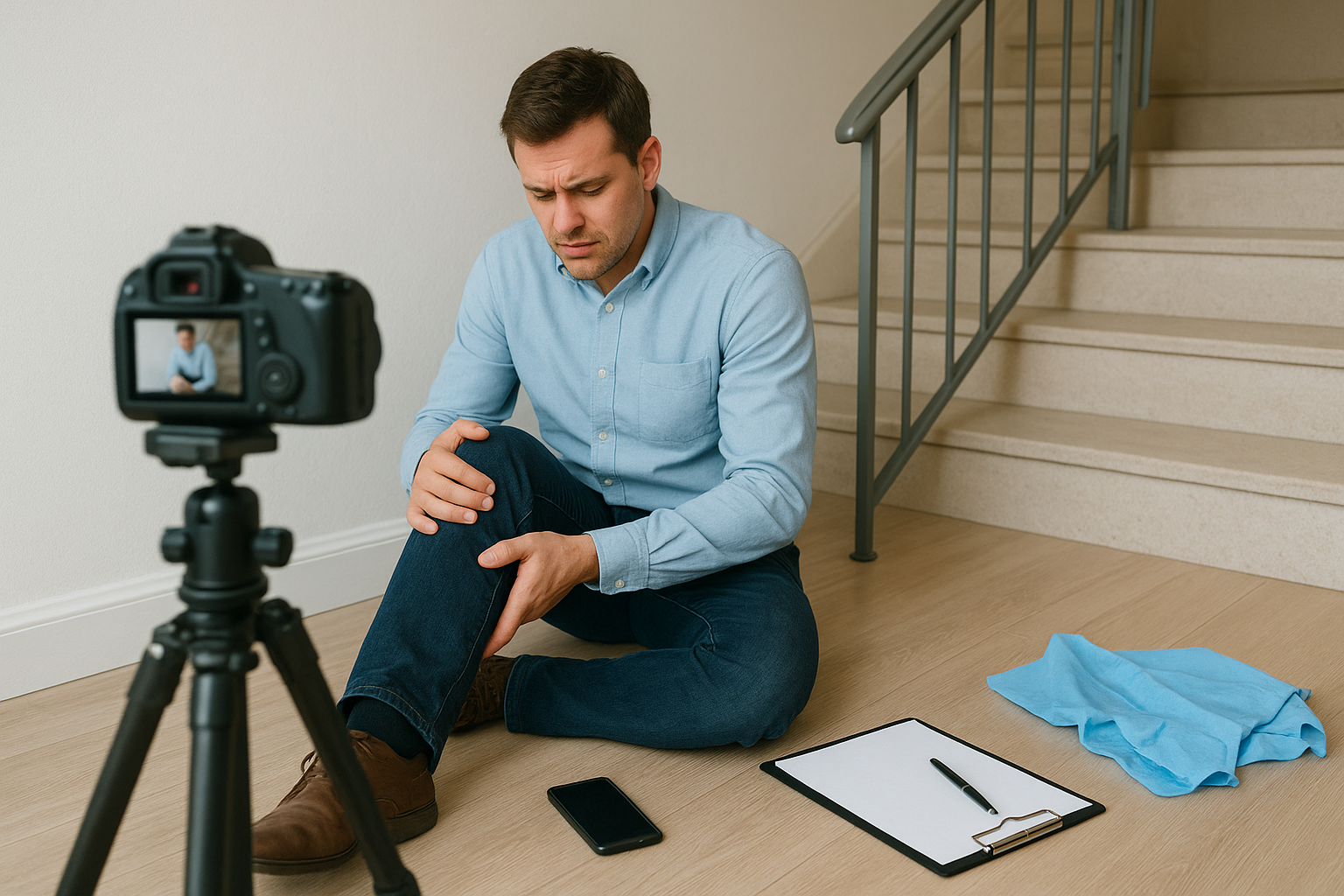
Same-day evidence checklist:
- Photograph the exact hazard from multiple angles, including close-up and wide shots showing the surrounding area
- Capture your clothing and footwear in photos before washing or discarding them
- Write down the names and phone numbers of anyone who witnessed your fall
- Ask the property manager or business owner to file an incident report and request a copy in writing
- Send a written message (text or email) to the property owner requesting that all surveillance footage be preserved immediately
When you do search for a trip and fall attorney near me, bringing this documentation to your first consultation gives your attorney a much clearer picture of liability and damages from the very first conversation.
Step 2. Confirm who may owe you a duty in California
Before you narrow your search for a trip and fall attorney near me, you need to identify who is actually responsible for the hazard that caused your fall. California law assigns a duty of care to different types of property owners and occupiers, and the party you pursue determines which legal rules apply, what deadlines you face, and how much your case may be worth.
Private property owners and businesses
Most trip and fall claims target a private property owner, landlord, or business that controls the space where you fell. Under California Civil Code Section 1714, property owners must use reasonable care to keep their premises safe for anyone lawfully on the property. That includes retail stores, restaurants, apartment complexes, and private residences.
To confirm liability, ask yourself these questions about the location of your fall:
- Who owns or operates the property where you fell?
- Was the hazard something the owner created, or something they knew about and failed to repair?
- Did you have legal permission to be there (customer, tenant, invited guest)?
- Was there any posted warning about the specific hazard?
Your answers tell your attorney whether liability is straightforward or whether they need to investigate further before building your case.
Government entities and public property
If you tripped on a public sidewalk, park, government building, or city-maintained road, different rules apply. Claims against California government agencies require you to file a government tort claim within six months of the date of your injury under the California Government Claims Act. Missing this deadline eliminates your right to sue entirely, regardless of how strong your evidence is.
If your fall happened on public property, six months moves faster than most people expect, especially while you are focused on recovery.
Identifying the right government agency is also critical. A cracked sidewalk may fall under city jurisdiction, while a state park trail may involve the California Department of Parks and Recreation. Your attorney will determine the correct agency and file the required claim on time, which is one of the clearest reasons to hire legal representation as quickly as possible after any government-property fall.
Step 3. Build a shortlist of nearby trip and fall lawyers
Once you know who may owe you a duty of care, you are ready to find attorneys who specifically handle the kind of case you have. Searching for a trip and fall attorney near me will return a long list of results, but most people stop at the first few names without checking whether those firms actually focus on premises liability. A targeted shortlist of three to five attorneys is far more useful than a disorganized list of twenty names you will never get through.
Where to search
Start with sources that filter attorneys by practice area rather than just geography. Using more than one source cross-checks reputation and helps you catch firms that appear credible on one platform but have thin records on another.
Use these sources to build your initial list:
- State bar directories: The California State Bar’s attorney search tool lets you confirm that any lawyer you consider is licensed and in good standing with no disciplinary actions on record
- Google Business profiles: Search your city plus “trip and fall lawyer” and check Google reviews specifically for mentions of premises liability, settlement results, and how the firm treated clients during the case
- Personal referrals: Ask anyone in your network who has worked with a personal injury attorney in California, since a direct referral carries more weight than a paid advertisement
A lawyer with a clean bar record, strong Google reviews specific to premises liability, and a referral from someone you trust is worth prioritizing over any firm that simply ranks first in a paid search result.
What to look for on each firm’s website
After you have a few names, spend five minutes on each firm’s website before you call. Look for specific mentions of trip and fall or slip and fall cases, not just a broad personal injury landing page. A firm that lists 30 different practice areas with one sentence each is likely a volume operation that will not give your case close attention.
Check the attorney biography section for trial experience, case results related to premises liability, and years practicing in California. These details tell you whether the firm has the depth your case may require.
Step 4. Vet fast, then hire the right attorney
You have a shortlist of two to four firms. Now move through consultations quickly and make a decision. Most personal injury attorneys offer free initial consultations, so there is no cost to calling more than one. Your goal in each consultation is not to sell the attorney on your case but to assess whether this firm treats your case as a serious claim worth preparing for trial.
Ask these questions in your consultation
Come into every consultation with a prepared list of direct questions. Attorneys who hesitate or give vague answers to straightforward questions are showing you something important. The right attorney will give you clear, honest answers even when the answer is unfavorable to you.

Use this template for every call or meeting:
- Who specifically will handle my case day to day? (You or a paralegal you never meet?)
- What is your firm’s track record with trip and fall cases similar to mine?
- Have you taken premises liability cases to trial, or do you settle everything?
- What is your contingency fee percentage, and what costs get deducted before my share?
- What is your honest assessment of how strong my liability evidence is?
- How often will you update me on my case status?
The attorney who answers your questions directly, without overselling, is more likely to give your case the focused attention it deserves.
Red flags to cut someone from your list
Not every attorney who handles personal injury cases has real experience with trip and fall claims specifically. Watch for these warning signs during or after your consultation.
Remove any firm from your list if they:
- Cannot name a comparable premises liability result when you ask directly
- Pressure you to sign a retainer at the end of the consultation before you have considered your options
- Refuse to explain their fee structure in writing
- Hand you off to a non-attorney staff member for the entire consultation without explanation
What to check before you sign
Once you identify the right fit after searching for a trip and fall attorney near me, verify two final details before signing anything. Confirm the fee agreement is in writing and specifies the exact contingency percentage along with any litigation costs you may owe. Also verify through the California State Bar that the attorney’s license is currently active with no public discipline on record.
Tools you can use before you call any lawyer
You do not need to wait for a referral or pay for a consultation to start making informed decisions. Several free tools give you a clearer picture of any attorney’s background, standing, and relevance to your specific situation before you pick up the phone. Using these tools takes less than 20 minutes and puts you ahead of most injury victims who search for a trip and fall attorney near me without doing any background work first.
California State Bar license lookup
The California State Bar’s attorney search is the most important tool to use before signing anything. Every licensed California attorney has a public record that shows their admission date, current status, and any public discipline on file. You are looking for three things: an active license, no disciplinary actions, and a bar number that matches the attorney’s official bio on their firm website.
If a public discipline record appears for any attorney on your list, remove them immediately regardless of how strong their marketing looks.
Google Maps review screening
Google Maps reviews give you unfiltered client feedback that a firm’s own website will never show you. Search the attorney or firm name directly in Google Maps and filter reviews by relevance to trip and fall or premises liability. Look for patterns across multiple reviews rather than a single outlier. Pay attention to comments about case communication, actual settlement outcomes, and how staff treated clients during the process rather than only the star rating.
A self-assessment checklist before your first call
Running through a quick checklist before you contact any attorney helps you walk into the conversation prepared and focused. Use this template to organize what you already know:
| Item | Status |
|---|---|
| Date, time, and exact location of fall | Documented? Yes / No |
| Photographs of the hazard | Collected? Yes / No |
| Medical record from date of injury | Obtained? Yes / No |
| Property owner or manager identified | Confirmed? Yes / No |
| Incident report filed and copy requested | Done? Yes / No |
| Government property involved (6-month deadline) | Applies? Yes / No |
Fill this out before your first consultation so you can give every attorney the same factual baseline and compare their responses directly against each other.
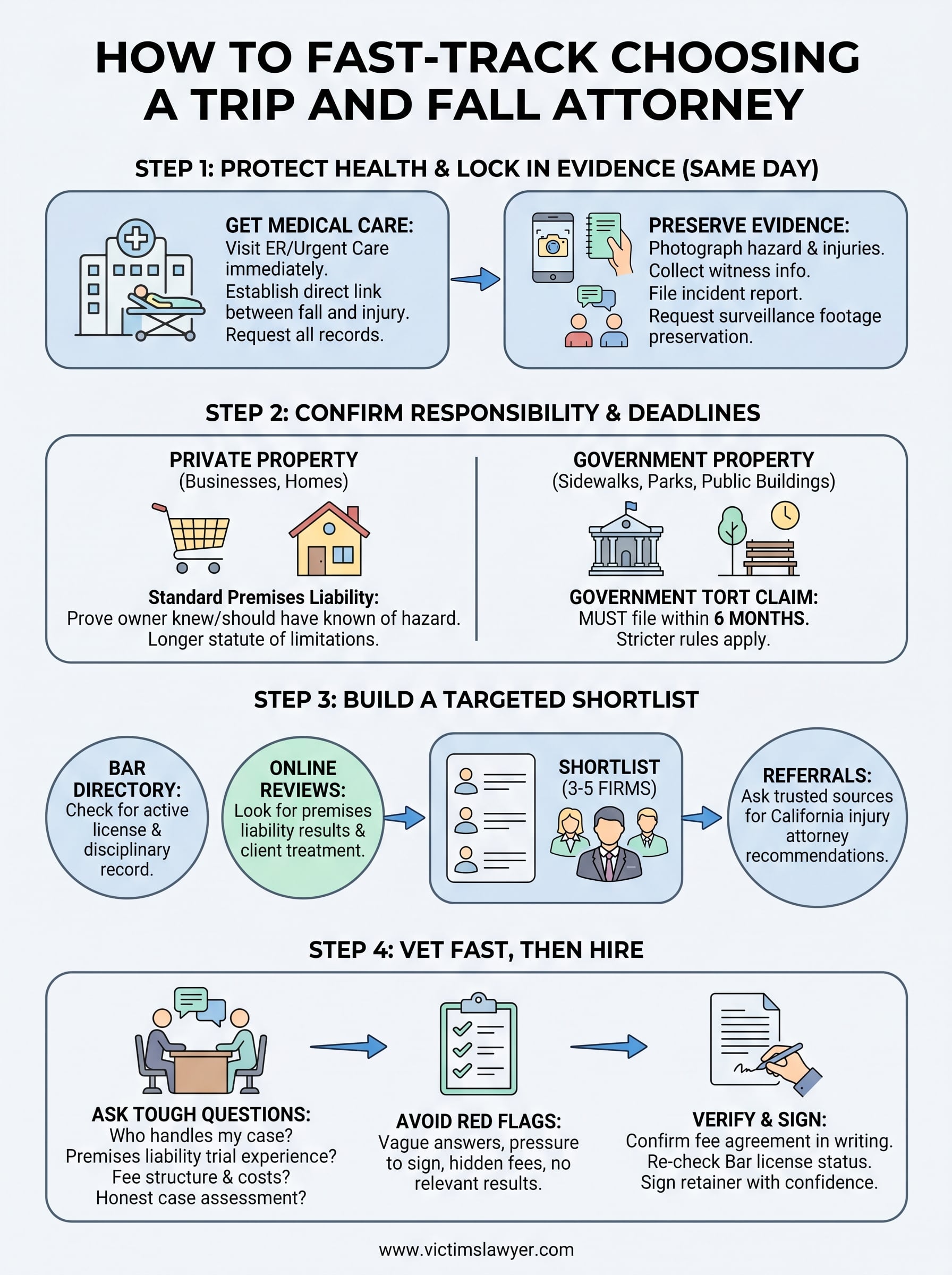
Next steps
You now have everything you need to move from a search for a trip and fall attorney near me to a signed retainer with the right firm. The path is straightforward: secure your medical records, preserve your evidence, identify the responsible party, and vet attorneys using the tools and questions in this guide. Every day you wait creates real legal risk, whether that means lost evidence, a fading witness memory, or a missed government claims deadline.
Start with the self-assessment checklist from the previous section. Fill in every row before you make a single call, so you walk into each consultation with facts rather than gaps. If your list is incomplete, prioritize filling it. Once you are ready to speak with an experienced California premises liability attorney, contact our team at Steven M. Sweat, Personal Injury Lawyers, APC for a free consultation available 24 hours a day, seven days a week.