 California Accident Attorneys Blog


Article Summary: Proving a slip and fall case in California requires establishing four essential elements of negligence: duty of care, breach of duty, causation, and damages. Because California law places the burden of proof on the victim, immediate action is necessary to secure evidence before it disappears, such as photographing the hazard and obtaining incident reports. A successful claim hinges on demonstrating that a property owner had actual or constructive notice of a dangerous condition, meaning they knew or reasonably should have discovered the hazard through routine maintenance. Linking the incident directly to specific injuries is equally important; victims must maintain a consistent medical record and document financial losses, including lost wages and medical bills, to build a strong case for damages. Additionally, claimants must be prepared for defenses like comparative fault, which can reduce compensation if the victim is deemed partially responsible. Understanding the two-year statute of limitations is vital to preserving the right to legal action. Seeking professional counsel from experienced firms like Steven M. Sweat, Personal Injury Lawyers, APC ensures that critical documentation is preserved and that insurance companies are handled effectively to secure the full value of a claim.
Slip and Fall Accident Claims in California
You slipped, you fell, and now you’re hurt, but proving someone else is responsible takes more than just saying it happened. Knowing how to prove a slip and fall case requires you to establish specific legal elements and back them up with solid evidence. Without the right documentation and strategy, even a legitimate claim can fall apart before it ever reaches a settlement negotiation or courtroom.
California law places specific obligations on property owners to keep their premises reasonably safe. When they fail and someone gets injured, the victim has the right to pursue compensation, but the burden of proof falls on you. That means gathering evidence of the hazard, linking it to the property owner’s negligence, and documenting your injuries from day one. Insurance companies will look for every reason to deny or minimize your claim, so preparation matters.
At Steven M. Sweat, Personal Injury Lawyers, APC, we’ve spent over 25 years handling premises liability cases across Los Angeles and throughout California. We’ve seen firsthand what separates the claims that succeed from the ones that don’t. This guide breaks down the four elements of negligence you need to prove, the types of evidence that carry the most weight, and the practical steps you should take right after a slip and fall to protect your right to compensation.
What you must prove in a California slip and fall
California premises liability law requires you to prove four specific elements of negligence to win a slip and fall claim. These elements apply whether you fell in a grocery store, a parking lot, or a private residence. Understanding each element before you start collecting evidence gives you a clear target and prevents you from missing critical gaps in your case.
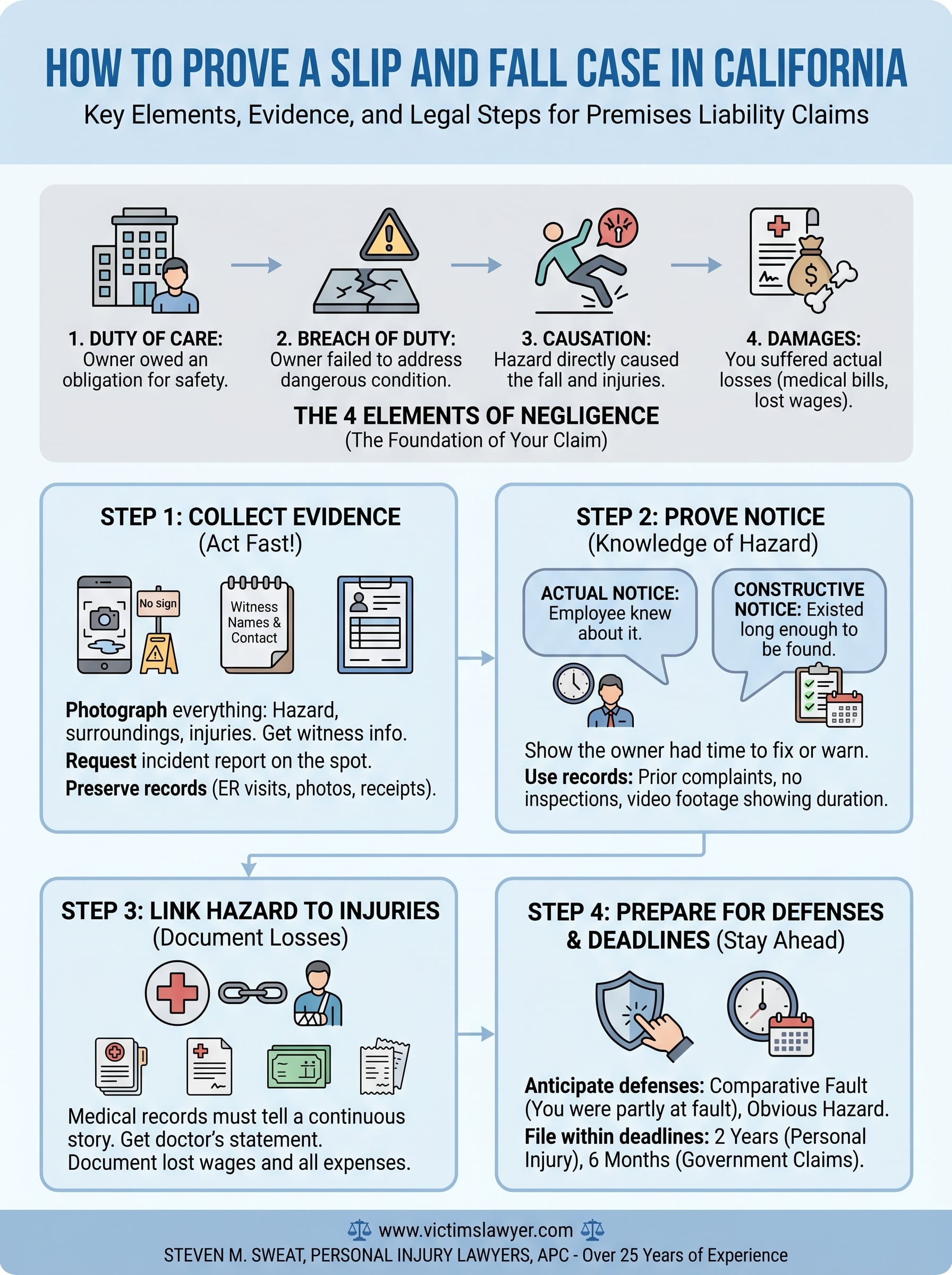
The four elements of negligence
To understand how to prove a slip and fall case in California, think of these four elements as the foundation of your claim. Every single one must be established with actual evidence, not assumptions or your word alone.
| Element | What You Must Show |
|---|---|
| Duty of care | The property owner owed you a legal obligation to maintain reasonably safe conditions |
| Breach of duty | The owner failed that obligation by allowing a dangerous condition to exist |
| Causation | The dangerous condition directly caused your fall and resulting injuries |
| Damages | You suffered actual losses, including medical bills, lost wages, or pain and suffering |
If you cannot establish even one of these four elements with supporting evidence, the entire claim can fall apart, regardless of how serious your injuries are.
Property owners in California carry a duty under Civil Code Section 1714 to use ordinary care in managing their premises. That duty covers both hazards they knew about and conditions they reasonably should have found through routine inspection. If a wet floor sat unmarked for two hours before you fell, the owner’s failure to act within that window is exactly the kind of breach that can anchor your case. Each element feeds into the next, which is why building a complete, organized evidence file from the very beginning makes the difference.
Step 1. Get evidence before it disappears
Evidence in slip and fall cases disappears faster than most people expect. Surveillance footage gets overwritten within 24 to 72 hours, spills get cleaned up, and wet floor signs appear after the fact. Understanding how to prove a slip and fall case starts with acting immediately, while the scene still reflects the conditions that caused your fall.
What to collect at the scene
Take out your phone and photograph everything at the scene: the hazard itself, the surrounding area, any missing warning signs, and your injuries. Get the names and contact information of anyone who witnessed the fall. Ask the property manager or store employee to file an incident report and request a copy before you leave.

Request your copy of the incident report on the spot. Once you leave, the property owner controls that document, and recovering it later can become a serious obstacle.
Preserve your records
Keep every piece of documentation tied to your injury and send a written notice to the property owner demanding preservation of all surveillance footage within days of the incident. Core records to hold onto include:
- Emergency room and urgent care visit records
- Photographs of your injuries taken the day of the fall
- The written incident report from the property
- Receipts for medications and medical appointments
Step 2. Show the owner knew or should have known
Proving knowledge of the hazard is often the most contested part of any premises liability claim. California law recognizes two types of notice, and understanding which applies to your situation shapes how to prove a slip and fall case from a factual standpoint.
Actual notice vs. constructive notice
Actual notice means the owner or an employee knew about the dangerous condition before you fell. A common example is a staff member who saw a ceiling leak but never placed a warning sign or filed a maintenance report. Constructive notice means the hazard existed long enough that a reasonable property inspection would have discovered it, even if no one reported it directly.

The length of time a hazard existed before your fall is one of the strongest indicators of constructive notice.
Evidence that establishes notice
Your goal is to show the owner had enough time and opportunity to fix or warn about the condition. Target any records documenting the premises before your fall, including:
- Prior complaints or maintenance requests about the same hazard
- Inspection logs that show no routine checks were performed
- Witness statements from employees or customers who observed the condition earlier
- Video footage showing how long the hazard sat unaddressed before you fell
Step 3. Link the hazard to your injuries and losses
Proving that the hazard caused your specific injuries is where causation and damages become concrete. Even if you establish duty and breach, the insurance company will challenge whether the fall caused your injuries or whether your injuries are as serious as you claim. Knowing how to prove a slip and fall case means building a documented chain that runs directly from the dangerous condition to your medical treatment and financial losses.
Gaps in medical treatment give insurance adjusters the opening they need to argue your injuries were not serious or were caused by something else.
Document the full scope of your losses
Your medical records should tell a clear, unbroken story from the day of the fall forward. See a doctor immediately, follow every treatment recommendation, and keep records of everything you spend. Gather the following:
- Emergency and follow-up visit records linking your diagnosis directly to the fall
- A written statement from your treating physician connecting the injury to the incident
- Pay stubs and employer letters documenting lost wages from missed work
- Receipts for out-of-pocket costs like transportation to appointments and prescription medications
Step 4. Prepare for defenses and legal deadlines
California property owners and their insurers rely on predictable defenses to defeat slip and fall claims. Knowing what’s coming lets you build your case to address those arguments before they ever get raised.
Common defenses property owners raise
Defense attorneys typically argue that you were partly at fault for your own fall, that the hazard was obvious enough that any reasonable person would have avoided it, or that you were in an area you had no right to access. California follows comparative fault rules, which means any percentage of fault assigned to you directly reduces your total compensation. Documenting that the hazard was hidden, unmarked, and outside normal sight lines counters each of these arguments before they gain traction.
If the defense successfully shifts even a portion of fault onto you, your final recovery drops by that same percentage.
The statute of limitations in California
Part of knowing how to prove a slip and fall case is understanding the filing deadlines. California gives you two years from the date of your injury to file a personal injury lawsuit under California Code of Civil Procedure Section 335.1. Claims against a government entity require you to file an administrative claim within six months of the incident. Missing either deadline eliminates your right to compensation entirely.
What to do next
Knowing how to prove a slip and fall case in California gives you a clear roadmap, but evidence fades and deadlines move fast. Your strongest move right now is to secure your documentation, see a doctor if you haven’t already, and stop talking to the property owner’s insurance company without legal representation. Insurance adjusters work for the property owner, not for you, and anything you say without counsel can be used to reduce your claim.
Steven M. Sweat, Personal Injury Lawyers, APC has handled premises liability cases throughout Los Angeles and California for over 25 years. Our team knows what evidence holds up, how to counter the defenses insurers raise, and how to build a case that reflects the full value of your losses. We offer free consultations with no upfront costs and no fees unless we recover for you. Contact our office today to get your case reviewed before critical evidence disappears.