 California Accident Attorneys Blog


Article Summary: California’s no-fault workers’ compensation system ensures that almost all employees receive essential benefits, including medical care and wage replacement, regardless of who caused a workplace injury. To secure these rights, workers must navigate a process defined by strict deadlines and specific documentation. The first critical step involves reporting the injury to the employer in writing within thirty days to establish a clear paper trail. Seeking immediate medical attention from an employer-approved provider within the Medical Provider Network is equally vital, as these records serve as primary evidence for the claim. Formally opening a case requires submitting the DWC-1 claim form, which employers must provide within one working day of being notified. While insurers have ninety days to accept or deny a claim, workers must be mindful of the one-year statute of limitations for filing. If a claim is denied, the injured party can appeal through the Workers’ Compensation Appeals Board. Given the complexity of insurance tactics and legal timelines, seeking professional representation is often necessary to avoid costly mistakes and ensure the full recovery of owed benefits, such as temporary disability payments or supplemental job retraining vouchers.
Filing a Workers Compensation Claim in California
If you’ve been hurt on the job in California, figuring out how to file a workers’ compensation claim in California can feel overwhelming, especially when you’re already dealing with pain, medical appointments, and missed paychecks. But here’s what matters: the process has strict deadlines and specific forms that you can’t afford to get wrong. Missing a step could delay your benefits or jeopardize your claim entirely.
California law entitles most injured workers to medical treatment, wage replacement, and other benefits, regardless of who caused the accident. The key is knowing exactly what to do, when to do it, and which forms to submit (starting with the DWC-1). At Steven M. Sweat, Personal Injury Lawyers, APC, we’ve spent over 25 years helping injured Californians protect their rights, and we’ve seen firsthand how costly simple filing mistakes can be.
This guide walks you through the entire workers’ compensation claim process, from reporting your injury to your employer to what happens after you submit your paperwork. We’ll cover the official forms you need, the deadlines you must meet, and what to do if your claim gets denied.
What to know before you file in California
California runs a no-fault workers’ compensation system, which means you don’t need to prove that your employer was negligent to collect benefits. If you got hurt while doing your job, or if you developed an illness because of your work environment, you’re generally covered. Almost every employee in California is entitled to these protections, whether you work full-time, part-time, or even as a seasonal worker.
Who qualifies for workers’ compensation benefits
Most workers in California qualify automatically from their first day on the job. Your employer is legally required to carry workers’ compensation insurance, and that coverage applies to you the moment you start working. However, a few categories of workers face different rules, so it’s worth knowing exactly where you stand before you begin the process of how to file a workers compensation claim in California.
Here’s a quick look at who is and isn’t typically covered:
| Worker Type | Coverage Status |
|---|---|
| Full-time employees | Covered |
| Part-time employees | Covered |
| Seasonal employees | Covered |
| Independent contractors | Generally NOT covered |
| Undocumented workers | Covered under California law |
| Domestic workers | Generally covered |
If your employer misclassifies you as an independent contractor to avoid liability, you may still have legal options to recover the workers’ compensation benefits you’re owed.
What benefits workers’ compensation actually covers
Workers’ compensation in California covers more than just your medical bills. If your claim gets approved, you may be entitled to several types of benefits depending on how seriously you were hurt and how long you can’t work. Knowing what you’re owed helps you recognize when an insurance company is trying to underpay or deny you.
The main benefit categories include:
- Medical treatment: All reasonable and necessary care related to your injury, paid in full
- Temporary disability (TD) payments: Wage replacement while you recover, equal to roughly two-thirds of your average weekly wage
- Permanent disability (PD) payments: Compensation if your injury causes a lasting physical or mental impairment
- Supplemental job displacement benefit: A voucher to help cover retraining costs if you can’t return to your prior job
- Death benefits: Payments to eligible dependents if a worker dies from a work-related injury or illness
Step 1. Report the injury and create a paper trail
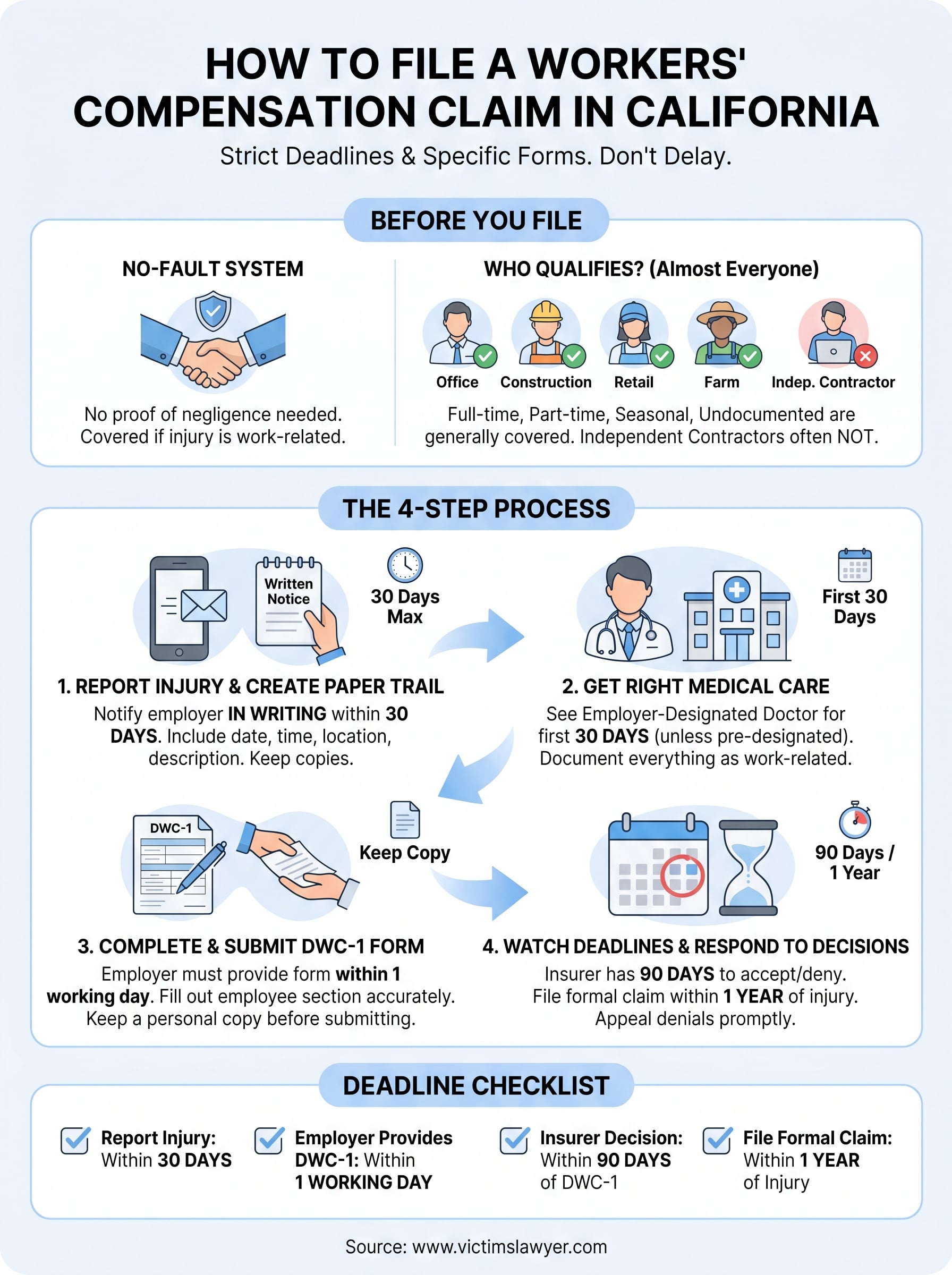
The first step is simple but critical: tell your employer about your injury as soon as possible. In California, you have 30 days from the date of injury to report it to your employer, but waiting that long is a mistake. The sooner you report, the stronger your claim becomes. Delays give insurers room to argue that your injury happened outside of work.
How to notify your employer
Always report in writing, even if you’ve already told your supervisor verbally. A written record protects you if your employer later claims they never received notice. Send your notification by email or hand-deliver a written note and keep a copy for yourself. Include your name, job title, the date and time of the injury, exactly where it happened, and a brief description of what occurred.

Verbal reports alone can disappear. A written notice with a date stamp is evidence that no one can erase.
Here’s a simple template you can adapt:
Workplace Injury Notification
Date: [Date] To: [Supervisor’s Name / HR Department] From: [Your Full Name] Subject: Work-Related Injury Report
I am writing to formally report a work-related injury I sustained on [date] at approximately [time] at [location]. The injury occurred when [brief description of what happened]. I am notifying you in accordance with California workers’ compensation law and request the appropriate claim forms at your earliest convenience.
[Your Signature]Keep copies of all communications related to your injury, including emails, text messages, and any written responses from your employer or HR. This documentation becomes your foundation as you move forward with how to file a workers compensation claim in California.
Step 2. Get the right medical care right away
Your medical records are not just a treatment plan – they are evidence. Every doctor visit, diagnosis, and prescription creates a documented link between your injury and your job, which is exactly what workers’ compensation insurers will scrutinize. Getting the right care quickly protects both your health and your claim.
See an employer-designated doctor first
In California, your employer has the right to direct your medical care for the first 30 days after you report your injury. Unless you pre-designated your own physician before the injury occurred, you must see a doctor from your employer’s Medical Provider Network (MPN) during this initial period. Refusing or skipping this step can give the insurance company grounds to dispute your claim.
After the initial 30-day period, you can typically request to change doctors or see a specialist within the MPN. If your employer does not have an MPN, you have more freedom to choose your provider. Check with your HR department to confirm which network applies to you.
Never skip the employer-designated doctor during the first 30 days, even if you prefer your own physician, because doing so can seriously damage your case.
Document your treatment from day one
Every appointment matters when you’re learning how to file a workers compensation claim in California. Ask your doctor to record your injury as work-related in their notes from the very first visit. Keep copies of all medical reports, prescription receipts, and referral letters, since this paperwork forms the backbone of your benefits calculation.
Tell every provider exactly how and where the injury happened. Inconsistencies between your medical records and your initial injury report give insurers a ready-made reason to deny your claim.
Step 3. Complete and submit the DWC-1 claim form
The DWC-1 (Workers’ Compensation Claim Form) is the official document that formally opens your claim. Your employer must give you this form within one working day of learning about your injury. Once you receive it, you fill out the employee section, return it to your employer, and they complete their portion before forwarding it to their insurance carrier. This handoff triggers the insurer’s obligation to start investigating and responding to your claim.
What the DWC-1 form asks you to fill out
Your section of the form is straightforward, but accuracy matters on every line. Write clearly and describe your injury in plain, specific language. Vague descriptions like “back pain” are weaker than “I lifted a 60-pound box and felt sharp pain in my lower back.”

The employee section asks for:
- Your full name, address, and date of birth
- Date and time the injury occurred
- Address where the injury happened
- A description of how the injury occurred and the body part(s) affected
- Your signature and the date you filled out the form
Keep a copy of the completed form before you hand it back to your employer. Never submit without making a personal copy first.
Your employer must provide written authorization for medical treatment within one working day of receiving your completed DWC-1, so returning the form quickly protects your access to care.
How to submit the form and confirm receipt
Learning how to file a workers compensation claim in California means understanding that delivery matters as much as completion. Hand-deliver the form and request written confirmation that your employer received it. If you mail it, use certified mail with a return receipt so you have proof of the submission date in your records.
Step 4. Watch deadlines and respond to claim decisions
Deadlines in California workers’ compensation law are not suggestions. Missing one can end your claim permanently, regardless of how legitimate your injury is. Once you submit the DWC-1 form, the insurance company has 90 days to accept, deny, or delay your claim. During that window, they must provide you with up to $10,000 in medical treatment while the investigation is ongoing.
Key deadlines you need to track
Your most important protection is California’s one-year statute of limitations, which gives you one year from the date of injury to file a formal workers’ compensation claim. There is also a one-year deadline to file for most ongoing benefits once your claim is accepted. Tracking these dates keeps you from losing rights that were already earned.
Here are the critical deadlines at a glance:
| Deadline | Timeframe |
|---|---|
| Report injury to employer | Within 30 days of injury |
| Employer provides DWC-1 form | Within 1 working day of notice |
| File formal claim (statute of limitations) | Within 1 year of injury date |
| Insurer must accept or deny claim | Within 90 days of DWC-1 submission |
What to do if your claim is denied
A denial letter is not the end of the road. You have the right to appeal the decision by filing a Declaration of Readiness to Proceed (DOR) with the Workers’ Compensation Appeals Board (WCAB). This is one of the most important steps in how to file a workers compensation claim in California when things don’t go smoothly.
Filing an appeal without legal guidance is risky, because insurance companies send experienced adjusters and attorneys to every hearing.
You have 20 days to respond to many formal notices in the appeals process, so read every piece of mail from the insurer carefully and note the response date the moment it arrives.
Next steps if you need help
Now you know how to file a workers compensation claim in California, but knowing the steps and executing them perfectly under pressure are two different things. If your employer is unresponsive, the insurer is stalling, or you’ve already received a denial letter, trying to manage the appeals process alone puts you at a serious disadvantage. Insurance companies use experienced legal teams to minimize what they pay out, and you deserve the same level of representation on your side.
At Steven M. Sweat, Personal Injury Lawyers, APC, we offer free consultations with no upfront costs. You pay nothing unless we recover compensation for you. Our attorneys have spent over 25 years fighting for injured workers across California, and we can help you protect every benefit you’re owed from day one. Don’t wait until a deadline slips past you. Contact our team today and get a straight answer about where your claim stands.