 California Accident Attorneys Blog


Article Summary: Filing a car accident claim in California requires a strategic approach to navigate the state’s fault-based insurance system and strict legal deadlines. Success begins at the scene by ensuring safety, calling 911 to secure an official police report, and documenting physical evidence through photos and witness information. Under California’s pure comparative fault rule, any admitted blame can reduce compensation, making it vital to avoid discussing fault with adjusters. Key procedural requirements include filing an SR-1 form with the DMV within ten days for any accident involving injuries or property damage exceeding $1,000. Additionally, claimants must seek medical attention promptly to prevent insurers from questioning the severity of injuries. A comprehensive claim must account for both economic damages, like medical bills and lost wages, and non-economic losses, such as pain and suffering. When facing lowball offers or stalling tactics from insurance companies, maintaining a documented paper trail and submitting formal written counteroffers is essential for securing a fair settlement. Understanding these specific steps—from initial documentation to calculating total claim value—protects a victim’s right to full financial recovery and prevents common mistakes that could lead to a permanent loss of benefits.
California Car Accident Claims
You’ve been in a car accident in California, and now you’re staring down a pile of paperwork, phone calls, and deadlines you didn’t know existed. Figuring out how to file a car accident claim in California can feel overwhelming when you’re also dealing with injuries, vehicle damage, and mounting bills. The reality is that missing a single step or deadline can cost you the compensation you’re entitled to.
California has specific requirements for reporting accidents to the DMV, strict timelines for filing insurance claims, and a statute of limitations that puts a hard cap on when you can take legal action. Understanding each of these pieces, and how they fit together, is the difference between a claim that gets results and one that falls apart. Knowing your rights early gives you a significant advantage, especially when insurance adjusters start calling with lowball offers before you’ve even seen a doctor.
At Steven M. Sweat, Personal Injury Lawyers, APC, we’ve spent over 25 years representing car accident victims across Los Angeles and throughout California. We’ve guided thousands of clients through this exact process, from filling out the SR-1 form to negotiating with insurers to filing lawsuits when necessary. This guide walks you through every step of filing a car accident claim in California, so you know exactly what to do, when to do it, and what mistakes to avoid along the way.
What to know before you file in California
Before you take any action on your claim, you need to understand how California’s auto accident laws apply to your situation. California operates under a fault-based insurance system, which means the driver who caused the accident is financially responsible for the resulting injuries, property damage, and other losses. In practice, that means you will be dealing directly with the at-fault driver’s insurance company, and those companies are motivated to pay as little as possible.
California also follows a pure comparative fault rule. If you share any portion of the blame for the crash, your compensation gets reduced by your percentage of fault. For example, if a court finds you were 20% at fault, you collect 80% of the total damages. Insurance adjusters use this rule strategically, and they will often try to shift more blame onto you than the facts support to reduce their payout.
Understanding how comparative fault works before you speak to any adjuster can protect you from accidentally accepting a larger share of blame than is warranted.
Deadlines that control your entire claim
Missing a deadline in California can permanently end your right to recover compensation, so you need to lock in these dates before you do anything else. The statute of limitations sets a hard cutoff for filing a lawsuit, but several other deadlines apply much earlier in the process.

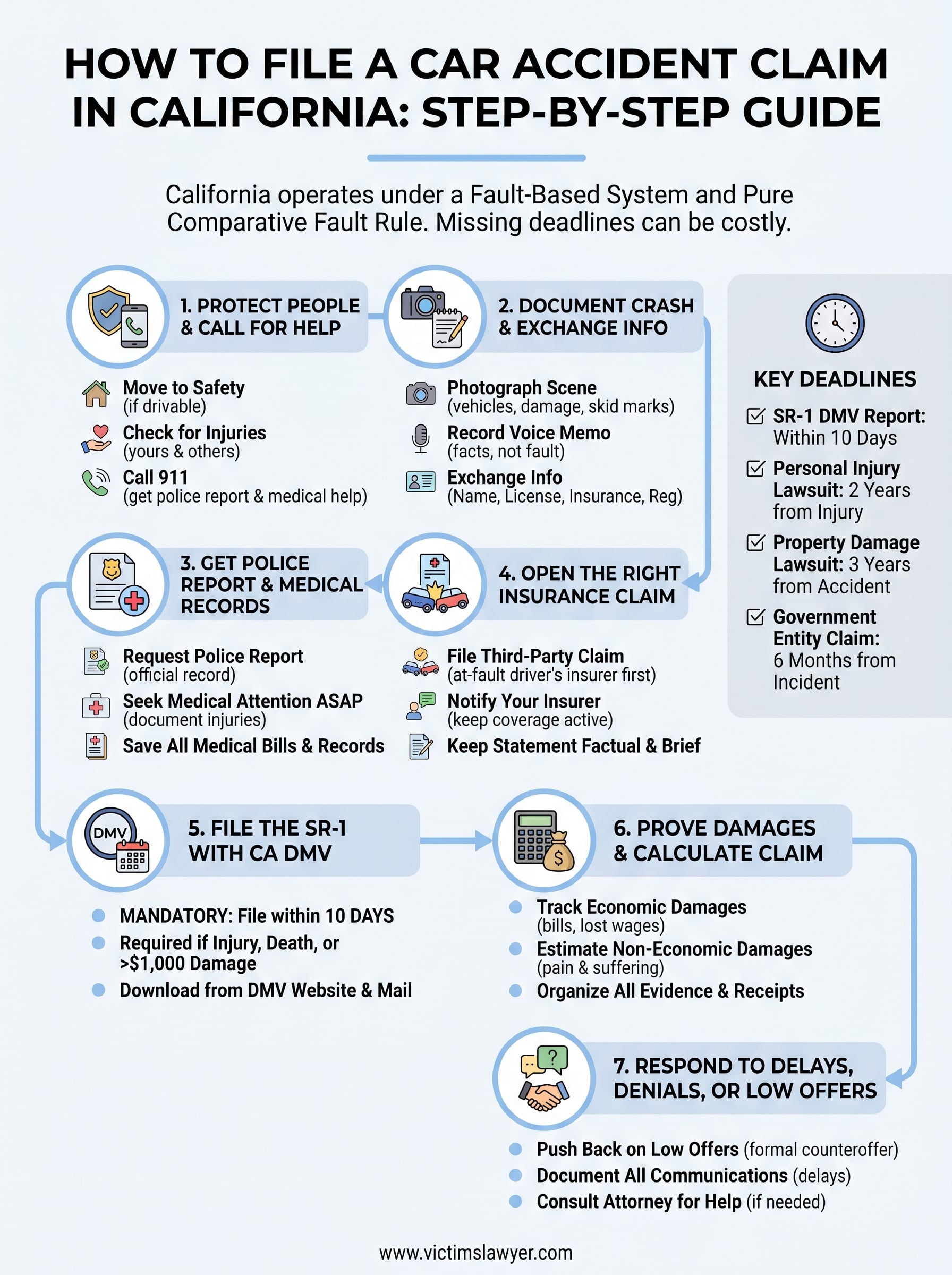
Here are the key deadlines you must track:
| Requirement | Deadline | Who It Applies To |
|---|---|---|
| SR-1 DMV report | Within 10 days of accident | Any accident with injury, death, or $1,000+ in damage |
| Insurance claim notification | As soon as possible (check your policy) | Your own insurer |
| Personal injury lawsuit | 2 years from date of injury | All injured parties |
| Property damage lawsuit | 3 years from date of accident | All parties with vehicle or property damage |
| Claims against a government entity | 6 months from incident | Accidents involving city, county, or state vehicles |
If a government vehicle caused your accident, that six-month window is dangerously short. Missing it means losing your claim entirely, no matter how strong the facts are in your favor.
What California requires you to carry
California law requires all drivers to maintain minimum liability insurance coverage, currently set at $30,000 per person for bodily injury, $60,000 per accident for bodily injury, and $15,000 for property damage. These minimums increased in 2025 under AB 1107, but they still fall short of covering real losses in a serious crash.
Knowing this matters directly to how to file a car accident claim in California, because your recovery strategy depends heavily on whether the at-fault driver carried enough insurance. Uninsured and underinsured motorist coverage on your own policy can fill that gap, but only if you have it and know how to use it. Pull out your declarations page now and confirm exactly what coverage you carry before you start any part of the claims process.
Step 1. Protect people first and call for help
Your first priority after any collision is human safety, not paperwork. Before you think about how to file a car accident claim in California, you need to take immediate steps at the scene that will also protect your legal rights. What you do in the first few minutes after a crash shapes everything that follows, including how the police report gets written and how insurance adjusters evaluate fault.
Move to safety and check for injuries
If your vehicle is drivable and sitting in active traffic, move it to the nearest shoulder or parking lot right away. Turn on your hazard lights immediately so other drivers can see you. California Vehicle Code Section 20001 requires you to stop and remain at the scene of any accident involving injury, death, or property damage, so do not leave under any circumstances.
Check yourself and every passenger for injuries before stepping out of the vehicle. Some injuries, particularly whiplash and traumatic brain injuries, do not produce obvious symptoms right away. Even if you feel alert and physically okay, take note of any pain, stiffness, confusion, or nausea so you can report it accurately when medical personnel arrive.
Never tell anyone at the scene that you are “fine” or “not injured,” since those words can be used against your claim later, even when symptoms surface hours or days afterward.
Call 911 and make the scene official
Call 911 immediately for any accident involving injury, and ask for both law enforcement and emergency medical services. Even in minor crashes with no visible injuries, a police report creates an official, time-stamped record that is critical to your claim. Without that report, proving what actually happened becomes significantly harder when the other driver changes their story.
When officers arrive, give a factual account of the events without guessing about fault or offering any apology. Stick strictly to what you directly observed. Ask the responding officer for their name and badge number, and request information on how to obtain the official report. That report number becomes one of the most important documents in your entire claim file.
Step 2. Document the crash and exchange information
Once the scene is safe and help is on the way, start building your evidence immediately. Documentation created at the scene carries far more weight than anything reconstructed later, because it captures physical details before vehicles move, weather changes, or memories fade. This is one of the most important steps in understanding how to file a car accident claim in California the right way.
What to photograph and record
Your smartphone is your most valuable tool in the first few minutes after a crash. Photograph everything before any vehicles are moved, including all points of impact, skid marks, road conditions, traffic signals, signage, and any debris in the roadway. Take wide shots to capture the full scene and close-up shots to capture specific damage.

The more thorough your photo documentation is at the scene, the harder it becomes for an insurer to dispute the facts later.
Beyond photos, record a short voice memo describing exactly what happened while the sequence of events is still fresh in your mind. Note the direction each vehicle was traveling, the speed you estimate each vehicle was moving, any distractions you observed, and the precise location of impact. Include the time, weather conditions, and lighting at the scene.
Here is a quick checklist of what to document:
- All vehicle positions before they are moved
- Damage to every vehicle involved
- License plates of all vehicles
- Any visible injuries on yourself or others
- Road conditions, potholes, or obstructions
- Witness names and phone numbers
- Location intersection or nearest cross street
Information to exchange with the other driver
California law requires drivers involved in a collision to exchange specific identifying information before leaving the scene. Collect the following from every driver involved:
| Information to Collect | Why You Need It |
|---|---|
| Full legal name | Identifies the responsible party |
| Driver’s license number | Confirms identity and driving status |
| Insurance company and policy number | Enables you to file a third-party claim |
| Vehicle registration number | Links the vehicle to its owner |
| Phone number | Allows follow-up contact |
Stay calm and factual during this exchange and avoid any discussion of fault, settlements, or who is to blame.
Step 3. Get the right police report and medical records
Two documents carry more weight than almost anything else in your claim file: the official police report and your medical records. Without both, you give the insurance company room to dispute what happened and how seriously you were hurt. Securing them quickly is a critical part of knowing how to file a car accident claim in California the right way.
How to obtain your official police report
The responding officer files the report with their agency, not directly with you, so you have to request it separately. In Los Angeles, you can request a California Highway Patrol report through the CHP’s online portal, or contact the local LAPD division if city officers responded. Reports typically become available within 5 to 10 business days after the accident.
Save the officer’s name, badge number, and report number at the scene so you can track down the correct document without delays.
When you receive the report, read every line carefully and look for factual errors in the listed driver information, vehicle descriptions, or the officer’s narrative. If you find a mistake, contact the reporting agency immediately and request a formal amendment before you submit anything to an insurer.
Why medical records matter to your claim
Seeing a doctor within 24 to 72 hours of your accident is not just good health practice; it directly protects your compensation. Insurance adjusters routinely use gaps in medical treatment as evidence that you were not seriously injured, even when you clearly were. The closer your first medical visit is to the crash, the harder that argument becomes for the insurer to make.
Request copies of every medical record, diagnosis, treatment note, and bill from each provider who treats you, and keep them organized by date and provider. Your attorney or claims representative will use these records to build a damages calculation that reflects your actual losses. Thorough medical documentation is one of the strongest tools you have throughout the entire claims process.
Step 4. Open the right insurance claim
Opening the right claims in the right order is one of the most consequential decisions in the entire process of how to file a car accident claim in California. You have two potential channels: a third-party claim against the at-fault driver’s insurance and a first-party claim through your own policy. Getting this step wrong can slow your recovery or give an adjuster an opening to reduce your payout.
Which claims to file and when
File a third-party claim against the at-fault driver’s insurer first, since that driver is financially responsible under California’s fault-based system. Call their insurance company as soon as possible, provide basic identifying information, and get a claim number in writing.
Always notify your own insurer that an accident occurred, even when you plan to pursue the at-fault driver’s policy, because most California policies require prompt notification to keep your uninsured motorist benefits active.
Notifying your own carrier does not mean you are filing a claim against yourself. It preserves your right to tap MedPay coverage, uninsured motorist protection, or collision coverage if the third-party process stalls or falls short of covering your actual losses.
What to say when you first call
Your opening statement to any adjuster should be short, factual, and limited to basic identifying information. Use this template as your starting point:
“My name is [Your Name]. I was involved in an accident on [Date] at approximately [Time] at [Location]. I am calling to open a claim. I will share additional details once I have spoken with my attorney.”
This approach protects your statement from being used against you before you have a complete picture of your injuries and damages. Do not walk through the sequence of events in detail, do not estimate fault percentages, and never agree to a recorded statement without first consulting a personal injury attorney. Adjusters are trained to ask questions that draw out admissions, and one careless answer in that first call can cut your final compensation significantly.
Step 5. File the SR-1 with the California DMV
Filing the SR-1 form is a legal requirement that runs parallel to your insurance claim, and skipping it creates a separate problem entirely apart from any insurer dispute. This step is one of the most overlooked parts of understanding how to file a car accident claim in California, but the DMV takes it seriously. Failing to submit the SR-1 within 10 days of an accident that qualifies can result in your driver’s license being suspended, which adds a serious complication on top of everything else you’re already managing.
Who Must File and When
You must file the SR-1 if your accident involved any injury or death, or if the property damage to any one vehicle or object exceeded $1,000. That threshold is low enough that nearly every collision on a California road triggers this requirement. Both drivers involved in a qualifying accident are each independently responsible for filing their own SR-1, so you cannot rely on the other driver to handle it on your behalf.
The deadline is firm: you have 10 calendar days from the date of the accident to submit the form. Here is a quick breakdown of who must file:
| Situation | SR-1 Required? |
|---|---|
| Injury to any person (including minor) | Yes |
| Death of any person | Yes |
| Property damage over $1,000 | Yes |
| Minor fender bender under $1,000, no injuries | No |
How to Complete and Submit the SR-1
Download the SR-1 directly from the California DMV website. The form asks for your driver’s license number, vehicle registration details, insurance policy information, the names and contact details of all parties involved, and a basic description of how the accident occurred.
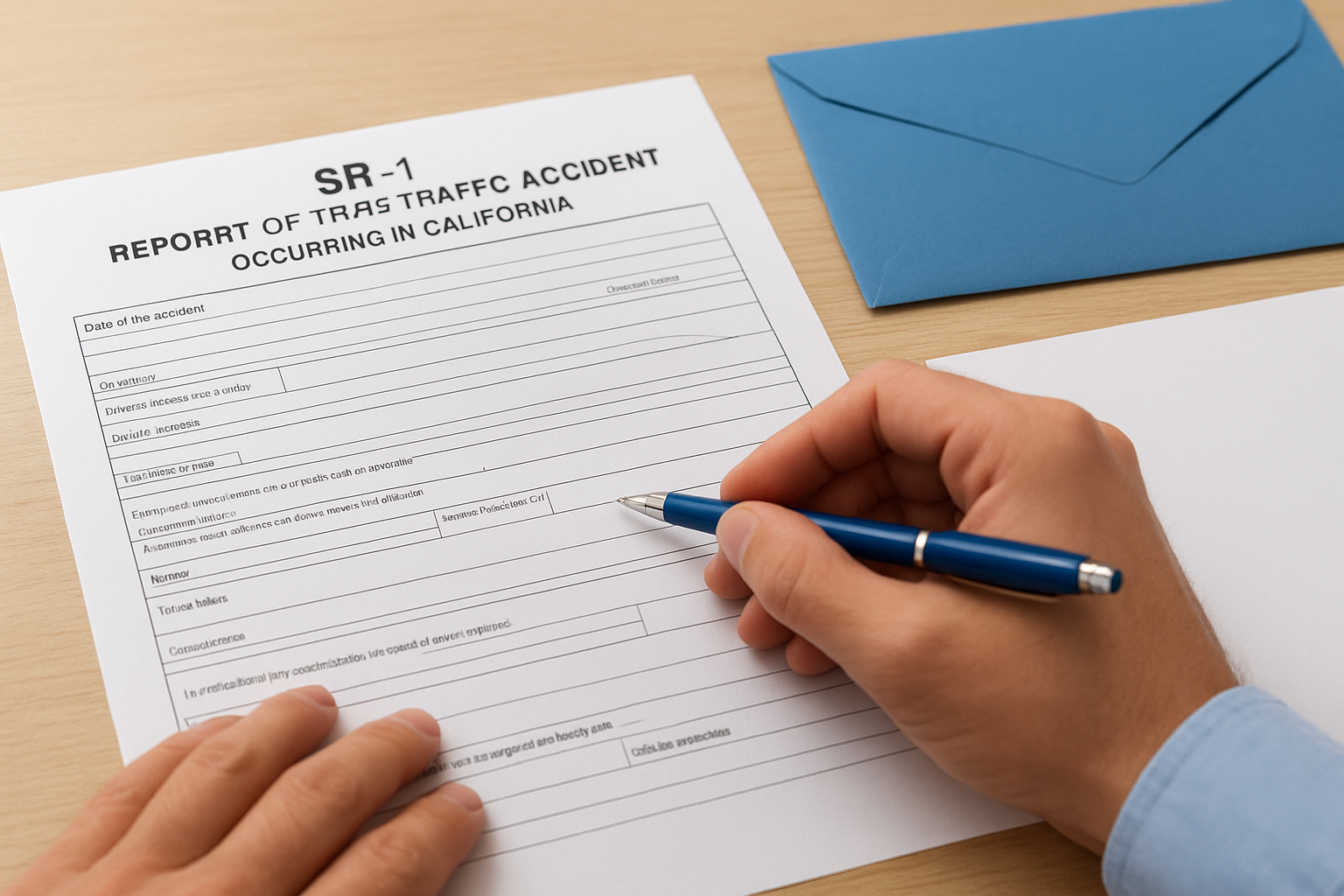
Keep your completed SR-1 copy in your claim file alongside your police report, because insurers sometimes request proof that you fulfilled your DMV reporting obligation.
Submit the completed form by mail to the DMV address printed on the form, or submit it in person at any DMV field office. There is no online submission option available at this time.
Step 6. Prove your damages and calculate a fair claim
Knowing how to file a car accident claim in California means nothing if you cannot back your claim with documented evidence of your actual losses. Insurance adjusters do not take your word for what you suffered; they need a paper trail. Your job is to build a complete record of every financial and personal harm the accident caused, organized clearly enough that an adjuster or a jury can follow it without any gaps.
Two categories of damages to document
California personal injury claims recognize two main categories of damages: economic and non-economic. Economic damages cover your measurable out-of-pocket losses, while non-economic damages cover the personal harm that does not come with a receipt. You need evidence for both to reach a fair total.
Here is what falls into each category:
| Category | Examples |
|---|---|
| Economic | Medical bills, future treatment costs, lost wages, reduced earning capacity, vehicle repair or replacement |
| Non-Economic | Pain and suffering, emotional distress, loss of enjoyment of life, permanent disability or disfigurement |
Keep every bill, pay stub, repair estimate, and medical record organized by date, because a well-organized damages file puts you in a stronger position at every stage of negotiation.
How to calculate your total claim value
Start by adding up all confirmed economic losses using your actual bills and records. Then calculate your non-economic damages using either the multiplier method, where you multiply your total economic losses by a number between 1.5 and 5 depending on injury severity, or the per diem method, where you assign a daily dollar value to your suffering and multiply it by the number of days you were affected.
Use this template to organize your starting calculation:
Total Medical Expenses:        $________
Estimated Future Medical:      $________
Lost Wages to Date:            $________
Projected Lost Earnings:       $________
Property Damage:               $________
-------------------------------------
Total Economic Damages:        $________

Non-Economic Multiplier (x):   ________
Estimated Non-Economic:        $________
-------------------------------------
Starting Claim Value:          $________
This number is your baseline, not your final settlement, but it gives you a concrete figure to defend when negotiations begin.
Step 7. Respond to delays, denials, or low offers
Insurance companies use delays, denials, and low offers as standard negotiation tactics to reduce what they pay out. Knowing how to file a car accident claim in California only gets you so far if you don’t know how to respond when an insurer stonewalls you or hands you a number that doesn’t cover your actual losses. Every response you make at this stage either strengthens or weakens your final recovery, so you need a clear plan before you pick up the phone.
When an insurer stalls or goes silent
California Insurance Code Section 790.03 prohibits insurers from unreasonably delaying the investigation or payment of claims. If an adjuster stops returning your calls or keeps requesting documents you’ve already submitted, send a written follow-up via certified mail and document the date and content of every communication attempt. A paper trail of their delays becomes direct evidence you can use against them.
If an insurer fails to accept or deny your claim within 40 days of receiving your proof of loss, they are violating California’s Fair Claims Settlement Practices Regulations, and you can file a formal complaint with the California Department of Insurance.
How to push back on a low settlement offer
When an adjuster sends a low initial offer, treat it as an opening move in a negotiation, not a final number. Respond in writing with a formal counteroffer letter that references your documented damages, medical records, and the specific reasons their figure falls short. Use this template as your starting framework:
Date: [Date]
Claim Number: [Claim #]
Re: Counteroffer to Settlement Offer of $[Amount]

Dear [Adjuster Name],

I am responding to your offer of $[Amount] dated [Date].
Based on documented losses, including $[Medical Total] in medical
expenses, $[Lost Wages] in lost income, and substantial pain and
suffering, I am requesting a settlement of $[Your Amount].

Attached: [List of supporting documents]

[Your Name]
Send this letter with all supporting documents attached, and include a written 14-day response deadline to keep the process moving on your terms.
A quick wrap-up
Filing a car accident claim in California involves more moving parts than most people expect, and each step builds directly on the one before it. You need to document the scene immediately, notify the right insurers in the right order, submit the SR-1 to the DMV within 10 days, and respond strategically when an adjuster delays or sends a low initial offer.
Knowing how to file a car accident claim in California puts you ahead of most claimants who hand the entire process over to insurers without a plan. Every step covered in this guide, from exchanging information at the scene to calculating your damages and sending a formal counteroffer letter, is designed to protect your full recovery rather than let it shrink under insurer pressure.
If you want an experienced California personal injury attorney to take this off your plate, schedule a free consultation with Steven M. Sweat, Personal Injury Lawyers, APC and get an honest evaluation of your claim at no cost.