 California Accident Attorneys Blog


Every year, millions of vehicles are recalled due to safety defects, faulty airbags, brake failures, steering malfunctions, and other problems that put drivers and passengers at serious risk. If you own a Nissan, running a Nissan recall lookup is one of the simplest steps you can take to protect yourself and your family on the road.
At Steven M. Sweat, Personal Injury Lawyers, APC, we’ve spent over 25 years representing people injured in vehicle accidents across California. We’ve seen firsthand what happens when defective vehicle components go unrepaired, catastrophic crashes, life-altering injuries, and families left picking up the pieces. That’s why we put together this guide. Checking your vehicle for open recalls isn’t just smart maintenance; it’s a matter of personal safety.
This article walks you through exactly how to look up recalls on your Nissan using your VIN (Vehicle Identification Number), which models and model years have been most affected, and what to do once you find an active recall on your vehicle. We’ll also cover your rights as a vehicle owner, including what happens if a recall-related defect causes an accident before repairs are made. Whether you just bought a used Nissan or you’ve been driving the same one for years, this information applies to you.
What you need before you start
Before you run a Nissan recall lookup, gather a few key items. Having everything ready upfront means you won’t get halfway through the process and stall out looking for information. This entire process takes less than 10 minutes if you’re prepared, so a little organization before you start pays off quickly.
Gathering your materials before you begin will save you time and help you document everything correctly if you do find an active recall on your vehicle.
Your vehicle’s VIN
Your Vehicle Identification Number (VIN) is the single most important piece of information you need to check your Nissan for recalls. Every VIN is a unique 17-character code assigned to your specific vehicle, and no two vehicles share the same one. Without it, you can only search by model and year, which gives you broader results and may miss recall notices that apply specifically to your car’s production batch.
Here’s where to find your VIN on a Nissan:
| Location | How to Access It |
|---|---|
| Driver’s side dashboard | Look through the windshield at the lower corner near the A-pillar |
| Driver’s side door jamb | Open the door and check the sticker on the door frame |
| Vehicle title or registration | Check your physical documents in your glove box |
| Insurance card or policy | Your insurer lists the VIN on most documents |
| Original purchase paperwork | Check your bill of sale or dealer documentation |
Your vehicle’s model year and trim level
Your model year helps you cross-reference recall notices and confirm that search results match your actual vehicle. Nissan has issued recalls on specific production years and trim levels within the same model line, so a recall on a 2018 Rogue may not apply to a 2019 Rogue, even though they look nearly identical on the outside.
You can find your model year on your vehicle registration, on the driver’s door jamb sticker, or in your insurance documents. Your trim level (such as S, SV, SL, or Platinum) also appears on that same door jamb sticker. Write both pieces of information down before you begin your search, since you may need them to confirm results or when you call the dealership.
A working email address
Once you complete your recall search, you’ll want to save or document your results. Most official recall lookup tools allow you to sign up for recall alerts tied to your VIN, and having a working email address means you’ll receive automatic notifications if a new recall is issued for your Nissan in the future. This is especially useful if you own an older model, since manufacturers sometimes issue additional recalls years after a vehicle was first produced.
Set up a dedicated folder in your email for vehicle documents. Store copies of recall notices, repair confirmations, and any correspondence with your dealership in one place. If a recall-related defect ever leads to an accident, those records become critical evidence in any legal claim.
Basic knowledge of your Nissan’s current repair status
Before you start, think about any recent repairs or service visits your Nissan has had at a dealership. If a dealer already performed a recall repair on your vehicle, it may or may not show as closed in the recall database depending on how the records were updated. Knowing your service history helps you interpret search results accurately and ask the right questions when you contact the dealership.
Pull out any service receipts you have on hand. If you bought your Nissan used, request a full service history from the dealer or previous owner before you begin. A vehicle with an unaddressed recall in its history presents a specific risk, and you’ll want to know going into the lookup whether prior repairs were actually completed or just documented.
Step 1. Find your Nissan VIN
Your VIN is the key that makes any Nissan recall lookup accurate. Without it, you’re searching by model and year alone, which casts a wide net and can return recall information that doesn’t actually apply to your specific vehicle. Nissan builds its vehicles in batches, and a defect can affect one production run but not another from the same model year. Finding your exact 17-character VIN before you start ensures the results you see are specific to the car sitting in your driveway.
Where your VIN appears on the vehicle
Your Nissan displays its VIN in at least two physical locations on the vehicle itself. The most reliable spot is the driver’s side dashboard, visible through the lower corner of the windshield on the passenger side of the steering column. You can read it from outside the car without opening the door. The second location is the driver’s side door jamb sticker, which also shows your trim level, tire pressure ratings, and manufacturing date.
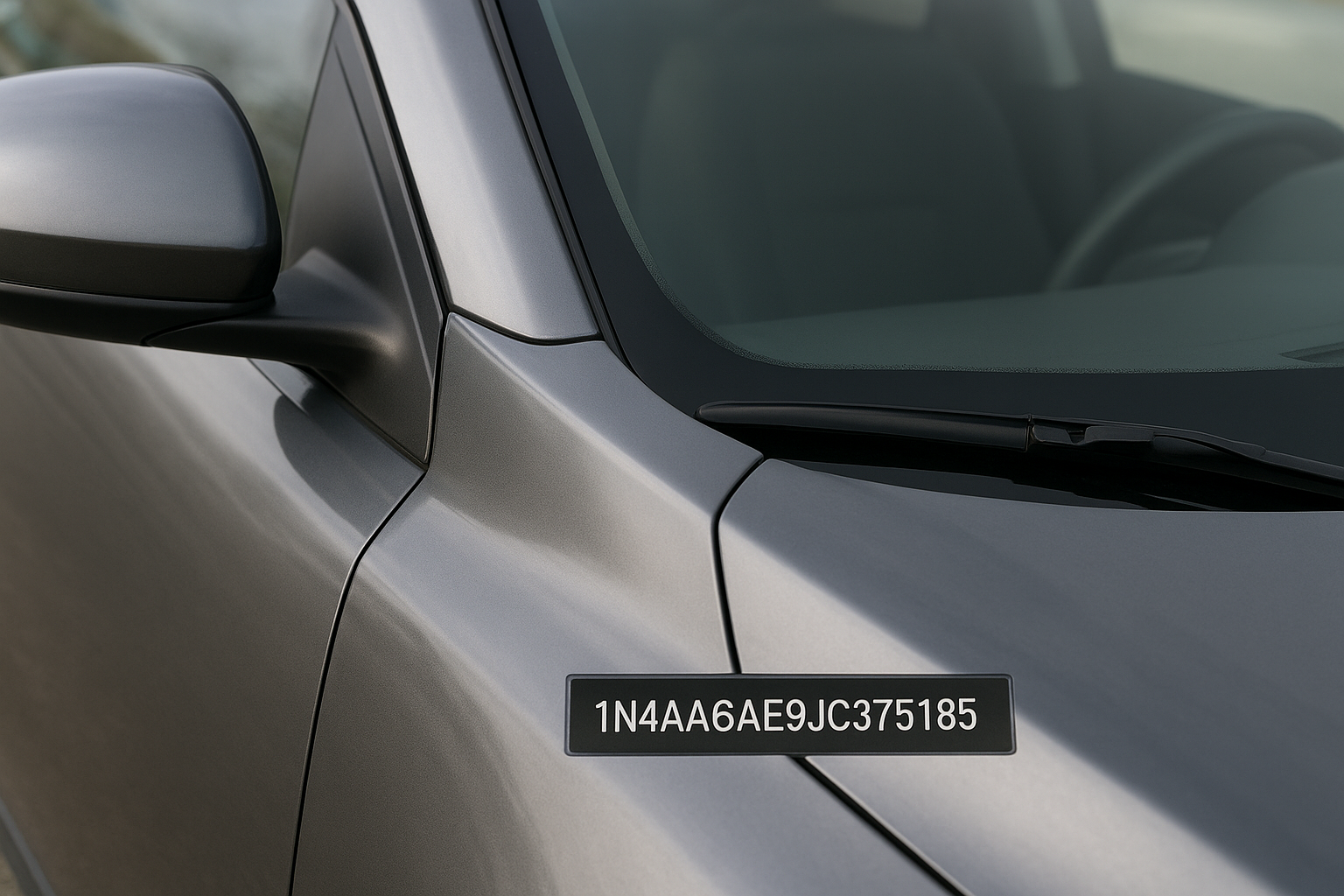
Check both locations and confirm the numbers match. If they don’t, that’s a red flag worth investigating before you proceed.
Never rely on a VIN written on a sticky note or recalled from memory. Always verify it directly from the vehicle or an official document before running your search.
Where to find your VIN on documents
If you can’t get to your vehicle right now, several official documents carry the full VIN:
- Vehicle title: Listed near the top of the document, typically labeled “Vehicle Identification Number”
- Current registration: Issued by your state’s DMV and renewed annually
- Insurance card or declarations page: Your insurer prints the VIN on your coverage documents
- Dealer purchase paperwork: Your bill of sale or financing agreement includes the VIN
- Service records: Any legitimate dealership repair order will carry the VIN at the top
How to confirm you have the right number
Once you have a VIN written down, count the characters. A valid VIN always contains exactly 17 characters, using both letters and numbers. Nissan VINs for vehicles sold in North America typically begin with the number 1, 3, or 5, depending on the manufacturing country. The tenth character identifies the model year, which you can cross-reference against a standard VIN decoder.
Take 30 seconds to verify the VIN visually before entering it into any recall search tool. A single transposed character will return results for a completely different vehicle, and you could miss an active recall that directly affects your car.
Step 2. Run a Nissan recall lookup by VIN
With your 17-character VIN confirmed and in hand, you’re ready to run the actual search. There are two primary places to do this: the federal government’s recall database maintained by the National Highway Traffic Safety Administration (NHTSA) and Nissan’s own owner portal. Both are free and take less than two minutes to use. Start with NHTSA, since it captures all federally mandated recalls regardless of whether the manufacturer has updated its own records yet.
Use the NHTSA recall search tool
The NHTSA database at nhtsa.gov is the most complete source for any Nissan recall lookup because federal law requires manufacturers to report all safety recalls to NHTSA before notifying owners. That means the government database often shows a recall before you’d ever receive a mailer from Nissan directly.
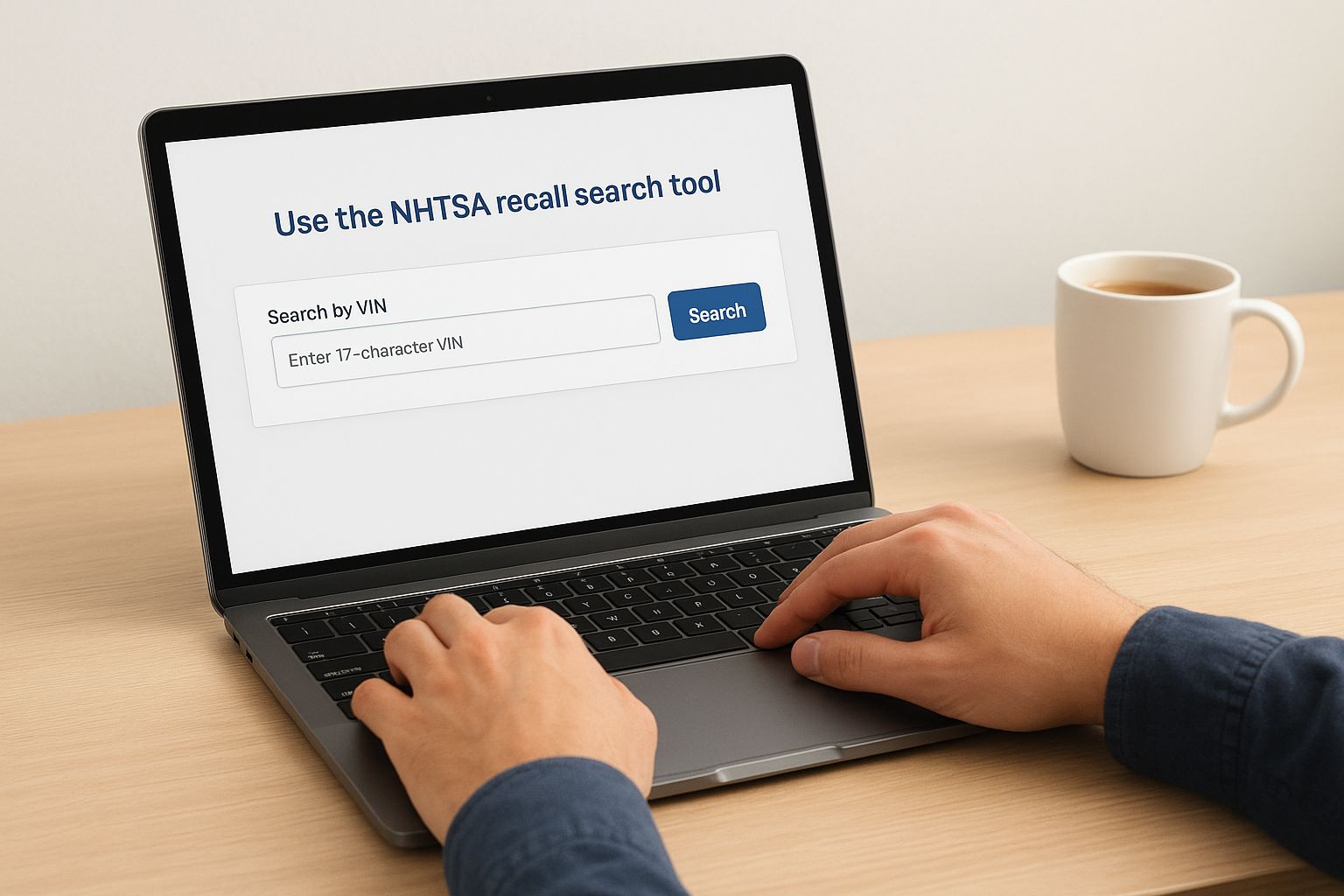
Follow these steps to run your search:
- Go to nhtsa.gov/vehicle-safety/recalls
- Click the “Search by VIN” tab at the top of the recall search tool
- Enter your full 17-character VIN in the search field exactly as it appears on your vehicle
- Click “Search” and wait for the results page to load
- Review each listed recall for its current status (open or completed) and the associated safety risk
- Take a screenshot or print the results page before closing the browser
If the results show an open recall, write down the NHTSA Campaign Number listed for each one. You’ll need that number when you call your Nissan dealership to schedule a repair.
Use Nissan’s official owner portal
Nissan also maintains its own recall search tool at owners.nissanusa.com, and running your VIN through both tools is worth the extra two minutes. Nissan’s portal sometimes includes additional service campaigns or technical service bulletins that NHTSA’s tool doesn’t always surface, particularly for issues that fall just below the federal recall threshold but still affect safety or vehicle performance.
On the Nissan owner portal, enter your VIN in the recall search field and review the full list of results. Pay attention to the repair status column, which will tell you whether the issue remains open or whether a prior owner or dealership already addressed it. If results differ between NHTSA and the Nissan portal, contact Nissan’s customer support line at 1-800-867-7669 to clarify which records are current before scheduling anything.
Step 3. Confirm results with NHTSA and other tools
Running your VIN through both NHTSA and the Nissan owner portal gives you a solid starting point, but confirming your results with additional tools adds another layer of accuracy. Manufacturers sometimes lag on updating their portals, and a cross-reference check takes only a few extra minutes but can surface safety concerns that a single search might miss entirely.
Verify your VIN details with a free decoder
Before accepting any recall results at face value, run your VIN through the NHTSA VIN decoder to confirm the vehicle data actually matches your car. The NHTSA website at nhtsa.gov includes a built-in decoder that returns the make, model, year, trim, and engine size tied to that specific VIN. If the decoder returns details that don’t match your vehicle, stop and recheck your VIN against a physical location on the car before proceeding further.
Here’s what a confirmed VIN decode should show for a typical Nissan:
| Field | Example Value |
|---|---|
| Make | Nissan |
| Model | Altima |
| Model Year | 2019 |
| Body Style | Sedan |
| Engine | 2.5L 4-cylinder |
| Plant of Manufacture | Smyrna, Tennessee |
Confirming these details takes less than a minute, and it protects you from acting on recall information that belongs to a completely different vehicle.
Search NHTSA’s complaints database
NHTSA also maintains a consumer complaints database at nhtsa.gov where owners report safety problems with their vehicles. Searching this database by your Nissan’s model year and make can reveal patterns of failure that haven’t yet triggered a formal recall but that federal investigators are actively reviewing. Complaints filed by other owners often precede official recalls by several months.
If you find a cluster of complaints that match a problem you’ve personally experienced, file your own complaint with NHTSA directly, since owner reports contribute to the federal investigation process and can accelerate a recall decision.
When you run this Nissan recall lookup confirmation step, pay close attention to complaints tagged under “NHTSA Investigation” status. That tag means federal investigators are already reviewing a specific safety issue for your model, and a recall could follow. Write down the ODI numbers (Office of Defects Investigation reference numbers) listed for any active investigations related to your vehicle. Those numbers become important documentation if the defect causes an accident before a recall is officially issued, and they give your attorney a clear starting point when building a product liability or negligent repair claim on your behalf.
Step 4. Schedule the free recall repair and document it
Once your Nissan recall lookup confirms an open recall on your vehicle, your next move is to schedule the free repair at an authorized Nissan dealership. Federal law requires Nissan to fix any open safety recall at no charge to you, regardless of whether you’re the original owner, how old the vehicle is, or how many miles you’ve put on it. Call your nearest authorized Nissan dealership and reference the NHTSA Campaign Number you recorded in the previous steps.
Contact your Nissan dealership directly
When you call to book your appointment, give the service advisor your full 17-character VIN and the NHTSA Campaign Number for each open recall. This gets you routed to the right department immediately and prevents any confusion about what work needs to be done. If parts are backordered, ask the dealer to place you on a priority notification list and get a written estimate of when parts are expected to arrive.
Use this call script to keep the conversation focused:
“Hi, I’m calling to schedule a free recall repair. My VIN is [your VIN], and the NHTSA Campaign Number is [number]. Can you confirm the parts are in stock and schedule my appointment?”
Here’s what to ask before you end the call:
- Whether parts for your specific recall are currently in stock
- How long the repair is expected to take
- Whether a loaner vehicle or rental reimbursement is available if the repair takes more than one day
- The name of the service advisor you spoke with
What to document at the repair appointment
When you bring your Nissan in, ask for a written repair order before any work begins. That document should list your VIN, the recall campaign number, the specific parts being replaced, and the name of the technician performing the work. When you pick up the vehicle, request the completed repair order showing that the work was finished and signed off.
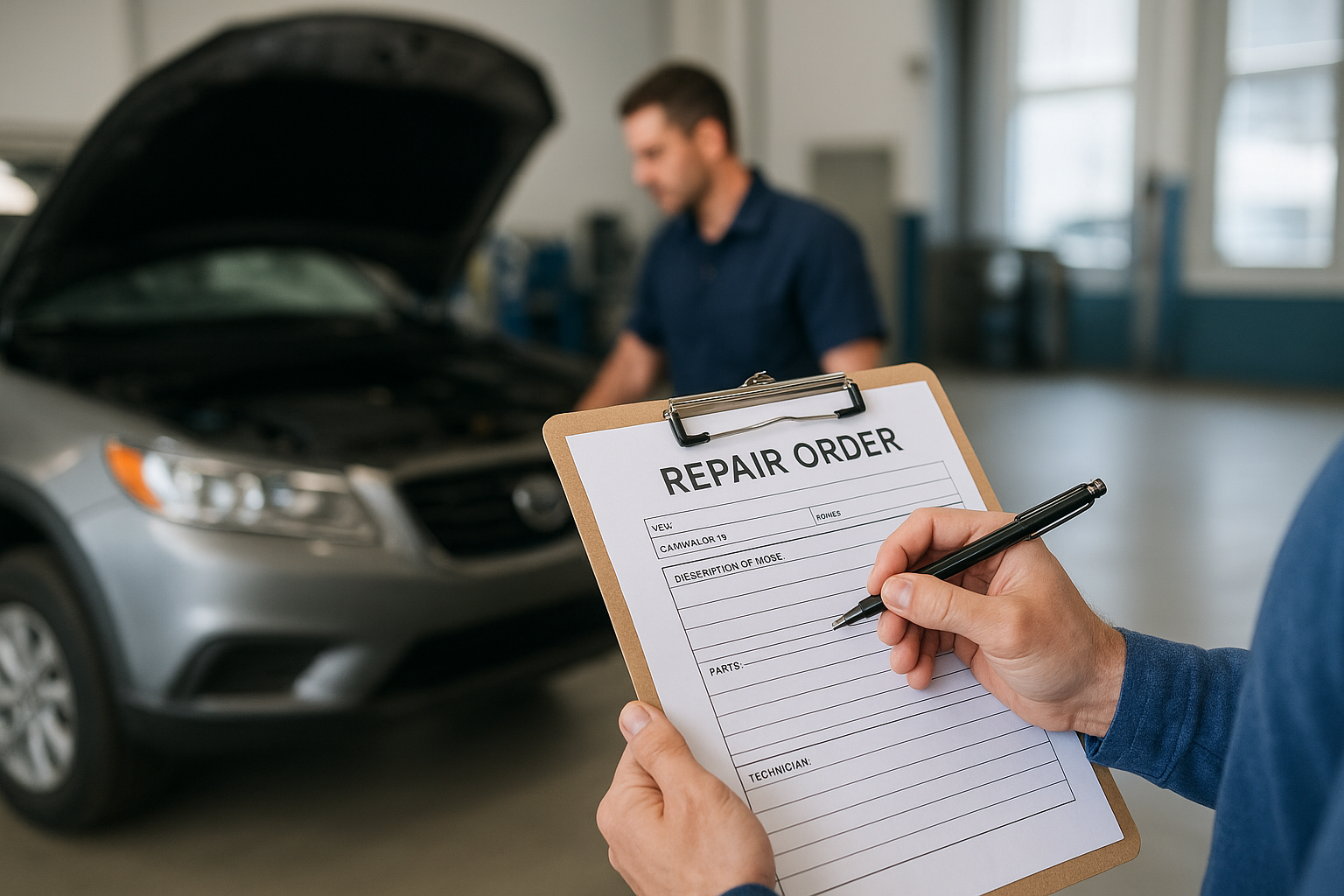
Store everything in a dedicated folder, either physical or digital, that you keep specifically for your vehicle’s records. A well-documented repair history protects you in two important ways. First, it proves the recall was addressed, which matters if you sell the vehicle. Second, if a future accident involves the same component, your documented repair history establishes a clear timeline that can support or refute liability claims. Photograph the repair orders and back them up to cloud storage using a service like Google Drive so you never lose access to them.
Step 5. Protect yourself if a recall causes a crash
Running a Nissan recall lookup and scheduling the repair protects you going forward, but what happens if a defect causes a crash before you get that repair done, or before Nissan even issues the recall? You have legal rights, and the steps you take in the hours and days immediately after a crash directly affect your ability to pursue compensation for your injuries, medical bills, and lost income.
If you were injured in a crash linked to a known defect or an open recall, do not sign any insurance settlement or release before speaking with a personal injury attorney.
Know your legal rights as a crash victim
When a vehicle defect contributes to a crash, multiple parties can bear legal responsibility beyond the other driver. Nissan, as the manufacturer, can face liability under product liability law if a defective component caused or worsened your injuries. If a dealership performed a recall repair that failed, they may also carry responsibility for negligent repair work. California law gives injured victims the right to pursue compensation from every party whose negligence contributed to the harm they suffered.
Your documentation trail matters enormously in these cases. Every recall notice, repair order, NHTSA complaint number, and service record you’ve preserved becomes evidence that can support your claim. Courts and insurance adjusters pay close attention to whether the manufacturer knew about a defect before the crash occurred.
Steps to take immediately after a recall-related crash
Taking the right actions after a crash locks in critical evidence before it disappears. Follow these steps in order:
- Call 911 and get a police report filed at the scene, even if injuries seem minor
- Photograph the vehicle damage from multiple angles, including close-ups of any component that may have malfunctioned
- Request a copy of the police report as soon as it’s available from the responding agency
- Preserve your vehicle by not authorizing any repairs until an attorney or investigator can inspect it
- Pull up your NHTSA recall search results from your saved records and note whether an open recall existed on that specific component at the time of the crash
- Write a detailed account of what happened while your memory is fresh, including road conditions, speeds, and exactly how the vehicle behaved
Contact a personal injury attorney early
Time limits apply to injury claims in California. The statute of limitations for most personal injury cases is two years from the date of the injury, but certain claims involving government entities or minors carry shorter deadlines. Contacting an attorney early in the process gives your legal team time to retain expert witnesses, inspect the vehicle, and request manufacturer records before evidence is lost or destroyed.
Wrap up and get help
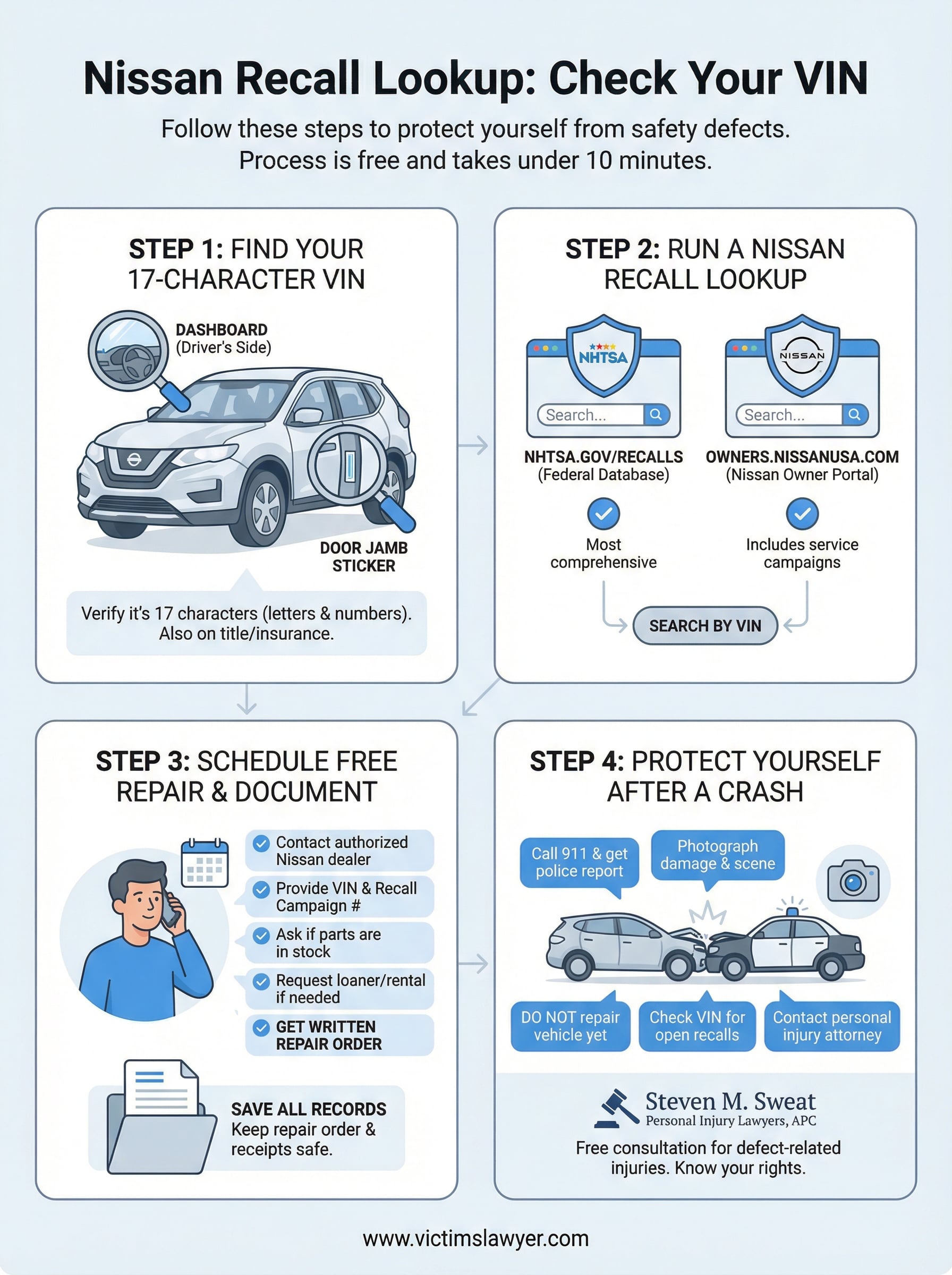
Running a Nissan recall lookup takes less than 10 minutes, costs nothing, and can prevent a serious crash before it happens. You now know where to find your VIN, how to search both the NHTSA database and Nissan’s owner portal, how to confirm your results, and what to do when you schedule your free repair. Keeping documentation of every step protects you both as a vehicle owner and as a potential claimant if something goes wrong on the road.
If you were already in a crash and a vehicle defect played a role, the steps you take right now matter. At Steven M. Sweat, Personal Injury Lawyers, APC, we represent injured Californians every day against manufacturers, dealerships, and insurance companies. Our team reviews your case for free and charges nothing unless we recover money for you. Contact us today to schedule your free consultation and find out exactly where you stand.