 California Accident Attorneys Blog


You’ve been injured, you’ve filed your claim, and now the insurance company has come back with a number that barely covers your medical bills, let alone your lost wages, pain, or long-term recovery. If you’re wondering how to respond to a low settlement offer, you’re not alone. Insurance adjusters are trained to minimize payouts, and their first offer is almost never their best. The good news: you don’t have to accept it.
At Steven M. Sweat, Personal Injury Lawyers, APC, we’ve spent over 25 years negotiating against insurers on behalf of injured Californians, and we’ve seen every lowball tactic in the book. A weak initial offer doesn’t mean your case lacks value. It means the negotiation has just started, and how you respond in this moment can make or break your final recovery.
This guide walks you through exactly what to do when you receive an inadequate settlement offer. You’ll learn how to evaluate whether the number is truly low, build a stronger counter-demand backed by evidence, and handle the back-and-forth negotiation process, whether you’re doing it on your own or deciding it’s time to bring in legal help.
Before you counter, understand the offer
Knowing how to respond to a low settlement offer starts with understanding exactly what the insurer is doing and why. Insurance companies send low initial offers for a specific reason: they expect you to be uninformed about your claim’s true value, and they count on urgency, confusion, or financial pressure to push you into accepting quickly. Before you write a single word of your counter, take time to break down what the offer actually says, what it covers, and what it leaves out entirely.
An initial offer is a negotiating position, not a final verdict on what your case is worth.
Why insurers start low
Insurance adjusters work for the carrier, not for you. Their job is to close claims at the lowest possible cost, and starting with a number below your actual damages gives them room to negotiate upward while still paying less than full value. Common tactics include undervaluing your medical treatment costs, ignoring future care needs, and dismissing non-economic damages like pain and suffering as too speculative to quantify. Recognizing these tactics prevents you from treating a low offer as a fair or final assessment of your claim.
What to check before you respond
Before drafting your counter, go through the offer line by line and compare it against what you have actually lost. Check each of these areas specifically:

- Medical expenses: Does the offer cover all treatment to date, or only part of it?
- Future medical costs: If your doctor has recommended ongoing therapy, surgery, or long-term medication, are those costs reflected?
- Lost income: Does the number match your actual documented earnings loss, not a reduced or estimated figure?
- Property damage: For vehicle accidents, is the repair or replacement value accurate and current?
- Pain and suffering: Non-economic damages are often missing entirely from early offers.
Once you’ve mapped the offer against your actual losses, you can identify the gap between what the insurer is proposing and what your claim is genuinely worth. That gap, backed by hard documentation, is your foundation for a strong counter-demand.
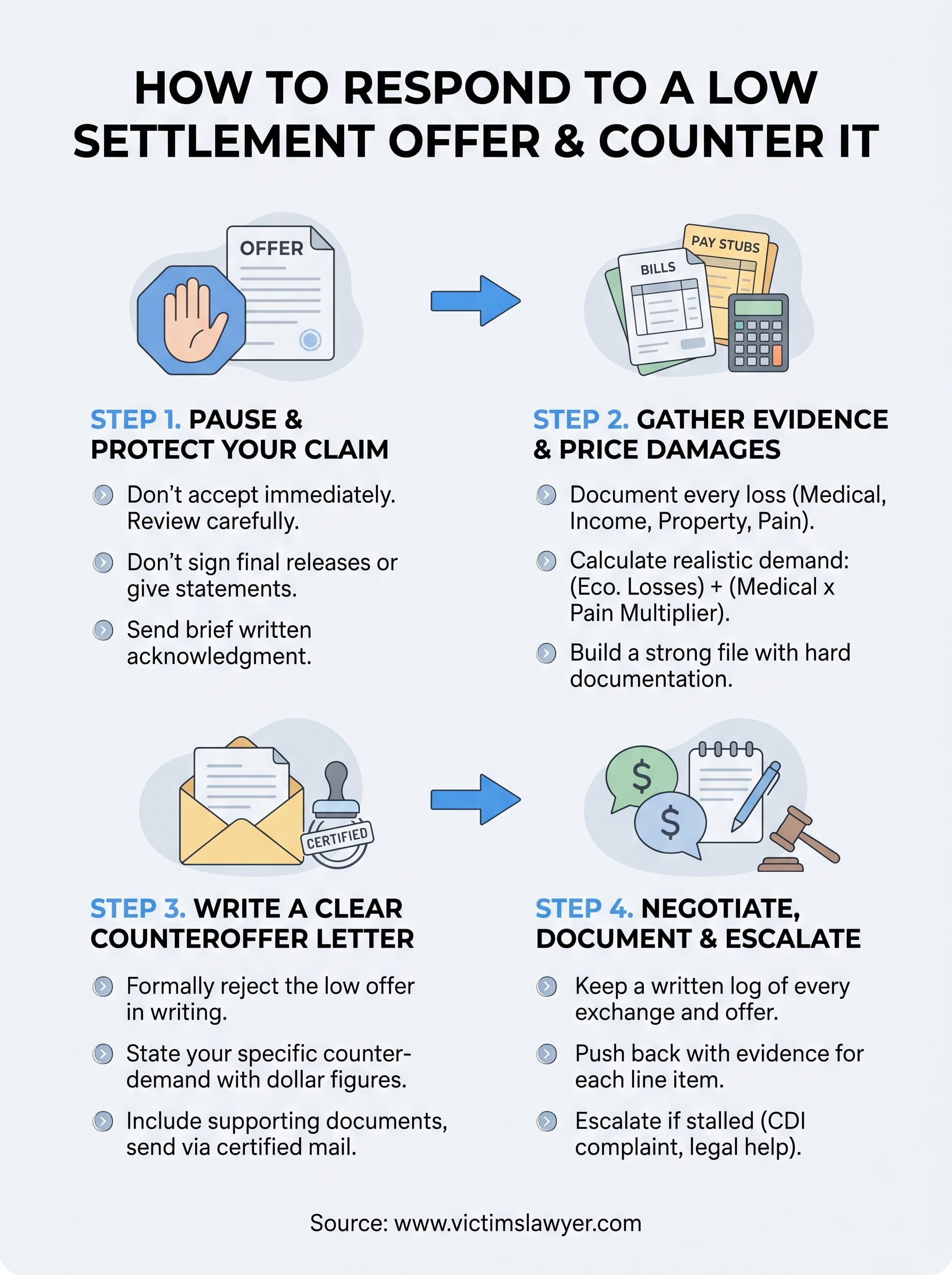
Step 1. Pause and protect your claim
When you receive a low offer, your first instinct might be to fire back immediately, but responding too quickly is one of the most common mistakes injured claimants make. Before you write anything or say anything to the adjuster, give yourself at least a few days to review the offer carefully and compare it against your actual documented losses.
Never accept a settlement offer verbally or in writing until you’ve fully reviewed every line and confirmed it reflects your total damages.
Don’t say yes, and don’t say nothing
Your silence can also work against you if you miss response deadlines, so you need to strike a balance. Send a brief written acknowledgment confirming you received the offer and that you are reviewing it. This protects your position, buys you time, and signals to the adjuster that you are an informed claimant who takes the process seriously. Keep your reply simple and non-committal:
“I received your settlement offer dated [date]. I am reviewing it and will respond in writing within [X] days.”
Watch what you say and sign
Knowing how to respond to a low settlement offer also means knowing what not to do in this early window. Do not give recorded statements to the adjuster, and do not sign any documents presented alongside the offer until you fully understand what rights you are releasing.
Watch specifically for these items before you sign anything:
- General release forms that waive your right to future compensation
- Medical authorization forms that give the insurer unlimited access to your records
- Any document described as a “final resolution” or “full and final settlement”
Step 2. Gather evidence and price your damages
A strong counter-demand lives or dies on the documentation behind it. When you’re working through how to respond to a low settlement offer, your goal in this step is to build a file that assigns a specific dollar figure to every category of loss, giving the adjuster nothing vague to push back on.
The more concrete your documentation, the harder it becomes for an insurer to defend a low number.
Document every loss category
Pull together records across all damage types before you write your counter. Medical records, billing statements, and physician notes are the foundation of your economic damages case. Add pay stubs or an employer letter confirming your actual lost wages, not an estimate. If your injury creates long-term limitations, a written prognosis from your doctor or a vocational expert’s opinion can anchor that figure.
Here is what to collect by damage type:
| Damage Type | Documents to Gather |
|---|---|
| Medical expenses | Bills, EOBs, treatment records |
| Future medical costs | Doctor prognosis, cost projections |
| Lost income | Pay stubs, employer letter, tax returns |
| Property damage | Repair estimates, photos, replacement value |
| Pain and suffering | Journal entries, therapist notes, witness statements |
Calculate a realistic demand number
Once your records are complete, add up every documented economic loss, then apply a multiplier for pain and suffering. California courts commonly use a multiplier of 1.5 to 5 times your medical costs for non-economic damages, depending on injury severity. Use this formula as your starting point:
Total demand = (Medical costs + Lost wages + Property damage) + (Medical costs x pain multiplier)
Step 3. Write a clear counteroffer demand letter
Your counter-demand letter is where knowing how to respond to a low settlement offer turns into a concrete action. This letter formally rejects the insurer’s figure and replaces it with your documented number, and it sets the tone for every round of negotiation that follows. Keep the tone professional and factual throughout.
A well-structured demand letter signals to the adjuster that you know your case’s value and are prepared to defend it.
What your letter must include
The letter needs to accomplish three things: reject the current offer on the record, lay out your losses with specific dollar figures tied to documentation, and state your counter-demand clearly. Avoid vague language. Every figure you include should point directly to supporting records you can back up.
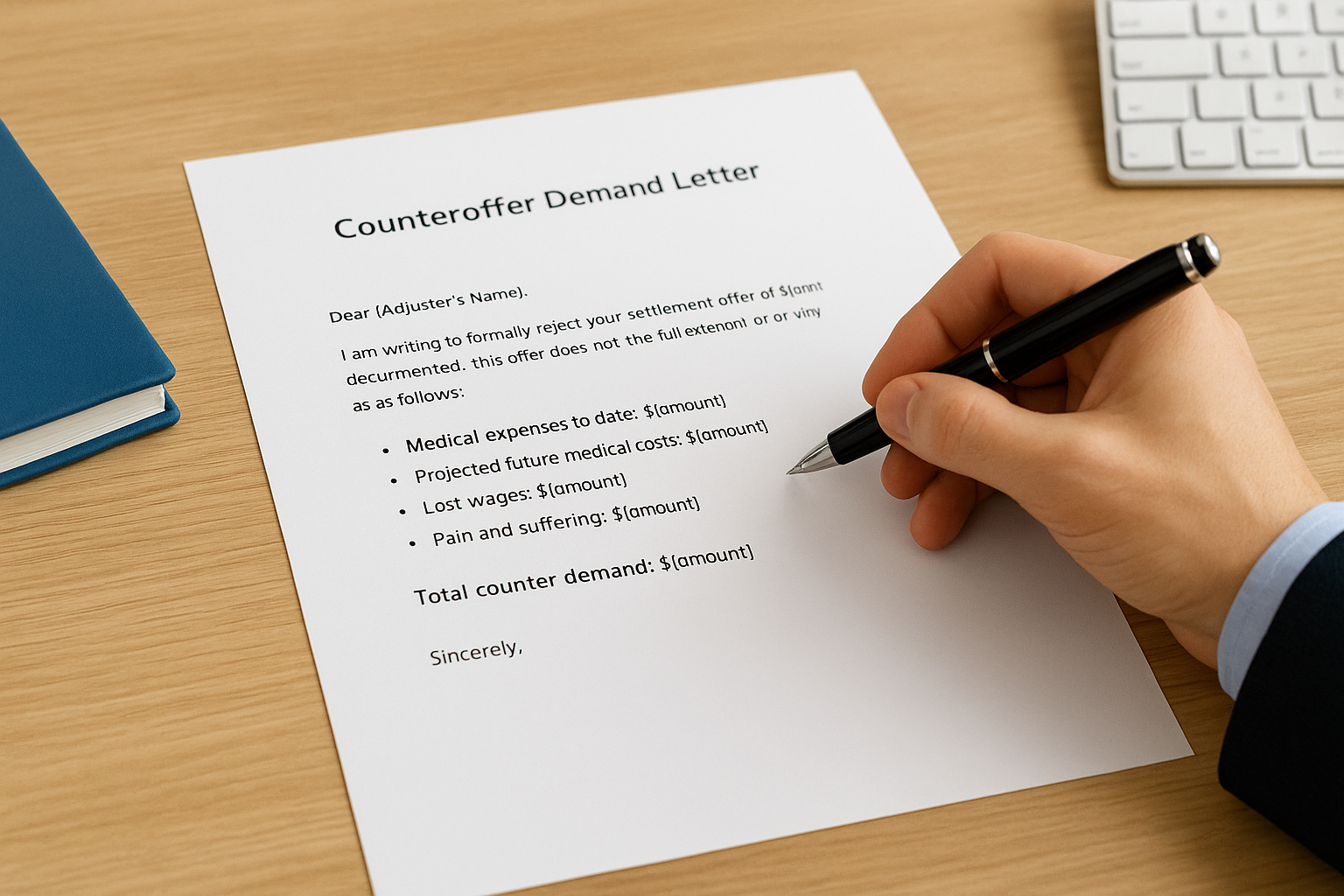
Use this template as your starting framework:
[Your Name] [Date]
Re: Claim No. [XXXXX] | [Your Name] vs. [Insured Party]
Dear [Adjuster’s Name],
I am writing to formally reject your settlement offer of $[amount] dated [date]. This offer does not reflect the full extent of my documented losses, which are as follows:
- Medical expenses to date: $[amount]
- Projected future medical costs: $[amount]
- Lost wages: $[amount]
- Pain and suffering: $[amount]
- Total counter-demand: $[amount]
Supporting documentation is available upon request. Please respond in writing within 14 to 21 days.
Sincerely, [Your Name] [Contact Information]
Send your letter via certified mail with return receipt and keep a dated copy in your claim file. Written communication creates a clear record that protects your position if the dispute escalates.
Step 4. Negotiate, document, and escalate when needed
After you send your counter-demand, the adjuster will typically come back with a revised number, which will still be lower than what you asked for. This is normal. Negotiation runs in rounds, and your job is to hold your position, push back with supporting documentation, and avoid accepting a number you cannot justify against your actual losses. Keep every communication written, and never agree to anything over the phone without confirming it in a follow-up email.
Verbal agreements with adjusters carry no weight if the insurer later denies what was discussed.
Track every exchange in writing
Each time the adjuster responds, log the date, the new offer amount, and the reasoning they give for the figure. This record becomes critical if the dispute escalates to a demand letter, a complaint, or litigation. When you reply to each counter, reference your original demand and specify exactly why their revised number still falls short. Keep your responses focused on specific line items.
Use this simple tracking log to stay organized:
| Date | Insurer Offer | Your Counter | Notes |
|---|---|---|---|
| [Date] | $[amount] | $[amount] | Initial offer rejected |
| [Date] | $[amount] | $[amount] | Future medical costs disputed |
Know when to escalate
If the adjuster reaches a ceiling and stops moving, you have real options. Filing a complaint with the California Department of Insurance puts the carrier on notice that you are taking the dispute seriously. Understanding how to respond to a low settlement offer also means knowing when the process calls for legal representation. At that point, bringing in an experienced personal injury attorney often shifts the dynamic entirely, since insurers respond differently when litigation becomes a realistic outcome.
Next steps
Knowing how to respond to a low settlement offer gives you a real advantage in a process that insurers rely on you not understanding. You now have the tools to pause before responding, build a documented damage file, write a counter-demand that holds up under scrutiny, and push back through every round of negotiation. Each step in this guide builds directly on the last, so follow the sequence and keep a written record of every exchange.
If the adjuster stops moving or starts using delay tactics you can’t break through, that is your signal to bring in professional legal help. At Steven M. Sweat, Personal Injury Lawyers, APC, our attorneys have spent over 25 years fighting lowball offers for injured Californians, and insurers know we take cases to trial when the number isn’t right. Schedule a free consultation today and let us take the negotiation off your plate.