 California Accident Attorneys Blog


You walk into a grocery store, step on a wet floor with no warning sign, and break your wrist. A loose railing at an apartment complex gives way, sending a tenant down a flight of stairs. A child falls into an unfenced pool at a neighbor’s property. Each of these situations raises the same legal question: what is premises liability, and who is responsible when someone gets hurt on another person’s property? The answer matters because property owners in California have a legal duty to maintain safe conditions for visitors, and when they fail, injured people have the right to seek compensation.
Premises liability is one of the most common foundations for personal injury claims, yet many people don’t realize they have a case until medical bills start piling up. Proving a property owner’s negligence requires more than just showing you were hurt. You need to establish that the owner knew or should have known about a dangerous condition and failed to fix it or warn you about it.
At Steven M. Sweat, Personal Injury Lawyers, APC, we’ve spent over 25 years representing injured Californians in premises liability cases, from slip and fall injuries at retail stores to catastrophic harm caused by unsafe building conditions across Los Angeles and throughout the state. This article breaks down what premises liability actually means, who qualifies to file a claim, the most common types of cases we see, and what you need to prove to hold a negligent property owner accountable.
Why premises liability matters
When you get hurt on someone else’s property, the financial consequences can escalate fast. Medical bills, lost wages, and long-term rehabilitation costs can stack up well before you even understand whether the property owner bears legal responsibility. Understanding what is premises liability gives you a foundation to recognize when the law is on your side and when you have a right to pursue compensation rather than absorbing those costs on your own.
Property owners in California are not automatically liable every time someone is injured on their land, but the law does hold them to a clear standard of care.
The scope of property-related injuries in California
Slip and fall accidents alone account for over one million emergency room visits in the United States each year, according to the National Safety Council. In California, property-related injuries span a wide range, from retail store accidents and apartment complex hazards to injuries at schools, hotels, and private homes. Many of these injuries are preventable, and they happen because a property owner skipped routine maintenance, ignored a reported hazard, or failed to warn visitors about a known danger. The result is that real people suffer broken bones, traumatic brain injuries, and spinal damage because someone else cut corners.
These cases are not limited to large commercial properties. A private homeowner, a landlord, or a business tenant can all be held responsible under California’s premises liability law if their negligence created the conditions that caused your injury. The law applies broadly, and that reach is one reason premises liability cases make up a significant portion of personal injury litigation in California courts.
Your status as a visitor changes everything
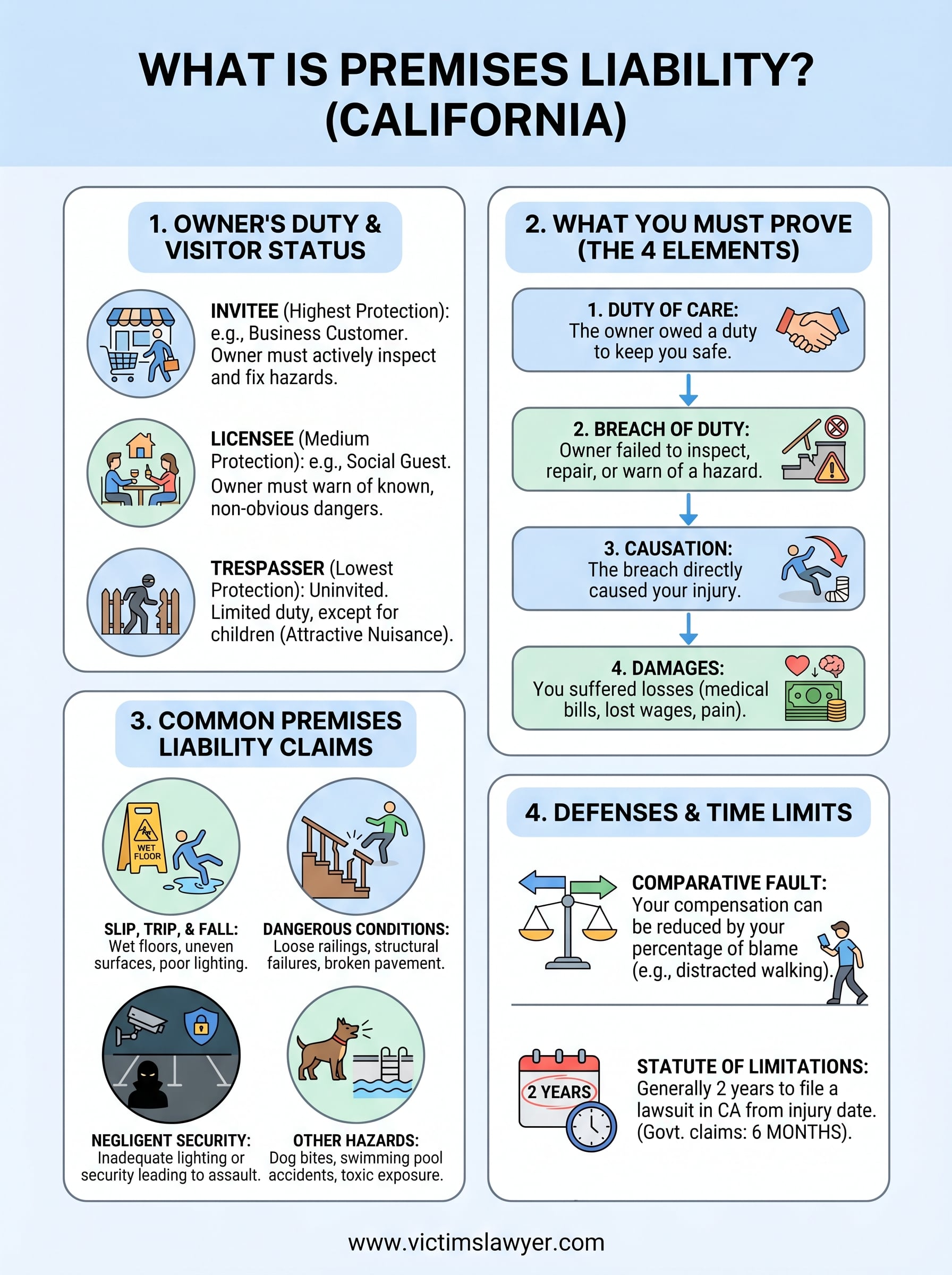
California law distinguishes between different types of visitors when determining how much duty of care a property owner owes. An invitee, someone invited onto the property for a business purpose like a customer in a store, receives the highest level of protection. A licensee, such as a social guest, is owed a somewhat lower duty. A trespasser generally receives the least protection, though there are important exceptions, particularly when children are involved through the attractive nuisance doctrine.
Your specific status at the time of your injury directly affects the strength of your claim. If you were a customer at a business, the owner had a duty to actively inspect for hazards and address them promptly. Knowing your visitor status before you speak with an attorney helps frame what standard applied to your situation and whether the property owner fell short of meeting it.
How premises liability claims work
At its core, a premises liability claim is a type of negligence case. Understanding what is premises liability in legal terms means recognizing that you must connect the property owner’s failure to act with the harm you actually suffered. Four core elements form the backbone of any premises liability claim in California, and each one needs to be supported by evidence before you can recover compensation.
The duty of care standard
California Civil Code Section 1714 establishes that property owners owe a duty of reasonable care to people on their property. The standard asks what a reasonably careful property owner would have done under the same circumstances. If the owner inspected regularly, fixed hazards promptly, and posted warnings when needed, a court may find they met their duty. If they ignored known dangers or skipped routine maintenance, they likely fell short.
The duty of care is not about perfection; it’s about whether the property owner acted as a reasonable person would to keep the premises safe.
From incident to claim
After an injury occurs, the claims process typically starts with documenting the scene, gathering witness information, and seeking immediate medical treatment. Your medical records become critical evidence because they link your injuries directly to the incident. Insurance companies representing property owners will often investigate quickly and look for reasons to minimize or deny your claim, which is why acting fast and contacting an attorney early gives you a real advantage.
The process moves from investigation to demand to negotiation, and sometimes to trial. Building a strong claim requires preserving evidence, identifying all responsible parties, and calculating the full scope of your damages, including future medical costs and lost earning capacity.
Common premises liability accidents and injuries
Understanding what is premises liability becomes much clearer when you look at the real situations that generate these claims. Property-related injuries cover a broad range of accidents, from routine falls at grocery stores to catastrophic injuries caused by structural failures. Knowing which incidents qualify helps you recognize when a property owner’s negligence may have caused your harm.
The most common premise liability claims share one factor: a property condition that the owner knew about or should have found through reasonable inspection.
Slip, trip, and fall accidents
Slip and fall incidents are the most frequently filed type of premises liability claim in California. Wet floors, broken pavement, torn carpet, poor lighting, and uneven walking surfaces all create the kind of hazards that cause serious falls. Grocery stores, restaurants, parking lots, and apartment buildings generate a large share of these cases because high foot traffic combines with inconsistent maintenance practices.

These accidents often cause fractures, head injuries, and torn ligaments that require surgery and months of recovery. Older victims face especially severe consequences, including hip fractures that permanently limit mobility. Your injuries following a fall deserve the same thorough legal evaluation as any other serious accident.
Other dangerous property conditions
Beyond falls, property owners face liability for a wide variety of hazardous conditions. Swimming pool accidents, dog bites, inadequate security that leads to assault, toxic exposure, elevator and escalator malfunctions, and fires caused by building code violations all fall under premises liability law. Each of these scenarios involves a property owner who failed to control a known risk.
California courts have also recognized cases involving negligent security at hotels, apartment complexes, and parking structures where a foreseeable criminal act harmed a visitor. If the owner knew violence had occurred on or near the property before and took no action, you may have a valid claim.
What you must prove to win a claim
Winning a premises liability case requires more than showing that you got hurt on someone else’s property. California law requires you to prove four distinct elements of negligence, and each one must be backed by evidence. Understanding what is premises liability from a legal standpoint means recognizing that the burden of proof rests with you as the injured party, not with the property owner.
Duty and breach
Every claim starts with establishing that the property owner owed you a duty of reasonable care. This duty applies when you are lawfully on the property, whether as a paying customer, a tenant, or a social guest. Once duty is established, you must show the owner breached that duty by failing to inspect, repair, or warn you about a hazardous condition that a reasonable owner would have handled.
A breach can be as clear as ignoring a reported hazard for several days, or as subtle as skipping routine inspection schedules that would have caught the problem.
Causation and damages
Causation connects the owner’s breach directly to your specific injury. You must show that the dangerous condition actually caused your harm, not just that the condition existed near where you got hurt. Courts look at whether the injury was a foreseeable result of the owner’s failure to act responsibly.
Damages cover everything you lost as a result of the injury. Medical expenses, lost wages, and pain and suffering all qualify as compensable damages in California premises liability claims. Future costs matter too, such as ongoing treatment and reduced earning capacity. Documenting every financial and physical impact from the moment of injury forward gives your attorney the strongest possible foundation to build your case.
Defenses and time limits that can block recovery
Even when you fully understand what is premises liability and you have a legitimate case, property owners and their insurers will use specific legal defenses to reduce or eliminate your recovery. Knowing these defenses ahead of time puts you in a better position to address them with your attorney before they derail your claim.
Comparative fault and the open and obvious rule
California follows a pure comparative fault system, which means the court can assign a percentage of blame to you for your own injury. If a jury finds you were 30 percent at fault for the accident, your damages get reduced by that same percentage. Property owners often argue you were distracted, ignored posted warnings, or wore improper footwear to push your share of responsibility higher and drive down their payout.
The open and obvious defense argues that a hazard was so visible that any reasonable person would have noticed and avoided it, reducing or eliminating the owner’s liability.
Insurers use this argument aggressively in slip and fall cases, so documenting the scene immediately after your injury, including whether any warnings were posted, gives you the evidence needed to counter it.
The statute of limitations
Time works against you in premises liability cases. California Code of Civil Procedure Section 335.1 gives you two years from the date of your injury to file a personal injury lawsuit. If you miss that deadline, California courts will almost certainly bar your claim entirely, regardless of how strong your evidence is.
Certain exceptions can shorten this window significantly. If your injury happened on government-owned property, such as a public school or a city sidewalk, you typically have only six months to file an administrative claim before any lawsuit can proceed. Acting quickly protects your rights.
What to do next
Now that you understand what is premises liability and how California law applies it, the most important step is acting before evidence disappears or deadlines pass. Photographs of the hazard, witness contact information, and your medical records all become harder to collect as time goes on. Report the incident to the property owner or manager in writing, and keep a copy of that report for your records.
Serious injuries demand fast legal action. Insurance adjusters for property owners move quickly to protect their client’s interests, and anything you say without legal guidance can be used to reduce your claim. At Steven M. Sweat, Personal Injury Lawyers, APC, we offer free consultations with no upfront fees, and you pay nothing unless we recover money for you. Contact our legal team today to get a straightforward assessment of your situation and find out what your claim may be worth.