 California Accident Attorneys Blog


Article Summary: Settling a truck accident claim in California typically takes between twelve and twenty-four months due to the inherent complexity of these cases compared to standard vehicle collisions. Unlike typical car accidents, truck incidents often involve multiple liable parties—such as trucking corporations and parts manufacturers—along with stringent federal regulations that necessitate extensive evidence gathering. The process begins with a crucial investigation and medical treatment phase, where victims must reach maximum medical improvement before finalizing any demands to ensure long-term care costs are accurately calculated. Following this, a formal demand package initiates negotiations, which often last several months as insurers typically issue low initial counteroffers. If a fair agreement cannot be reached, the case moves into litigation, involving a discovery phase that can extend the timeline by another six to twelve months. Factors such as injury severity and insurer cooperation significantly influence the speed of resolution. To expedite the process without sacrificing value, plaintiffs should maintain consistent medical treatment, preserve critical evidence like black box data immediately, and cooperate closely with legal counsel. Early legal representation is vital to counter the aggressive defense strategies employed by commercial trucking insurers and to secure comprehensive compensation.
If you’ve been hurt in a collision with a commercial truck, one of the first questions on your mind is probably how long does a truck accident settlement take. It’s a fair question, and an urgent one when medical bills are stacking up, you’re missing work, and insurance adjusters are already calling. The honest answer is that no two cases follow the same timeline, but understanding what drives the process forward (or stalls it) can help you make smarter decisions from the start.
Truck accident claims in California tend to be more complex than standard car accident cases. Multiple liable parties, the driver, the trucking company, a cargo loader, a parts manufacturer, can all be involved. Federal and state trucking regulations add layers of evidence to gather and analyze. Insurance policies are larger, which means carriers fight harder to reduce or deny payouts. All of this affects how long you’ll wait before seeing a resolution.
At Steven M. Sweat, Personal Injury Lawyers, APC, we’ve spent over 25 years handling serious injury cases across Los Angeles and throughout California, including truck accident claims involving catastrophic harm. Below, we break down the realistic stages of a truck accident settlement, what factors can shorten or extend your timeline, and what you can do to keep your case moving toward the compensation you deserve.
What a truck settlement timeline looks like
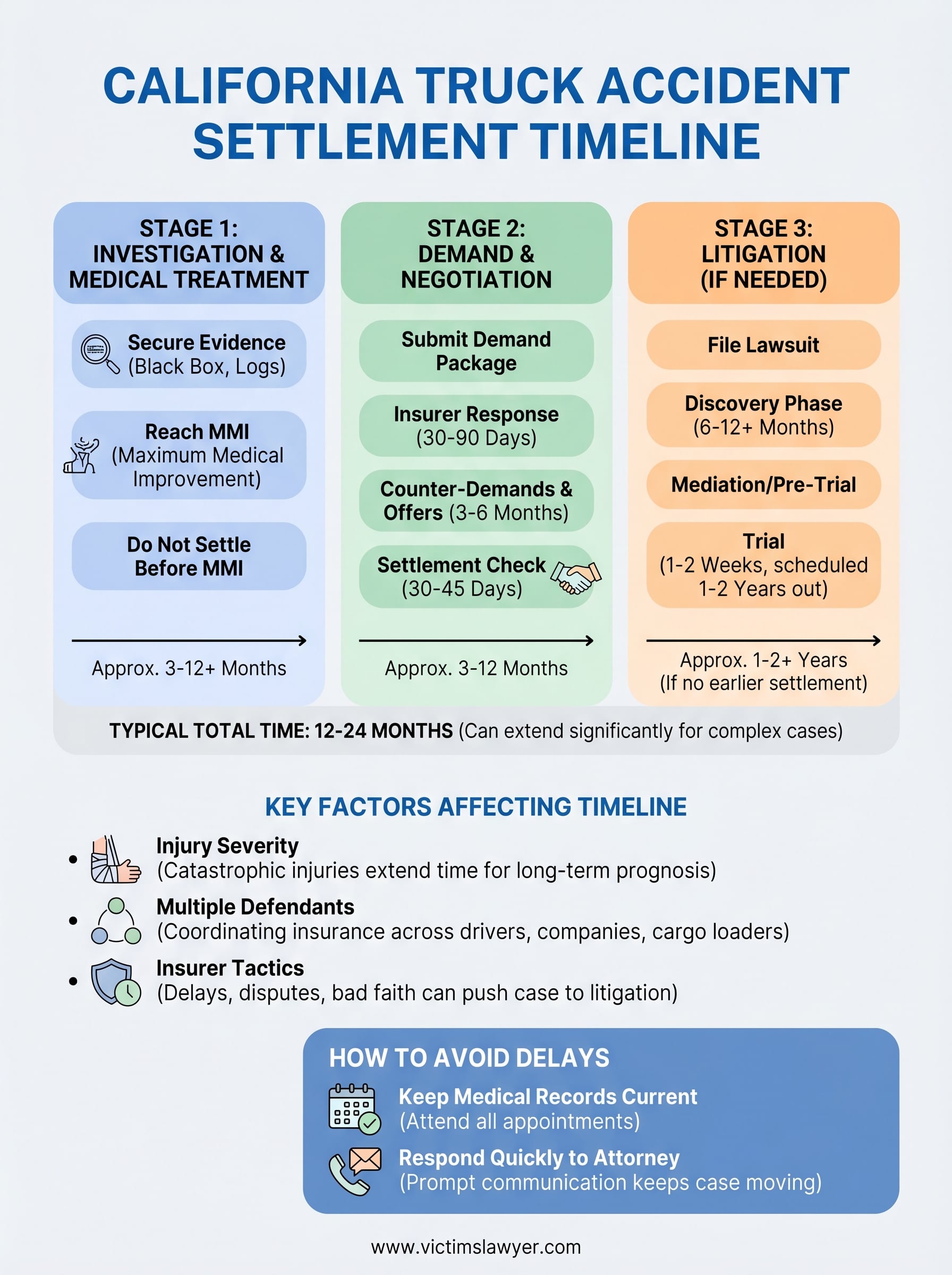
Most truck accident claims in California resolve somewhere between 12 and 24 months, though cases involving catastrophic injuries or multiple defendants can stretch well beyond that. If you’re wondering how long does a truck accident settlement take from start to finish, the process moves through three broad stages: investigation and medical treatment, demand and negotiation, and either a pre-trial resolution or a lawsuit. Each stage has its own pace, and what happens in one directly shapes what follows.
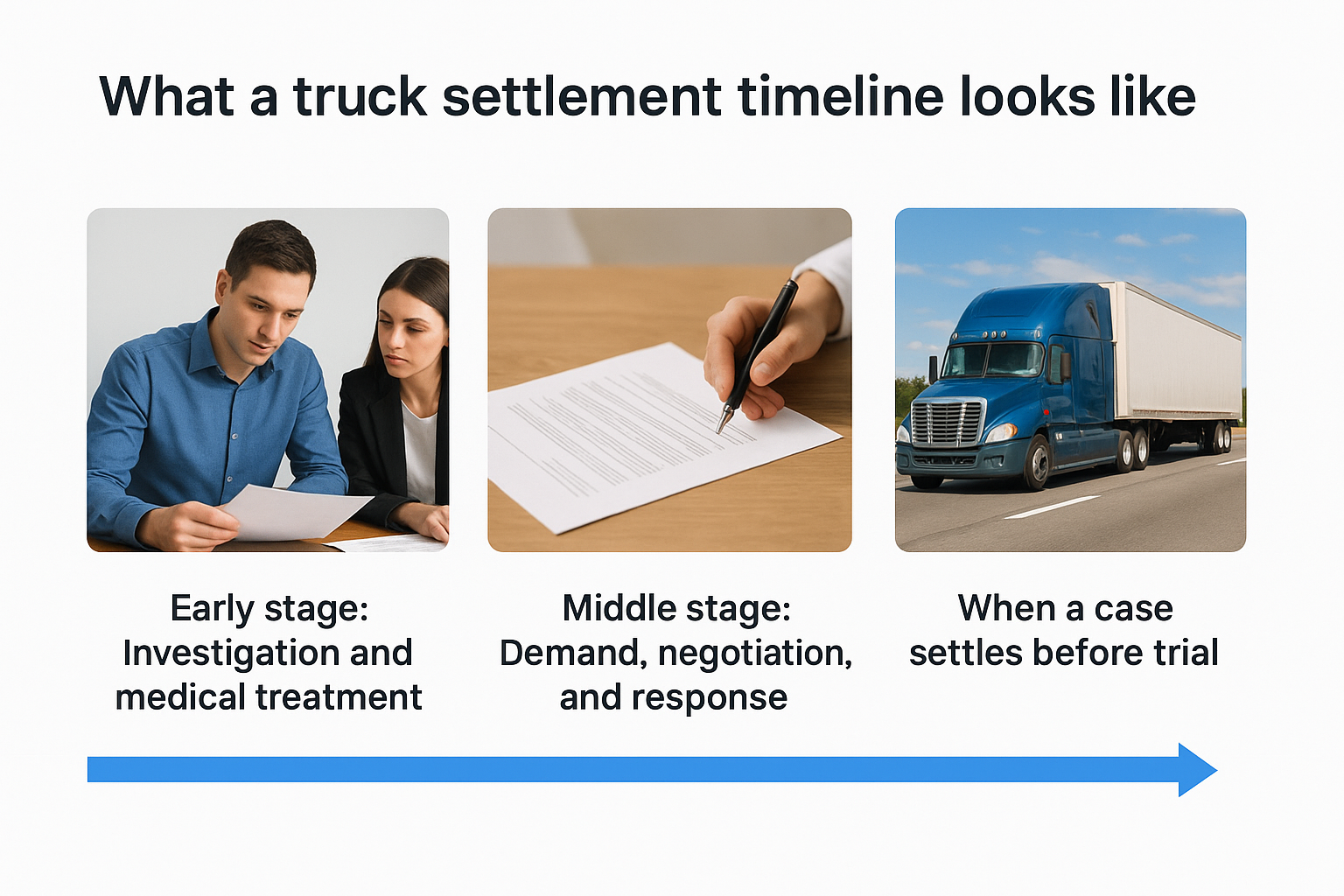
Early stage: investigation and medical treatment
The first several months after a crash are the most important for building your case, even though they often feel the slowest in terms of visible progress. Your attorney needs to secure the truck’s black box data, driver logs, maintenance records, inspection reports, and any dashcam footage before that evidence disappears. Trucking companies are only required to retain certain records for limited periods, so sending a formal evidence preservation letter immediately can be the difference between a strong case and a weakened one.
You should not consider settling while you are still receiving active medical treatment, because you won’t yet know the full extent of your injuries or your long-term care costs.
Your medical team also needs to bring you to a point called maximum medical improvement (MMI), which is when your condition has stabilized enough to accurately project your future care needs and calculate total damages. Pushing to settle before you reach MMI almost always means accepting less than your injuries actually cost you over time.
Middle stage: demand, negotiation, and response
Once your treatment is complete or your prognosis is well-established, your attorney will prepare a formal demand package that details your injuries, documented losses, liability evidence, and the compensation you are seeking. Sending that package to the trucking company’s insurer starts the negotiation phase. Expect the carrier to take 30 to 90 days to issue an initial response, and plan for multiple rounds of back-and-forth offers before both sides land on a number that genuinely reflects what your case is worth.
When a case settles before trial
Some truck accident claims reach a resolution during or shortly after the demand phase, typically within 12 to 18 months of the crash date. These cases generally involve clear liability, well-documented injuries, and an insurer willing to negotiate in good faith. When the trucking company’s carrier accepts responsibility and the damages are straightforward to calculate, your attorney can often secure fair compensation without ever filing a lawsuit.
Key factors that change the timeline in California
Several specific variables directly control how long does a truck accident settlement take in your case. California’s trucking industry includes massive interstate carriers, regional fleets, and independent owner-operators, each with different insurance structures and legal exposure. Knowing which factors affect your timeline helps you set realistic expectations and work with your attorney to manage delays before they cost you money.
Severity of your injuries
Catastrophic injuries, such as spinal cord damage, traumatic brain injury, or amputations, extend your timeline because you cannot finalize a settlement until your medical team establishes a long-term prognosis and care plan. Settling before that point locks in a number that will almost certainly fall short of what your future treatment actually costs you.
Never accept a settlement offer while you are still receiving active treatment or before your doctor has determined the full scope of your long-term medical needs.
Number of defendants
When multiple parties share liability, such as the driver, the trucking company, a third-party cargo loader, or a vehicle parts manufacturer, each party’s insurer operates on its own timeline. Coordinating evidence, discovery, and negotiations across several insurance carriers can add months to the process compared to a single-defendant claim. Your attorney must also track down separate insurance policies and confirm each party’s coverage limits, which takes additional time to verify.
Insurer cooperation and bad faith tactics
Large commercial trucking insurers assign dedicated defense teams to reduce or deny high-value claims. These carriers may delay responding to your demand letter, dispute liability even when evidence is strong, or request repeated documentation to slow the process. When a carrier acts in bad faith, your attorney may need to escalate to litigation to force a fair resolution.
How the claim moves from demand to payout
Understanding the mechanics of how a truck accident claim progresses from your initial demand letter to an actual check gives you realistic expectations and helps you stay engaged in the process. Your attorney controls several of these steps, but the insurer’s response time and willingness to negotiate ultimately shape the pace.
Submitting your demand package
Your attorney prepares a formal demand package once you have reached maximum medical improvement and your documented losses are complete. This package includes medical records, bills, proof of lost income, expert opinions on future care costs, and liability evidence tied directly to the trucking company or other defendants. Sending a thorough, well-organized demand gives the insurer less room to dispute the core facts and often produces faster, stronger initial offers.
The more complete and organized your demand package is, the harder it becomes for an insurer to delay or undervalue your claim.
What happens after the insurer responds
After receiving your demand, the carrier typically takes 30 to 90 days to issue a response. That response is almost always a lowball counteroffer. Your attorney then reviews it against your documented damages and responds with a counter-demand backed by evidence, and this back-and-forth can repeat several times before both sides agree on a figure. If you are asking how long does a truck accident settlement take at this stage specifically, budget three to six months for negotiation after your demand is sent. Once both parties sign a release agreement, the insurer issues payment within 30 to 45 days in most California truck cases.
When a truck case goes to lawsuit and trial
When negotiations stall or the insurer refuses to offer fair compensation, your attorney will file a formal lawsuit. Filing does not mean you are headed straight to a courtroom. In fact, most truck accident lawsuits resolve during the discovery phase before a trial ever begins. However, understanding what litigation adds to your timeline matters when you are asking how long does a truck accident settlement take if negotiations break down.
Discovery extends your timeline
Discovery is the formal evidence-exchange phase between both sides. Your attorney will depose the truck driver, company representatives, and expert witnesses, while the defense does the same on their end. This phase can run six to twelve months depending on how many parties are involved and how aggressively the defense team responds to documentation requests.

Cases involving multiple defendants can push discovery well past that range, sometimes adding an additional six months or more to your total wait.
What trial means for your case
If your case does not settle during discovery or at pre-trial mediation, it proceeds to a jury trial. A truck accident trial in California typically takes one to two weeks to complete, but scheduling alone often pushes that date one to two years after filing. Your attorney will continue negotiating a reasonable settlement at every stage of litigation, including during trial.
Key trial phase milestones your attorney manages include:
- Filing the complaint and serving defendants
- Completing depositions and expert witness reports
- Attending pre-trial conferences and mediation
- Selecting a jury and presenting your case
Ways to avoid delays without settling too soon
One of the most practical things you can do to control how long does a truck accident settlement take is to stay organized and proactive from day one. Gaps in your documentation, missed follow-up appointments, or slow responses to your attorney’s requests all give the insurer opportunities to question your claim or stall the negotiation process.
Keep your medical records current and consistent
Attending every scheduled medical appointment and following your treatment plan exactly as prescribed does more than help you heal. It creates a consistent paper trail that removes the insurer’s ability to argue your injuries were minor or that you delayed your own recovery. Request copies of your records regularly and forward them to your attorney as they arrive so your legal team is never waiting on documentation.
Missing medical appointments gives the defense a direct argument to reduce your settlement value, so treat each one as a legal obligation.
Respond to your attorney quickly and completely
Your attorney cannot push your case forward without your timely cooperation. When they request documents, authorizations, or your input on a settlement offer, a slow response on your end can push the timeline back by weeks. Build simple habits that keep your case moving:
- Return attorney calls or messages within 24 hours
- Keep a dedicated folder for all case-related documents
- Notify your attorney immediately if your medical status changes
These small, consistent actions compound over time and prevent the kind of avoidable delays that add months to your wait without adding value to your final settlement.
When to talk to a California truck accident lawyer
If you are still wondering how long does a truck accident settlement take and whether hiring an attorney is worth it, the answer is straightforward: the earlier you retain legal representation, the better your chances of protecting critical evidence and securing full compensation. Trucking companies dispatch their own investigators to accident scenes within hours. Without an attorney working to preserve black box data, driver logs, and witness statements on your behalf, that evidence can disappear before you even understand its value.
Waiting also gives insurers time to build a defense and pressure you into a low early offer before you know the true cost of your injuries. At Steven M. Sweat, Personal Injury Lawyers, APC, we offer free consultations with no upfront costs, and you pay nothing unless we recover money for you. Contact our team today and speak with a California truck accident lawyer who will fight for the full value of your case.