 California Accident Attorneys Blog


A rear-end collision happens when one vehicle strikes the back of another. It’s one of the most common types of crashes on California roads, and while many people assume the damage is minor, the reality is often far worse. Whiplash, herniated discs, concussions, and chronic pain are all frequent outcomes, even at low speeds that barely dent a bumper.
So what is a rear end collision in practical terms, and what should you actually know if you’ve been in one? Fault isn’t always as straightforward as “the driver in back is responsible,” injuries don’t always show up right away, and insurance companies have a playbook designed to minimize what they pay you. Understanding how these crashes work, from the mechanics of impact to the legal rules that govern liability, puts you in a much stronger position to protect yourself.
At Steven M. Sweat, Personal Injury Lawyers, APC, we’ve spent over 25 years representing rear-end collision victims across Los Angeles and throughout California. We’ve seen how quickly an “it’s just a fender bender” mindset leads people to accept lowball settlements or skip medical treatment they genuinely need. This article breaks down the causes, fault determination, common injuries, and vehicle damage associated with rear-end collisions so you can make informed decisions if you or someone you care about is ever involved in one.
Why rear-end collisions matter
Rear-end collisions are the most frequently reported type of crash on American roads. According to the National Highway Traffic Safety Administration, rear-end crashes account for roughly 29 percent of all vehicle accidents in the United States each year, resulting in hundreds of thousands of injuries and thousands of fatalities annually. In California specifically, millions of registered vehicles share congested freeways, surface streets, and intersections, creating the exact conditions where following distances shrink, reaction times compress, and crashes occur faster than most drivers expect.
The gap between visible damage and actual harm
One of the most costly assumptions you can make after a rear-end collision is that minor visible damage to the vehicle means you’re physically fine. Low-speed impacts, even those at 8 to 10 miles per hour, can generate enough force to cause soft tissue injuries, cervical strain, and neurological symptoms that take days or even weeks to surface. Insurance adjusters know this, and they use the “low impact” framing early in the process to justify smaller settlement offers, often before you’ve had enough time to understand what is a rear end collision and what your injuries actually cost you.
A vehicle that shows minimal damage after a crash can still transfer significant force directly to the occupants, particularly to the neck and spine.
Your body doesn’t come with a bumper. When your vehicle gets struck from behind, the sudden forward force moves through the seat and into your spine before traveling up into your skull. The energy transfer happens in milliseconds, far faster than any muscle group can brace against, which is why crash victims often report feeling fine at the scene and then wake up in pain the next morning. Dismissing symptoms in those first 24 to 48 hours is one of the most common mistakes crash victims make.
The financial and legal stakes involved
The costs of a rear-end collision rarely stop at the emergency room visit. Medical bills, physical therapy sessions, diagnostic imaging like MRIs and CT scans, and lost wages can accumulate over months, especially when the injury affects your ability to work full hours or perform job duties you previously handled without difficulty. A seemingly straightforward crash can become a significant financial burden before you’ve had a chance to fully recover.
California law gives you two years from the date of the crash to file a personal injury lawsuit under the statute of limitations, but waiting weeks or months before speaking with an attorney puts you at a serious disadvantage. Evidence degrades. Witnesses forget details. Surveillance footage gets deleted on a rolling schedule. Acting quickly after a crash protects your ability to preserve the facts that determine whether your claim succeeds.
Beyond individual costs, rear-end collisions frequently involve disputes over fault, insurance policy limits, and whether a pre-existing condition contributed to your current pain. Insurance companies employ claims adjusters and attorneys whose job is to reduce the amount they pay on every claim. Understanding your rights, documenting your injuries thoroughly, and consulting with an experienced attorney early gives you the best chance of recovering compensation that actually reflects what the crash has cost you, not just what the insurer decides is convenient to offer. The difference between a fair settlement and a lowball one often comes down to preparation in the days immediately following impact.
How a rear-end collision happens
When you ask what is a rear-end collision at a mechanical level, the answer starts with physics. One vehicle is traveling at speed, the vehicle ahead slows or stops, and the trailing driver fails to react in time to close the gap safely. The result is a transfer of kinetic energy from the striking vehicle into the rear of the struck vehicle. That energy doesn’t vanish on impact. It ripples forward through metal, glass, and eventually the human bodies seated inside.
The physics of impact
The severity of a rear-end collision depends on several interacting factors: the speed of the striking vehicle, the mass of both vehicles, the angle of impact, and how much the struck vehicle can absorb or redirect the force. A heavier truck striking a smaller sedan transfers significantly more energy than two vehicles of similar weight. Rear bumpers and crumple zones are engineered to absorb some of that force, but they have limits, and the energy they don’t absorb gets transmitted directly to the occupants.
Even when crumple zones function exactly as designed, the force reaching the occupants can still be enough to cause serious soft tissue damage or neurological injury.
Stiff or sport-tuned vehicles with less structural flex can actually transfer more force to passengers because the chassis absorbs less of the impact before passing it along. This is one reason why low-speed crashes in rigid vehicle frames sometimes produce injuries that seem disproportionate to the visible damage on the bumper.
What happens to your body in the first second
Your body responds to a rear-end impact in a specific sequence. The seat back pushes your torso forward while your head, which sits above the point of force, momentarily stays behind. This creates a rapid, uncontrolled extension of the neck followed by an equally sharp forward flexion. The entire whipping motion takes less than half a second from start to finish, which means your muscles never have a real chance to activate and protect the soft tissue structures in your cervical spine.
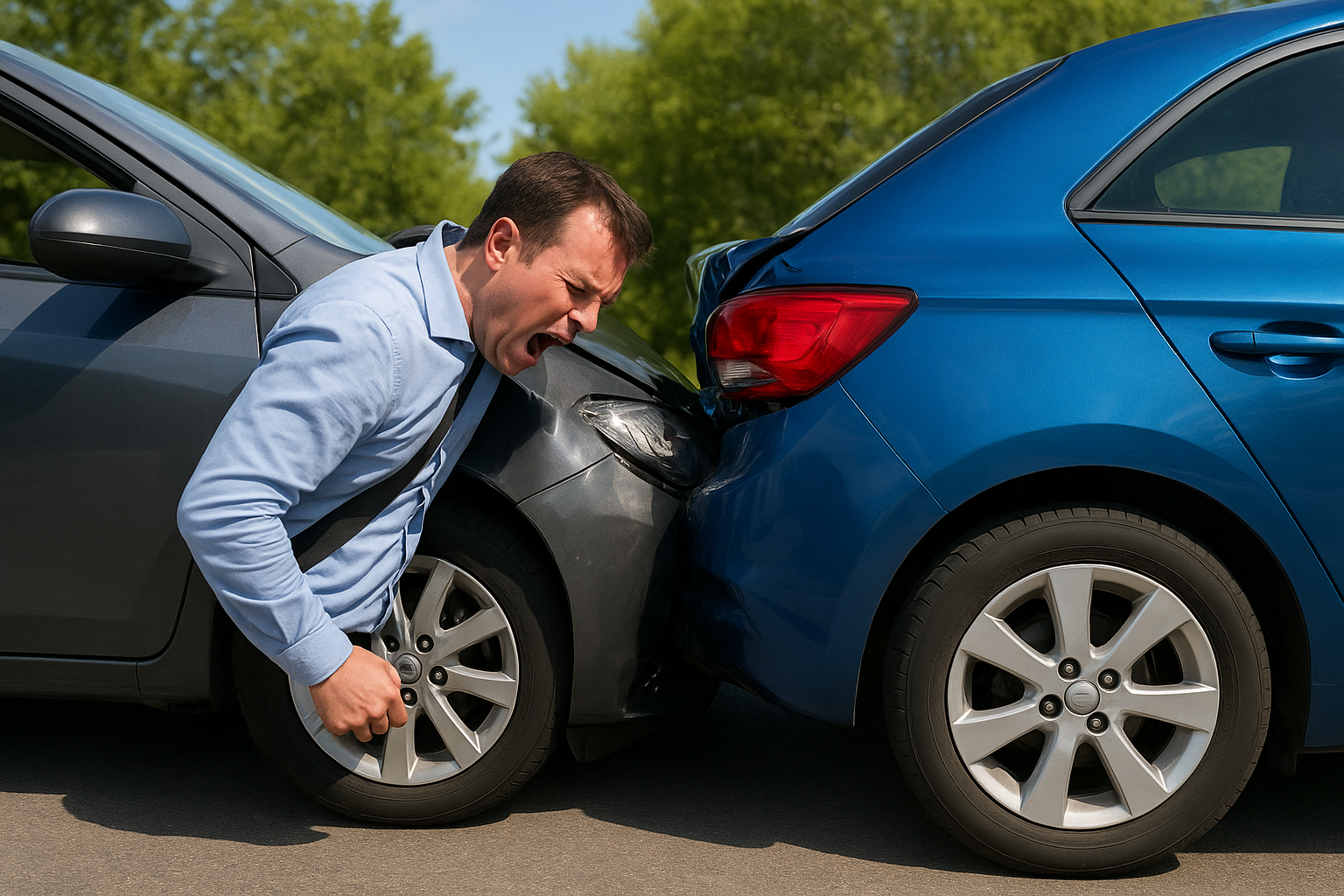
The brain also moves inside your skull during this sequence. Sudden acceleration and deceleration can cause the brain to shift and strike the interior of the skull, which is the mechanism behind concussions and traumatic brain injuries that result from rear-end crashes with no visible head contact at all.
Common causes and contributing factors
Understanding what is a rear-end collision means understanding what puts drivers in the position of striking the vehicle ahead of them in the first place. Rear-end crashes rarely happen from a single factor, they typically result from a combination of driver behavior, road conditions, and vehicle issues that converge at the wrong moment. Identifying which factors contributed to your crash matters because those details directly shape how fault gets assigned and what compensation you can recover.
Distracted and impaired driving
Distracted driving is the leading behavioral cause of rear-end crashes in the United States. Taking your eyes off the road for even two seconds at highway speed means traveling the length of a football field without watching what’s ahead. Phone use, navigation adjustments, eating, and conversations with passengers all pull driver attention away from the vehicle in front. Impaired driving, whether from alcohol, prescription medication, or fatigue, slows reaction time and reduces the ability to process a sudden brake light before the gap closes entirely.
A driver who is fatigued can have a reaction time comparable to someone legally intoxicated, which means drowsy driving carries similar crash risks even without any substance involved.
The National Highway Traffic Safety Administration consistently identifies distraction and impairment as top factors in rear-end crash fatalities, reinforcing what experienced personal injury attorneys see repeatedly in the cases they handle across California.
Speed, tailgating, and road conditions
Following too closely, known legally as tailgating, reduces the reaction window to nearly zero when the lead vehicle stops suddenly. At 60 miles per hour, a vehicle needs roughly 240 feet to stop under normal conditions. Drivers who close that gap below a safe threshold give themselves no room to respond. Speeding compounds the problem because stopping distance increases exponentially with speed, not proportionally.
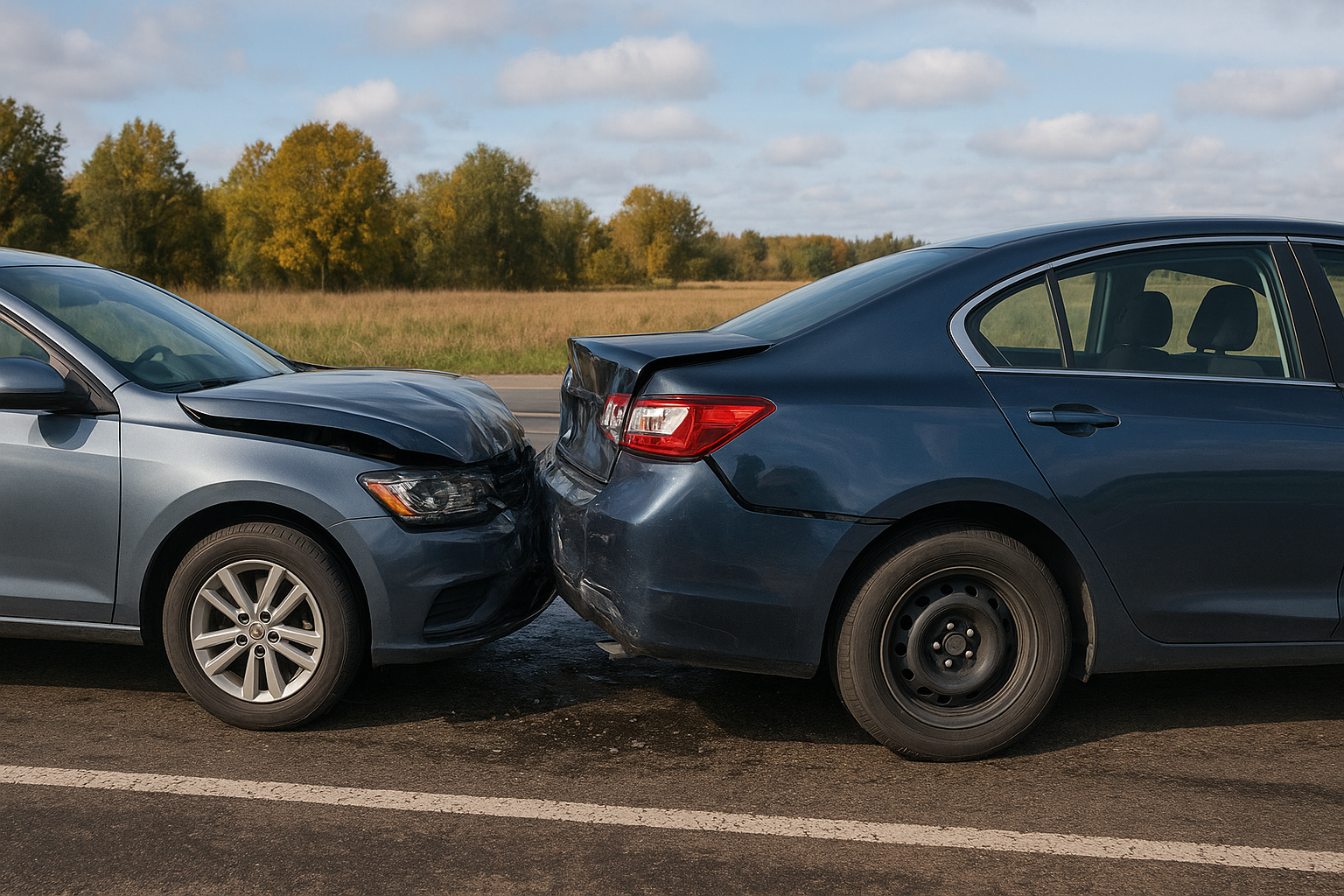
Road conditions also play a significant role. Wet pavement, loose gravel, and standing water all reduce tire traction and extend braking distances in ways that catch drivers off guard, particularly those traveling at speeds appropriate for dry surfaces. Mechanical issues like worn brake pads or tire tread below safe levels can turn a near-miss into a full collision even when the driver reacts on time. Both the trailing driver’s behavior and the physical state of their vehicle are relevant when building a case for liability.
Injuries and delayed symptoms to watch for
Part of understanding what is a rear-end collision is recognizing that the injuries it causes don’t always announce themselves immediately. Your body releases adrenaline and stress hormones during and after a crash, which can suppress pain signals for hours or even days. By the time those symptoms surface, you may have already signed paperwork or given a recorded statement that undercuts your claim.
Soft tissue, spinal, and neurological injuries
Whiplash is the most widely reported injury in rear-end crashes, but calling it “just whiplash” dramatically understates what the injury involves. The rapid extension and flexion of your cervical spine can tear ligaments, strain muscles, herniate discs, and compress nerve roots. Herniated discs in the neck or lower back can cause radiating pain, numbness, or weakness that extends into your arms, hands, or legs, and those symptoms sometimes take several days to become noticeable.

Disc herniations caused by a rear-end crash may not appear on imaging done at the emergency room but can show up clearly on an MRI performed days or weeks later.
Traumatic brain injury is another category that frequently gets missed after a rear-end collision. A concussion can occur without any direct blow to the head, simply from the rapid acceleration and deceleration that causes the brain to shift inside the skull. Symptoms like headaches, difficulty concentrating, memory gaps, light sensitivity, and mood changes are all signs that your brain may have been affected, even if you felt completely alert at the scene.
Delayed symptoms that demand attention
Delayed pain, stiffness, and neurological symptoms are extremely common in the days following a rear-end crash. If you wake up the morning after with a stiff neck, a persistent headache behind your eyes, tingling in your fingers, or trouble sleeping, those are not minor complaints you should push through without medical documentation.
Seeking medical care promptly after a crash does two critical things. It connects your injuries to the collision in the medical record, and it creates a timeline that protects you when an insurer tries to argue your condition came from somewhere else. Even if you feel only mildly sore, a same-day or next-day evaluation gives your case the documentation it needs to hold up later.
Fault and liability in California rear-end crashes
When people ask what is a rear-end collision from a legal standpoint, the first assumption they usually make is that the driver who struck the vehicle from behind is automatically at fault. California law does create a strong presumption of liability for the trailing driver, rooted in the basic duty to maintain a safe following distance and control your vehicle at all times. That presumption, however, is not absolute, and understanding how fault actually gets assigned determines how your claim gets valued and whether shared responsibility reduces what you can recover.
The presumption of fault and how California distributes it
California follows a pure comparative fault system, which means a court or insurer assigns each party a percentage of responsibility for the crash. If the trailing driver is found 100 percent at fault, you collect the full value of your damages. If the trailing driver is found 90 percent responsible and you carry 10 percent, your total recovery gets reduced by that 10 percent. This system applies even when your share of fault is small, which is why every detail about the crash matters from the moment it happens.
Your recovery gets reduced by whatever percentage of fault is assigned to you, which is exactly why documenting the crash scene thoroughly from the very start matters so much.
To build the strongest possible case, you need evidence that clearly establishes what the other driver did wrong. Police reports, witness statements, traffic camera footage, and data pulled from the vehicle’s event data recorder all help establish the timeline and the behavior of both drivers in the moments before impact.
When the lead driver shares fault
Not every rear-end crash falls entirely on the trailing driver. A lead driver who stops suddenly without cause, cuts into traffic with insufficient space, reverses unexpectedly, or operates a vehicle with non-functioning brake lights can bear a portion of responsibility for the collision. California’s comparative fault rules let you pursue compensation even if you contributed to the crash, as long as your share of responsibility is not 100 percent.
If another driver’s negligence caused or contributed to your crash, speaking with a personal injury attorney before you provide any recorded statement to an insurance company protects your ability to recover fair compensation. Adjusters are trained to identify statements they can use to shift blame onto you, and anything you say in those early conversations can significantly narrow your options down the line.
Vehicle damage and hidden repair issues
When you think about what is a rear end collision from a property standpoint, the bumper is only the beginning. Rear-end impacts frequently cause damage that extends well beyond the visible exterior, and a vehicle that looks drivable after a crash may carry hidden structural problems that compromise both its safety and its resale value. Relying solely on a visual inspection or a quick shop estimate leaves you exposed to repair costs that surface weeks or even months later.
What the bumper hides after impact
Modern bumpers are designed to absorb low-speed impacts and protect the components behind them, but that energy absorption comes at a direct cost to the internal structure. Bumper reinforcement bars, foam absorbers, and the brackets connecting those components to the vehicle frame can all bend, crack, or shift on impact without leaving visible marks on the exterior plastic cover. Replacing only the cover without inspecting those internal components is one of the most common and costly oversights made after a rear-end crash.
A bumper that looks intact after a collision may be hiding a bent reinforcement bar that leaves you completely unprotected in a second impact.
Structural, mechanical, and sensor damage
Frame and unibody damage is a serious concern in rear-end collisions, particularly those involving moderate to high speeds. Even a slight misalignment in the frame affects how your vehicle handles, how its doors and trunk close, and whether it performs correctly in a future crash. Wheel alignment, suspension geometry, and trunk seals are all areas that absorb rear-impact force and can degrade in ways a standard post-crash inspection misses entirely.
Modern vehicles also carry a dense network of sensors and cameras in the rear bumper assembly, including parking sensors, backup cameras, and collision warning systems. These components sit directly in the impact zone, and a crash that causes even minor bumper displacement can knock them out of calibration or damage them completely. Replacing and recalibrating those systems adds significant cost to the repair bill that initial estimates frequently overlook. Document every repair estimate, keep records of all parts replaced, and make sure your insurance claim accounts for the full scope of damage rather than just the surface-level repairs visible at first glance.
Key takeaways and next steps
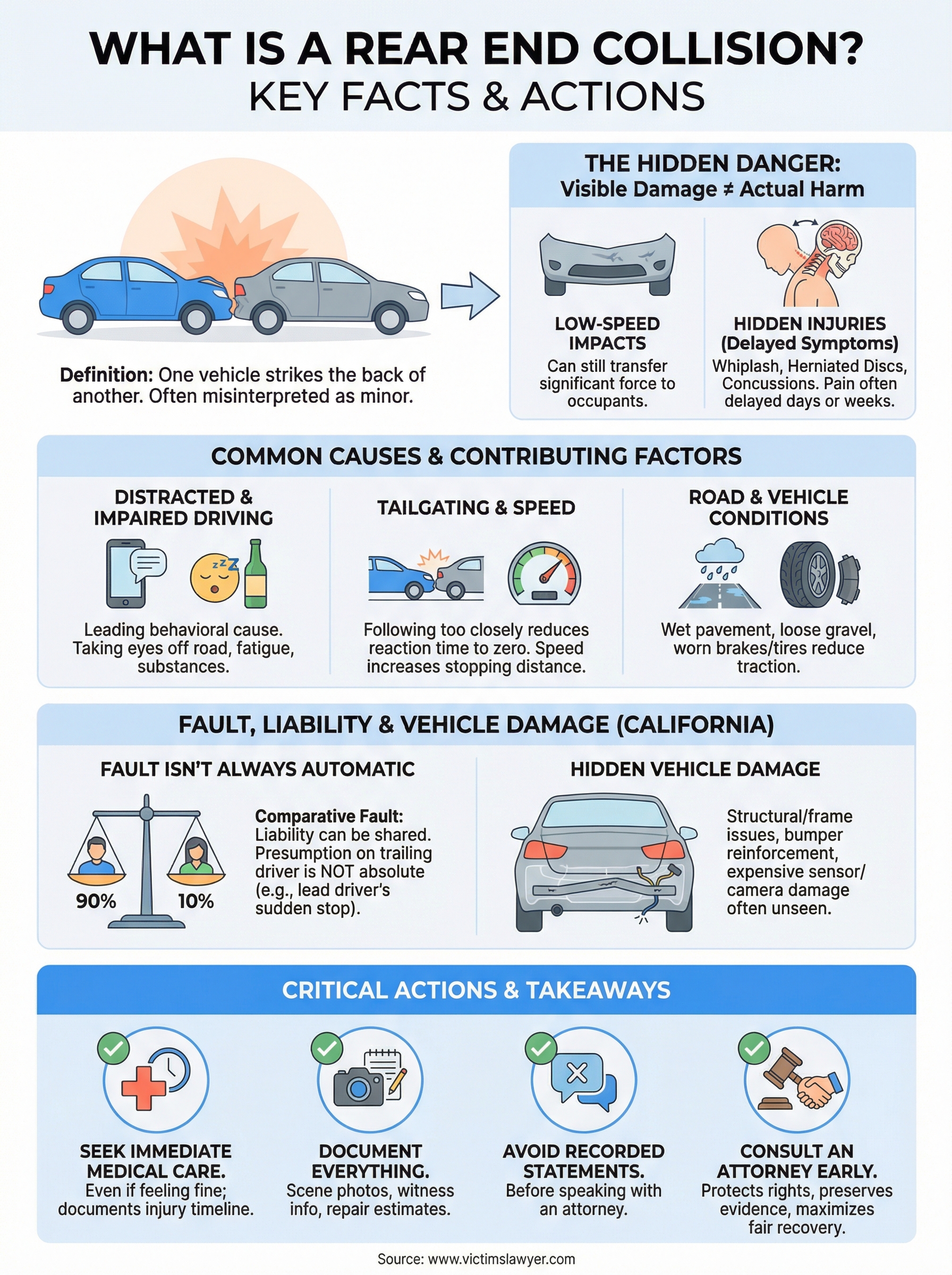
Understanding what is a rear end collision goes well beyond the basic definition. Rear-end crashes cause real injuries, vehicle damage that hides beneath the surface, and legal disputes that turn on details most people overlook in the hours immediately after impact.
Your health and your claim both depend on how quickly you act. Seek medical attention the same day, even if you feel fine at the scene. Document the crash scene, preserve repair estimates, and avoid giving recorded statements to insurance adjusters before speaking with an attorney. Delayed symptoms, hidden structural damage, and comparative fault arguments are all tools insurers use to reduce what they pay you.
If you or someone you know was struck from behind in California, reach out to Steven M. Sweat, Personal Injury Lawyers, APC today for a free consultation. Our team is available 24 hours a day, and you pay nothing unless we recover compensation for you.