 California Accident Attorneys Blog


Article Summary
In California, the statute of limitations for wrongful death claims generally grants surviving family members two years from the date of death to file a lawsuit. Under Code of Civil Procedure Section 335.1, this deadline is a strict legal barrier; missing it typically results in the permanent dismissal of the case regardless of its merits. Eligible plaintiffs include spouses, children, and certain financially dependent relatives. While the two-year rule is standard, specific circumstances can significantly alter this timeline. For instance, claims against government entities require an administrative filing within just six months. Medical malpractice cases follow a different structure, often requiring action within one year of discovering the negligence. Furthermore, the statute is tolled for minor children until they reach adulthood. The discovery rule may also delay the start of the clock if the cause of death was not immediately apparent. Because investigating these complex claims and gathering evidence takes considerable time, families must act quickly to preserve their rights and maintain leverage in settlement negotiations. Seeking experienced legal counsel early ensures that all procedural requirements are met before the window for seeking justice and financial compensation closes forever.
Making a Claim for Wrongful Death in California
 Losing a family member because of someone else’s negligence is devastating, and the legal process that follows can feel overwhelming. But if you’re considering a wrongful death claim in California, there’s one critical deadline you cannot afford to miss. The statute of limitations for wrongful death in California generally gives surviving family members two years from the date of death to file a lawsuit, and once that window closes, the court will almost certainly bar your claim for good.
That said, the two-year rule isn’t always straightforward. Certain circumstances, like cases involving medical malpractice or government entities, can either shorten or extend the filing deadline. Understanding exactly when the clock starts, and whether any exceptions apply to your situation, can mean the difference between recovering compensation and losing your right to sue entirely.
At Steven M. Sweat, Personal Injury Lawyers, APC, we’ve spent over 25 years representing families across Los Angeles and throughout California in wrongful death cases, recovering hundreds of millions of dollars for our clients. We know how quickly these deadlines can sneak up on grieving families, and we’ve seen firsthand what happens when people wait too long to act. This article breaks down the standard filing deadline, the exceptions that may apply, and the specific steps you should take to protect your family’s legal rights before time runs out.
What the California wrongful death deadline is
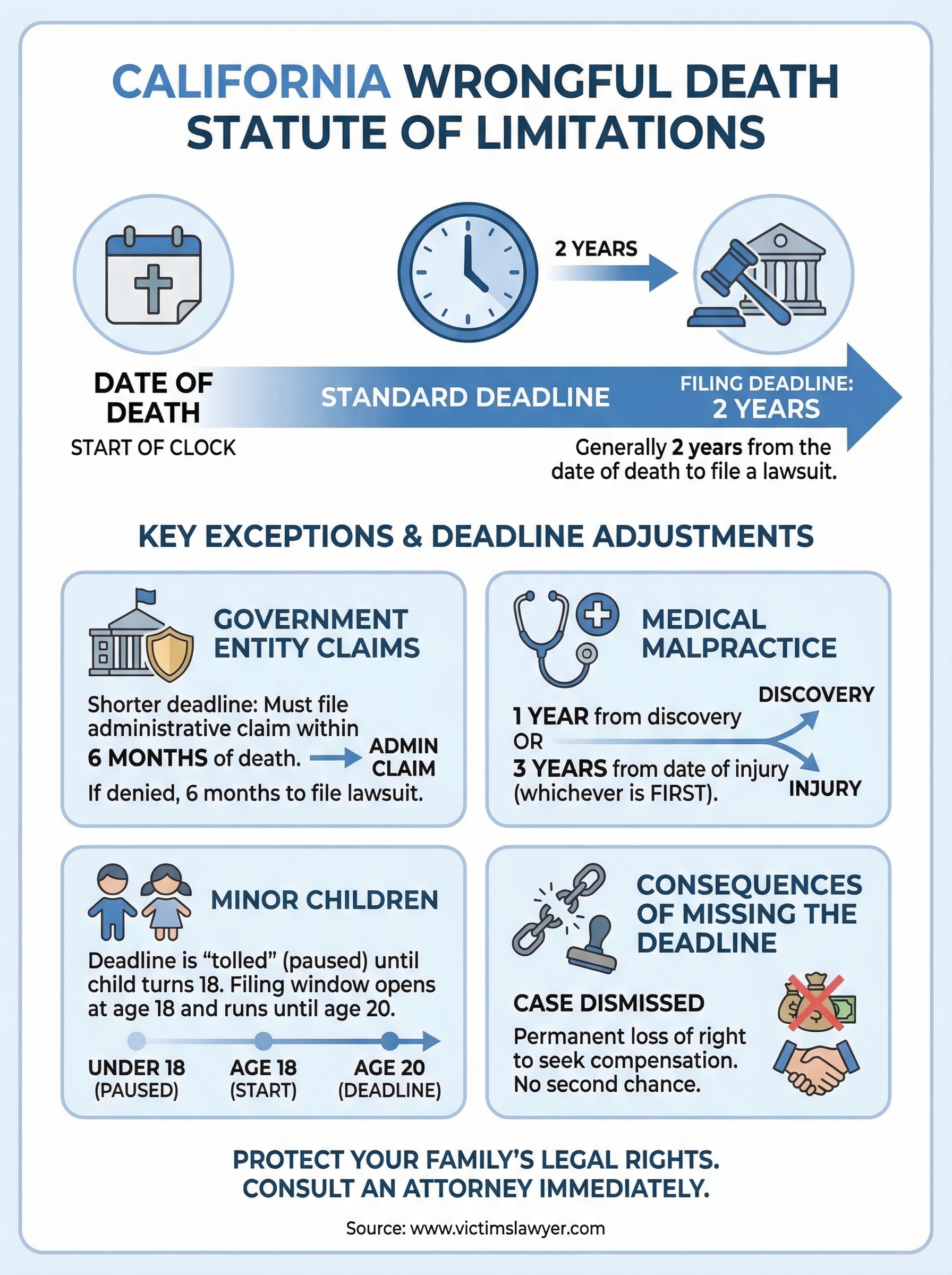
Under California Code of Civil Procedure Section 335.1, the general rule is straightforward: you have two years from the date of death to file a wrongful death lawsuit. This is the standard deadline that applies to most cases where someone dies because of another person’s negligence, recklessness, or intentional misconduct. If you don’t file within that window, California courts will almost certainly dismiss your case regardless of how strong your evidence is or how serious your loss was.
Missing the statute of limitations for wrongful death in California doesn’t just delay your case. It permanently eliminates your right to seek compensation.
Who can file a wrongful death lawsuit in California
Not everyone connected to the deceased can file a wrongful death claim. California law specifically identifies who has legal standing to bring this type of lawsuit under Code of Civil Procedure Section 377.60, and knowing whether you qualify is the first step before you can even think about the deadline.

Eligible plaintiffs include the surviving spouse or domestic partner, surviving children, and surviving grandchildren if the deceased’s children have also passed away. If none of those direct relatives exist, the law extends the right to any person who was financially dependent on the deceased, including a putative spouse, stepchildren, or parents. Here’s a clear breakdown of who qualifies:
- Spouse or registered domestic partner of the deceased
- Children of the deceased (biological or adopted)
- Grandchildren, if the deceased’s children are also deceased
- Putative spouse (someone who believed in good faith they were legally married)
- Stepchildren or parents who were financially dependent on the deceased
What the two-year deadline actually means in practice
The two-year cutoff functions as a hard legal barrier, not a flexible guideline. Once the statute of limitations expires, the defense attorney will file a motion to dismiss, and the court will grant it in virtually every case. You won’t get a hearing on the merits of your claim, and any chance of recovering the compensation your family needs to cover funeral costs, lost income, or long-term financial security disappears entirely.
California set this two-year window to balance two competing interests: giving families enough time to grieve and build a case, while also ensuring defendants aren’t forced to defend against claims built on evidence that has gone stale over years. Witnesses forget specific details, documents get lost or destroyed, and physical evidence deteriorates over time. The deadline exists to protect the integrity of the legal process for both sides, which is exactly why courts enforce it so strictly.
Your case also needs time to be properly investigated and documented before filing. Waiting until the final weeks of the deadline puts your attorney in a difficult position and can limit the quality of the case that gets presented to the court or to an insurance company in settlement negotiations.
When the two-year clock starts
The two-year period doesn’t start from the date of the accident or injury that caused the death. It starts from the date of death itself. If someone was injured on January 1 and died from those injuries three months later on April 1, your deadline runs from April 1, not January 1. That distinction matters in cases where the deceased survived for days, weeks, or months before passing, and it’s one of the most common sources of confusion for families trying to calculate their timeline under the statute of limitations for wrongful death in California.
Locking down the exact date of death is the starting point for every deadline calculation in a wrongful death case.
When the discovery rule applies
In most wrongful death cases, the cause of death is apparent from the start, so the clock begins ticking immediately. However, California’s discovery rule can shift that start date in situations where the family had no reasonable way to know that negligence caused the death. Under this rule, the clock begins when you discovered, or reasonably should have discovered, the connection between someone else’s wrongful conduct and your family member’s death.
This rule appears most frequently in medical malpractice deaths, where a misdiagnosis or surgical error may not surface right away. If a doctor’s negligence wasn’t revealed until a later autopsy report or a second medical opinion, a court may allow the clock to start from the date you discovered that connection rather than the date of death itself.
When the deceased had an existing personal injury claim
If your family member was pursuing a personal injury lawsuit at the time of death, California law allows a separate survival action to continue alongside the wrongful death claim. The deadlines for those two claims can differ, so tracking each timeline separately is critical. The wrongful death claim runs from the date of death, while the survival action may be tied to the original injury date and governed by its own limitations period.
These overlapping timelines create real complexity. Getting legal advice early ensures you don’t accidentally let one deadline expire while focusing entirely on the other.
Exceptions that change the deadline
The standard two-year rule doesn’t apply to every wrongful death case in California. Several specific circumstances can either shorten or extend your filing window, and missing these nuances can be just as damaging as ignoring the deadline altogether. Knowing which exceptions apply to your situation is a critical part of understanding the statute of limitations for wrongful death in California.
Claims against government entities
If the death was caused by a government employee or agency, such as a city bus driver, a county hospital, or a state highway patrol officer, you face a much shorter timeline. Under the California Government Claims Act (Government Code Section 945.4), you must file an administrative claim with the responsible government entity within six months of the date of death before you can even file a lawsuit in court. If the government denies your claim or ignores it, you then have six months from that rejection to file your lawsuit. Missing the initial six-month administrative deadline typically bars your entire case.

If a government entity was involved in the death, your actual deadline to act is far shorter than two years, and you need an attorney immediately.
Medical malpractice deaths
Wrongful death claims arising from medical negligence follow a different set of rules under California Code of Civil Procedure Section 340.5. In these cases, the deadline is three years from the date of injury or one year from the date you discovered the malpractice, whichever comes first. Because the date of injury in a malpractice death can be difficult to pinpoint, these cases require careful analysis to identify which deadline governs your specific situation.
Minor children and the tolling rule
California law pauses, or “tolls,” the statute of limitations for minor children who lose a parent. If you are under 18 at the time of the death, your two-year window generally doesn’t start running until you turn 18, giving you until your 20th birthday to file. However, this tolling rule applies to the minor’s individual claim and doesn’t automatically extend the deadline for adult family members filing the same case.
How to calculate the filing deadline
Calculating your deadline under the statute of limitations for wrongful death in California starts with one piece of information: the exact date of death. From that date, count forward two years to land on your filing deadline. If the death occurred on March 15, 2024, your deadline is March 15, 2026. That calculation sounds straightforward, but the real work is determining whether any exceptions apply to your situation before you commit to a number, because the wrong assumption can cost your family everything.
Step one: confirm the date of death and identify the applicable rule
Your starting point is always the official date of death, which you can verify through the death certificate. Once you have that date, you need to determine which rule governs your specific case. If a government entity was involved in the death, your administrative claim deadline is six months from that date, not two years. If the case involves medical malpractice, you need to compare the three-year-from-injury rule against the one-year-from-discovery rule and identify which one expires first. Here’s a quick reference for the most common scenarios:
| Situation | Deadline |
|---|---|
| Standard negligence (car accident, premises liability) | 2 years from date of death |
| Government entity involved | 6 months to file administrative claim |
| Medical malpractice | 1 year from discovery or 3 years from injury (whichever comes first) |
| Minor child filing individually | 2 years from 18th birthday |
Step two: account for time already spent
Once you know the applicable deadline, subtract any time that has already passed since the date of death. Many families spend weeks or months handling funeral arrangements, medical bills, and estate matters before they think about filing a lawsuit, and all of that time counts against your window. If six months have already passed, you’re already one quarter through a two-year deadline, which means you have significantly less runway than you might expect to gather evidence, retain an attorney, and put together a strong case.
The earlier you calculate your exact deadline, the more time your attorney has to investigate the facts and build the strongest possible claim for your family.
What happens if you miss the deadline
Missing the statute of limitations for wrongful death in California is not a procedural technicality that a judge will overlook. Once your deadline passes, the defendant’s attorney files a motion to dismiss, and the court grants it. It doesn’t matter how strong your evidence is, how clear the negligence was, or how serious your family’s financial loss has been. The expired deadline becomes an absolute legal defense, and the court will not allow your case to proceed on the merits.
A missed deadline ends your case before it begins, no matter how compelling your facts are.
The court dismisses your case without hearing the facts
When a judge dismisses a wrongful death claim because the statute of limitations has expired, the dismissal is typically “with prejudice,” which means you cannot refile the same claim in the future. You don’t get a second chance to correct the timing error. The compensation your family needed to cover funeral costs, lost income, and long-term financial support is gone permanently. No amount of negotiation, appeals, or new evidence will reopen a case that was dismissed on statute of limitations grounds.
Beyond losing the lawsuit itself, a missed deadline also removes your leverage in any settlement negotiations. Insurance companies know exactly when your filing window closes. If they sense you’re running out of time, they’ll offer nothing, knowing you have no credible threat of taking the case to court. Your ability to negotiate a fair settlement depends entirely on your right to sue still being intact.
Rare situations where courts may still allow a late filing
Courts do recognize a small number of situations where a late filing might survive a dismissal motion, but these are genuinely rare. If the defendant actively concealed information that prevented you from knowing a wrongful death claim existed, a court may apply equitable estoppel to extend the deadline. Similarly, if fraud or deliberate misrepresentation delayed your ability to discover the cause of death, you may have an argument for tolling the deadline. These defenses are legally complex and difficult to prove, which is why they should never be your fallback plan.
Next steps if you may have a claim
If you believe you have a wrongful death claim, the single most important thing you can do right now is contact an attorney before you do anything else. The statute of limitations for wrongful death in California moves whether you’re ready or not, and every week you wait is a week you don’t get back. Before your consultation, write down the exact date of death, gather the death certificate if you have it, and make a list of anyone who may have witnessed the events that caused the death. Bring any medical records, accident reports, or communications you’ve received from insurance companies.
Your family deserves honest answers about what your case is worth and how much time you have left to act. Steven M. Sweat, Personal Injury Lawyers, APC offers free consultations with no obligation and no upfront cost. Contact our wrongful death attorneys today to protect your rights before the deadline runs out.