 California Accident Attorneys Blog


Missing a filing deadline can permanently destroy your ability to recover compensation after an injury. The statute of limitations for personal injury in California gives you a limited window to take legal action, and once that window closes, it’s closed for good.
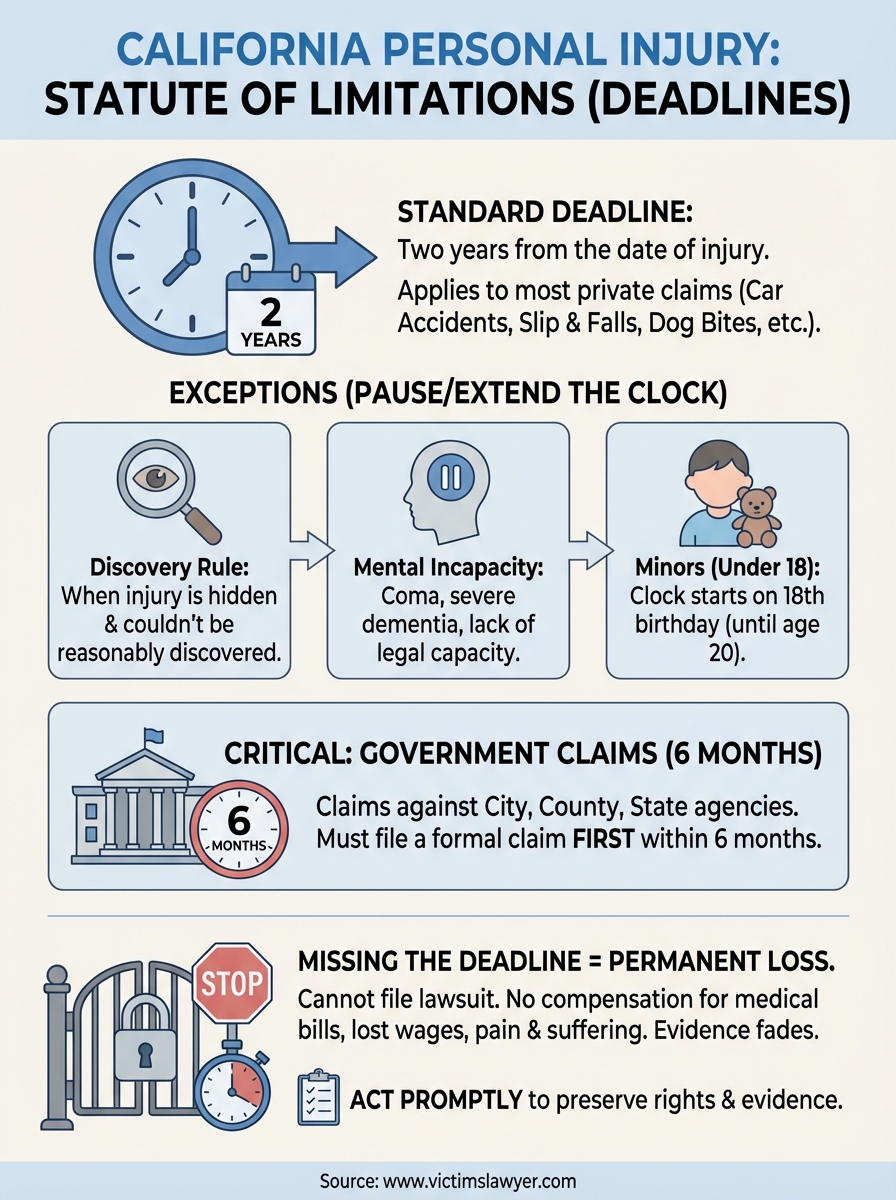
For most personal injury claims in California, you have two years from the date of your injury to file a lawsuit. But this straightforward rule comes with important exceptions. Certain circumstances can pause the clock, while claims against government agencies require action in as little as six months. Understanding these deadlines isn’t just helpful, it’s essential to protecting your legal rights.
At Steven M. Sweat, Personal Injury Lawyers, APC, we’ve spent over 25 years helping injured Californians navigate these time-sensitive requirements. This guide breaks down the specific deadlines you need to know, the exceptions that might extend or shorten your timeline, and the critical steps to take before time runs out.
What the California deadline is
California law gives you two years from the date of your injury to file a personal injury lawsuit in court. This deadline applies to most personal injury claims, including car accidents, slip and falls, dog bites, and assault cases. The law appears in California Code of Civil Procedure Section 335.1, and courts enforce it strictly.
The two-year standard rule
You have exactly two years to file your complaint with the court after an injury occurs. This timeline starts on the specific date you suffered harm, not when you discovered the full extent of your injuries or when you finished medical treatment. If your accident happened on February 15, 2024, you must file your lawsuit by February 15, 2026 at the latest.

The statute of limitations for personal injury in california doesn’t require you to settle your case within two years. You only need to file the initial paperwork with the courthouse before the deadline expires. Once you’ve filed, your case can continue through settlement negotiations or trial for months or even years afterward.
Missing the deadline by even one day typically means losing your right to sue forever.
What types of cases fall under this deadline
The two-year rule covers most physical injury claims you can bring against a private individual or business. Car accidents, motorcycle crashes, and pedestrian collisions all follow this standard timeline. Slip and fall injuries on someone else’s property, medical malpractice (with some exceptions), dog bites, and assault cases also fall under the two-year limit.
Product liability claims for defective products that cause injury generally follow the same two-year deadline. If a malfunctioning appliance burns you or a defective car part causes a crash, you have two years from the injury date. Construction site accidents, swimming pool injuries, and workplace accidents (outside of workers’ compensation) also typically use this timeframe.
How courts enforce this deadline
California courts treat filing deadlines as absolute requirements, not suggestions. Judges have no discretion to excuse a late filing simply because you didn’t know the law or because your case has merit. The defendant will file a motion to dismiss based on the expired deadline, and courts grant these motions routinely.
Your case ends before it begins if you file late. The court won’t examine evidence, hear testimony, or consider the severity of your injuries. No compensation becomes available once the deadline passes, regardless of how much you deserve or how clear the other party’s fault might be. The law protects defendants from facing claims indefinitely, which means you bear the responsibility to act within the allowed time.
You can’t restart the clock by refiling your case. Once the statute of limitations expires, it remains expired. Your only options involve proving an exception applies or demonstrating that special circumstances paused the deadline, situations we’ll cover in detail later in this article.
Why this deadline matters
The statute of limitations for personal injury in california exists to protect you and the defendant. You gain certainty about your legal options, while the other side knows they won’t face claims decades after an incident. This deadline creates a system where both parties can move forward with their lives once the window closes.
You lose your right to compensation forever
Once the deadline passes, you forfeit all legal remedies for your injuries. Courts will dismiss your case without examining the facts, regardless of how severe your injuries are or how clearly the defendant caused them. You can’t recover money for medical bills, lost wages, pain and suffering, or any other damages after the statute expires.
A missed deadline means no settlement negotiations, no trial, and no compensation, even if you have a strong case.
This permanent loss applies even when your injuries worsen years later. You might discover new complications or require additional surgeries long after your accident, but you can’t file a lawsuit if the original deadline has passed. Your only option involves seeking coverage through health insurance or personal funds.
Evidence disappears and memories fade
Physical evidence degrades with time. Accident scenes change, security footage gets recorded over, and vehicle damage gets repaired. Witnesses move away, forget critical details, or become unavailable to testify. Medical records become harder to obtain as doctors retire and facilities close or change ownership.
Acting quickly preserves the evidence you need to prove your case. Photographs, repair estimates, and witness statements collected immediately after an accident carry far more weight than attempts to reconstruct events years later. Insurance companies know this fact and exploit delays to challenge your version of what happened.
Defendants gain leverage as deadlines approach
Insurance adjusters track filing deadlines carefully. They know you lose all negotiating power once the statute runs out. Settlement offers often decrease as your deadline nears because adjusters understand you might accept less money rather than risk losing everything by filing too late.
Starting your case early gives you maximum leverage in settlement negotiations. You can reject lowball offers and prepare for trial without panic about approaching deadlines.
When the clock starts in common injury cases
The statute of limitations for personal injury in california begins counting from the date your injury occurs, not when you decide to hire a lawyer or when you finish medical treatment. For most accidents, this start date is straightforward and easy to identify. You need to know this precise date because it determines your filing deadline down to the day.
The date of injury rule
Your two-year countdown starts on the specific day you suffered physical harm. California courts call this the “accrual date” of your claim, the moment your legal right to sue comes into existence. If a drunk driver hits your car on March 10, 2025, your statute begins running on March 10, 2025 and expires on March 10, 2027.
This rule applies even if you don’t realize immediately how badly you’re hurt. Your broken arm might require surgery months later, or your back pain might worsen over time. The clock still started ticking on the day of the crash, not when you learned about additional complications or treatment needs.
The date of your accident controls your deadline, regardless of when you discover the full extent of your injuries.
Accidents with clear start dates
Vehicle collisions provide the clearest example of how this rule works. The crash happened at a specific moment in time, and witnesses, police reports, and medical records all document that exact date. Slip and fall accidents work the same way: you fell on a particular date, and that date triggers your statute of limitations.
Dog bite cases follow this pattern too. The animal attacked you on a specific day, and that day starts your deadline clock. Assault cases operate identically, with your two years beginning when the attacker physically harmed you. Construction accidents, bicycle crashes, and pedestrian injuries all share this characteristic of having an obvious, documentable injury date that leaves no question about when your deadline begins.
Physical injuries from single incidents rarely create confusion about start dates. Courts treat these cases as having clear accrual dates that you can prove through emergency room records, police reports, or witness testimony.
Exceptions that can extend or pause the deadline
The statute of limitations for personal injury in california includes several exceptions that can extend or pause your filing deadline. These exceptions recognize that certain circumstances prevent you from protecting your legal rights immediately after an injury occurs. Courts apply these rules narrowly, and you bear the burden of proving an exception applies to your case.

The discovery rule for hidden injuries
California law pauses the statute of limitations when you couldn’t reasonably discover your injury at the time it occurred. Medical malpractice cases use this rule frequently, since surgical errors or internal complications might not surface until years after a procedure. Your two-year clock starts when you discover the injury or should have discovered it through reasonable diligence, not when the negligent act happened.
This exception protects you only when the injury was truly hidden, not simply undiagnosed due to your failure to seek medical attention.
Toxic exposure cases often invoke this rule. Exposure to asbestos or other hazardous substances might not cause symptoms until decades later. The discovery rule allows you to file suit within two years of discovering the link between your illness and the defendant’s actions, provided you acted reasonably in investigating your symptoms.
When you’re mentally incapacitated
Mental incapacity pauses the deadline if you lack the legal capacity to understand your rights and make decisions about filing a lawsuit. This exception applies when you’re in a coma, suffer from severe dementia, or experience other conditions that prevent you from managing your legal affairs. The clock remains paused until your capacity returns or a guardian gets appointed to act on your behalf.
If you’re a minor
Children under 18 get special protection under California law. The statute of limitations doesn’t begin running until your 18th birthday, giving you until your 20th birthday to file most personal injury claims. Parents can file suit on behalf of injured children before they turn 18, but the child retains the right to file independently once they reach adulthood.
Special deadlines for government claims
Suing a government entity in California requires different, much shorter deadlines than claims against private parties. The statute of limitations for personal injury in california gives you only six months to file a formal claim with the appropriate government agency before you can even think about filing a lawsuit. This deadline applies whether you’re suing a city, county, state agency, or public school district.
The six-month claim requirement
You must file a written claim with the government entity that injured you within six months of your accident date. This claim isn’t a lawsuit filed in court. Instead, you submit it to the specific agency responsible for the harm, such as the city public works department after a pothole causes a crash or the county after a bus accident. Your claim acts as formal notice that you intend to seek compensation.
Missing this six-month deadline usually destroys your case permanently. Courts reject late claims except in extremely limited circumstances, such as physical or mental incapacity. You can’t simply file a lawsuit against a government defendant without first submitting this administrative claim and receiving a response.
Government claim deadlines are unforgiving, the six-month window closes faster than most people expect.
What the claim notice must include
Your claim must identify you and the government entity you’re holding responsible. You need to describe when and where the accident happened, explain how the government’s actions or negligence caused your injuries, and state the dollar amount you’re seeking in damages. California provides official claim forms that government agencies accept, though you can also draft your own document that meets the legal requirements.
After your claim gets filed
The government entity has 45 days to respond to your claim. They can approve it, reject it, or let the deadline pass without action. A rejection or failure to respond allows you to file a lawsuit in court. You then have six months from the rejection date (or from when 45 days expired) to file your actual lawsuit. This timing means you could have as little as one year total from your injury date to get your case into court against a government defendant.
Next steps
The statute of limitations for personal injury in california gives you a strict deadline to protect your legal rights. You have two years from your injury date in most cases, but government claims require action in just six months. Missing these deadlines means losing your right to compensation forever, regardless of how strong your case might be or how severe your injuries are.
Don’t wait until the last minute to explore your options. Evidence disappears, witnesses forget details, and insurance companies gain leverage as deadlines approach. Acting now protects your ability to recover full compensation for medical bills, lost wages, and pain and suffering.
Contact Steven M. Sweat, Personal Injury Lawyers, APC for a free consultation about your case. Our team has spent over 25 years helping injured Californians navigate filing deadlines and secure maximum compensation. We charge no fees unless we win your case, which means you risk nothing by getting answers today.