 California Accident Attorneys Blog


Article Summary: Seeking medical attention within 48 hours of a rear-end collision is essential for both physical recovery and legal protection. Although adrenaline often masks pain immediately after an impact, delayed-onset injuries like whiplash, concussions, and soft tissue damage can cause long-term complications if left untreated. Beyond the health benefits, a prompt doctor’s visit establishes a vital medical record that directly links injuries to the crash, preventing insurance companies from utilizing “gaps in treatment” to deny or devalue claims. Victims should initially rule out emergencies such as loss of consciousness or severe numbness before selecting the appropriate provider, ranging from urgent care for moderate pain to specialists like neurologists or orthopedists for specific symptoms. Throughout the recovery process, maintaining a detailed daily log of symptoms, medical costs, and missed work creates a robust paper trail that serves as concrete evidence for legal purposes. By prioritizing professional evaluation and thorough documentation, accident victims protect their health while building the strongest possible foundation for a personal injury claim. Consulting a legal expert can further ensure that insurance adjusters do not overlook the true extent of the damage sustained during the accident.
You just got hit from behind at a stoplight. Your car is damaged, your adrenaline is pumping, but you feel mostly okay. So should you go to the doctor after being rear ended? The short answer is yes, and sooner than you might think. Rear-end collisions often cause injuries like whiplash, concussions, and soft tissue damage that don’t show symptoms for hours or even days after the impact.
Beyond protecting your health, seeing a doctor creates a medical record that directly connects your injuries to the crash. Without that documentation, insurance companies will look for every reason to minimize or deny your claim. At Steven M. Sweat, Personal Injury Lawyers, APC, we’ve spent over 25 years representing rear-end collision victims across Los Angeles and throughout California, and we’ve seen firsthand how a delayed doctor visit can undercut an otherwise strong case.
This guide breaks down when to seek medical attention, which symptoms to watch for, what kind of doctor to see, and how your medical records factor into a personal injury claim. Whether you’re dealing with neck pain that started this morning or you walked away from the accident feeling fine, the information below will help you make the right call for your health and your legal rights.
Why you should get checked after a rear-end crash
Rear-end collisions create a sudden, violent force that snaps your head forward and back within a fraction of a second. Even a low-speed impact at 10 mph can generate enough force to damage the muscles, ligaments, and discs in your neck and spine. The problem is your body releases adrenaline and cortisol during a crash, and those hormones mask pain signals for hours or sometimes days after the accident.
Hidden injuries that show up late
The most common reason people skip the doctor after a rear-end crash is that they feel fine at the scene. That feeling is often misleading. Several serious conditions have delayed onset symptoms that get significantly worse without early medical intervention.

Here are injuries that commonly hide after a rear-end collision:
- Whiplash: Neck stiffness and pain can take 24 to 72 hours to peak
- Concussion or mild TBI: Confusion, headaches, and memory issues may appear a day or two later
- Herniated discs: Radiating pain down the arms or legs might not start immediately
- Internal bruising: Seat belt pressure can cause internal damage with no visible marks
- Soft tissue tears: Muscle and ligament injuries often swell and stiffen overnight
Seeing a doctor within 48 hours gives you the best chance to catch these injuries before they develop into chronic, harder-to-treat conditions.
How a doctor’s visit protects your claim
If you’re wondering whether you should go to the doctor after being rear ended, consider this: the medical record you create on day one is one of the most powerful pieces of evidence in a personal injury case. Insurance adjusters look for gaps in treatment to argue that your injuries weren’t serious or weren’t caused by the crash. A documented evaluation ties your diagnosis directly to the accident date and removes that argument entirely.
Your doctor’s notes, diagnostic imaging, and treatment recommendations give your attorney concrete evidence to build your claim around. Without that paper trail, you’re relying on your word against the insurance company’s, and that rarely ends in your favor.
Step 1. Rule out emergencies and get to safety
Before you think about insurance or medical records, your immediate priority is your physical safety. Right after the crash, stay calm and check yourself and any passengers for obvious injuries. If you feel severe pain, dizziness, or can’t move a limb, call 911 immediately and don’t attempt to move on your own.
If you have any doubt about whether you’re seriously injured, treat it as an emergency and wait for paramedics to assess you at the scene.
Signs that require an immediate 911 call
Some symptoms appearing right after a rear-end collision signal a medical emergency that can’t wait for a scheduled appointment. Knowing which warning signs require 911 helps you act quickly when every minute counts.
Watch for these emergency warning signs:
- Loss of consciousness, even briefly
- Severe headache or sudden blurred vision
- Numbness or tingling in your arms, legs, or hands
- Chest pain or difficulty breathing
- Inability to move your neck without sharp pain
- Visible bone deformity or skin penetration
After confirming you’re stable
Once you’ve confirmed you’re not in immediate danger, move your vehicle out of traffic if it’s safe to do so. Exchange contact and insurance information with the other driver and call the police to file an official report. Even if you feel fine at the scene, photographing the damage, road conditions, and any visible injuries creates critical evidence that supports any future personal injury claim.
Step 2. Get evaluated within 24 to 48 hours
If you’re still asking should I go to the doctor after being rear ended, the 24 to 48 hour window after your crash is when that decision matters most. Adrenaline from the impact can suppress pain signals for hours, so feeling okay right now doesn’t mean you’re uninjured. Waiting longer than two days gives insurance adjusters an opening to argue that your injuries weren’t serious enough to require prompt care, or that something else caused them.
What to tell your doctor at the appointment
When you arrive, be specific and thorough. Tell your doctor the exact details of the crash, including the direction of impact, your seating position, and whether you were wearing a seatbelt. Mention every symptom you’ve noticed, even minor ones like a stiff jaw, mild headache, or slight difficulty concentrating.
Don’t downplay symptoms to appear tough. Everything you report becomes part of your medical record and directly strengthens your personal injury claim.
Use this checklist to cover all your bases during the visit:
- Describe the crash mechanics (speed, impact direction, headrest position)
- List every symptom, even if it feels minor
- Request imaging such as an X-ray or MRI if you have neck, back, or head pain
- Ask for a written diagnosis and a treatment plan
- Confirm your next follow-up appointment date
Getting these details on record during your first visit locks in the medical evidence your attorney needs to establish a clear connection between the crash and your injuries, keeping your claim on solid ground.
Step 3. Choose the right medical care option
After a rear-end crash, you have several medical care options, and the one you choose affects both your recovery timeline and your legal claim. Not every provider gives you the same level of diagnostic depth or documentation, so matching your symptoms to the right type of care is a decision worth making deliberately.
Which provider fits your situation
Your choice of provider should depend on the severity of your symptoms and the type of injury you suspect. Visiting the wrong type of provider can delay an accurate diagnosis and leave gaps in your medical record that hurt your case later.

Use this table to match your situation to the right provider:
| Situation | Recommended Provider |
|---|---|
| Severe pain, numbness, or head injury | Emergency room |
| Moderate pain within 48 hours | Urgent care or primary care physician |
| Neck, back, or soft tissue injury | Orthopedist or chiropractor |
| Suspected concussion or brain injury | Neurologist |
| Ongoing or worsening symptoms | Physical therapist (as follow-up care) |
Choosing a provider who regularly treats car accident patients gives your records more weight when an insurance adjuster reviews your claim.
If you’re still unsure whether you should go to the doctor after being rear ended, your primary care physician is the safest starting point. They can refer you to the right specialists based on what the initial exam uncovers, keeping your treatment and documentation connected.
Step 4. Document symptoms, treatment, and costs
Documentation turns your medical visits into legal evidence that you own and control. If you’re still asking should I go to the doctor after being rear ended, understand that every appointment, every prescription, and every missed day of work needs a paper trail to support your claim. Insurance companies actively look for incomplete records to shrink settlement offers, and thorough documentation is your direct counter to that tactic.
Start your symptom log the same day as the crash, even before your first doctor’s appointment, so you capture early details that a medical exam might miss.
What to track from day one
Keeping a daily log takes less than five minutes and gives your attorney concrete, timestamped evidence to present at every stage of your claim. Record every physical symptom, every treatment session you attend, and every dollar you spend on injury-related expenses.
Use this template to stay organized:
| Date | Symptom or Change | Treatment Received | Cost |
|---|---|---|---|
| Day 1 | Neck stiffness, mild headache | Urgent care visit | $250 |
| Day 3 | Shoulder pain, disrupted sleep | X-ray, ibuprofen prescribed | $400 |
| Day 7 | Reduced range of motion | Chiropractor visit | $150 |
Save all receipts, bills, and Explanation of Benefits statements from your health insurance provider. Photograph visible injuries like bruising or swelling with your phone’s camera and make sure the timestamp feature is enabled.
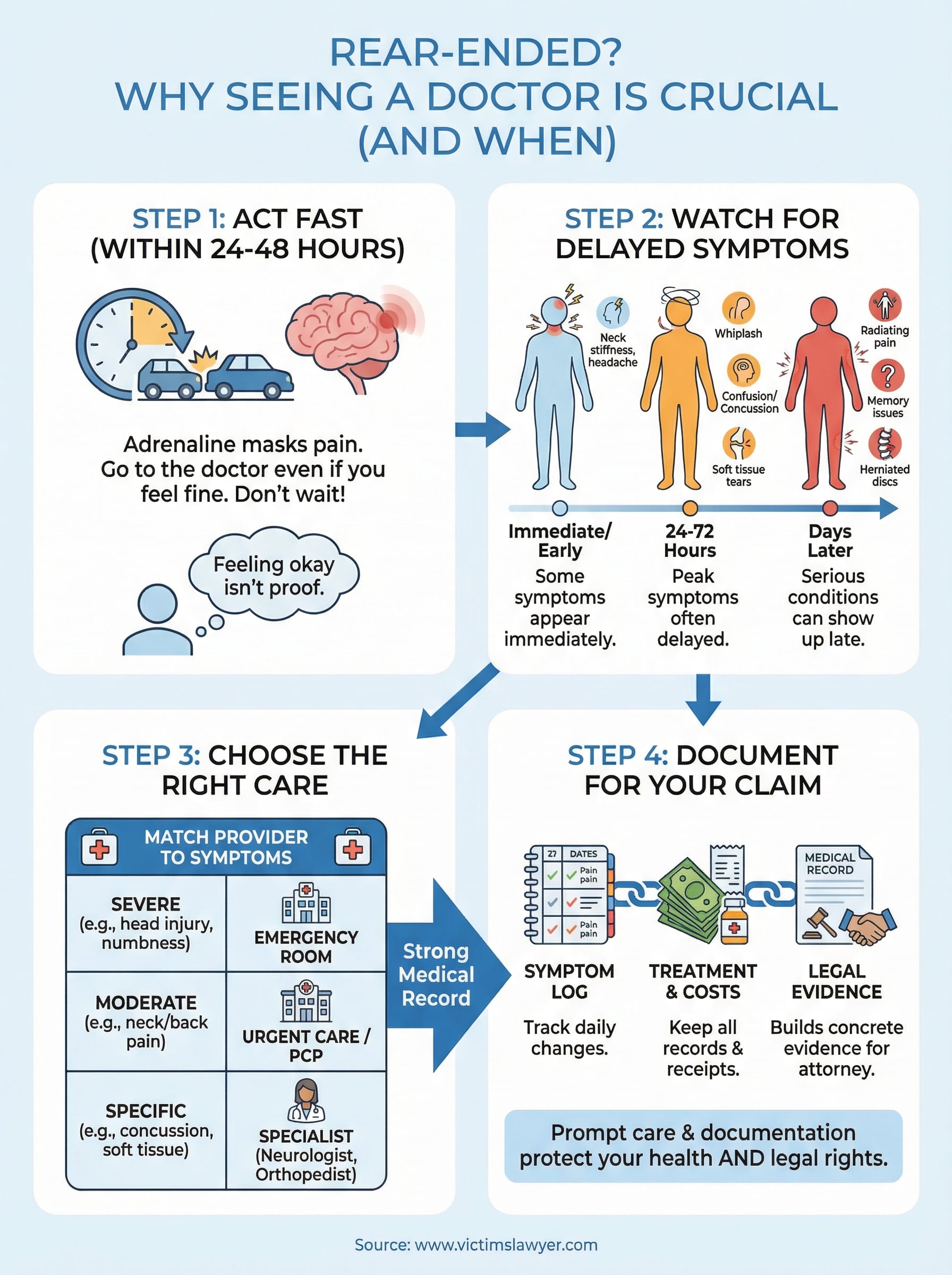
A simple way to protect your health and claim
The question of should you go to the doctor after being rear ended has one clear answer: yes, and within 48 hours. Every step in this guide connects to a single outcome: giving you the strongest possible foundation for your health recovery and your legal claim. See a doctor promptly, pick the right provider, and keep thorough records from day one.
Your documentation and medical records do the heavy lifting when it’s time to negotiate with an insurance company. The sooner you act, the harder it is for an adjuster to argue that the crash didn’t cause your injuries. If you’re dealing with neck pain, headaches, or any other symptoms after a rear-end collision, you don’t have to handle this alone. A personal injury attorney can review your records and tell you exactly where your claim stands.
Contact Steven M. Sweat, Personal Injury Lawyers, APC for a free consultation available 24/7 and get the experienced legal support your case deserves.