 California Accident Attorneys Blog


Article Summary: Ensuring vehicle safety through a proactive Honda recall lookup is a critical responsibility for every driver to prevent accidents caused by acknowledged defects like engine fires or faulty airbags. The process begins with identifying the 17-character Vehicle Identification Number (VIN) located on the dashboard, door jamb, or registration documents. Owners should utilize this unique identifier to search both the official Honda owners portal and the National Highway Traffic Safety Administration (NHTSA) database to confirm if any safety campaigns remain “incomplete.” While Honda tracks its own service history, the NHTSA provides an essential independent verification layer. If an open recall is identified, any authorized Honda dealership must perform the necessary repairs at no charge to the owner, regardless of the vehicle’s age or mileage. Experts recommend saving dated screenshots of lookup results as vital documentation in case of future safety incidents. By following these steps—locating the VIN, cross-referencing official databases, and scheduling free dealer repairs—Honda owners can effectively eliminate hidden “ticking time bombs” and ensure their vehicles meet federal safety standards, protecting both passengers and legal interests.
Every year, millions of Honda vehicles are subject to safety recalls, from faulty airbags and braking system defects to engine failures that can cause fires. If you own a Honda, running a honda recall lookup is one of the simplest things you can do to protect yourself and your passengers. An unresolved recall means your vehicle may have a known defect that the manufacturer has already acknowledged as dangerous.
At Steven M. Sweat, Personal Injury Lawyers, APC, we’ve spent over 25 years representing people across California who were seriously injured in preventable auto accidents. Some of those cases involved vehicles with open recalls that the owner never knew about. A quick VIN check could have made the difference. That’s why we put together this guide, because awareness saves lives, and no one should be driving around with a ticking time bomb under the hood.
Below, you’ll find step-by-step instructions for checking your Honda’s recall status using your VIN, what to do if your vehicle has an active recall, and how to get the problem fixed, typically at no cost to you. Whether you drive a Civic, Accord, CR-V, or any other Honda model, this process takes just a few minutes.
What a Honda recall lookup tells you
When you run a honda recall lookup, the results give you more than a simple yes or no. The report pulls data tied to your specific Vehicle Identification Number (VIN), so the information applies to your car specifically, not just your make and model. Two Civics from the same model year can have completely different recall statuses depending on when and where they were manufactured.
The specific information you receive
A successful lookup returns several key pieces of data about your vehicle. You’ll see the recall campaign number, which is the unique identifier NHTSA or Honda assigns to each safety issue. You’ll also see a plain-language description of the defect, which parts or systems are affected, and whether the remedy is still available or if the recall has already been completed on your vehicle.
If the lookup shows a recall as “incomplete,” that means your vehicle still has the unfixed defect and qualifies for a free repair at any authorized Honda dealership.
Here’s a breakdown of what a typical Honda recall result includes:
| Field | What it means |
|---|---|
| Recall campaign number | The official ID assigned to the safety issue |
| Component affected | The part or system with the defect (e.g., airbag, fuel pump) |
| Recall description | A plain summary of what the defect is and the risk it poses |
| Remedy status | Whether the fix has been completed on your specific vehicle |
| Remedy description | The actual repair the dealer will perform at no charge |
Why your VIN matters
Your 17-character VIN is the only way to get a vehicle-specific answer. Honda and NHTSA both track repair completion by VIN, so selecting your year and model alone will not tell you whether your individual car has been fixed. Without entering the VIN, you may see that a recall exists for your model but have no way of knowing if yours is actually affected.
You can find your VIN in three common places:
- On the driver’s side dashboard, visible through the windshield
- Inside the driver’s side door jamb on a label or sticker
- On your vehicle registration or insurance card
Step 1. Find your VIN and vehicle details
Before you run any honda recall lookup, you need your 17-character VIN in hand. This unique code is assigned to your specific vehicle at the factory, and it’s the only way to get results that apply to your car rather than just your model year.
Where to find your VIN
Your VIN appears in three standard locations on every Honda. Check the driver’s side dashboard first, where the VIN is stamped on a metal plate visible through the windshield from outside the car. You can also find it on the label inside the driver’s side door jamb, or printed on your vehicle’s registration card or insurance documents.
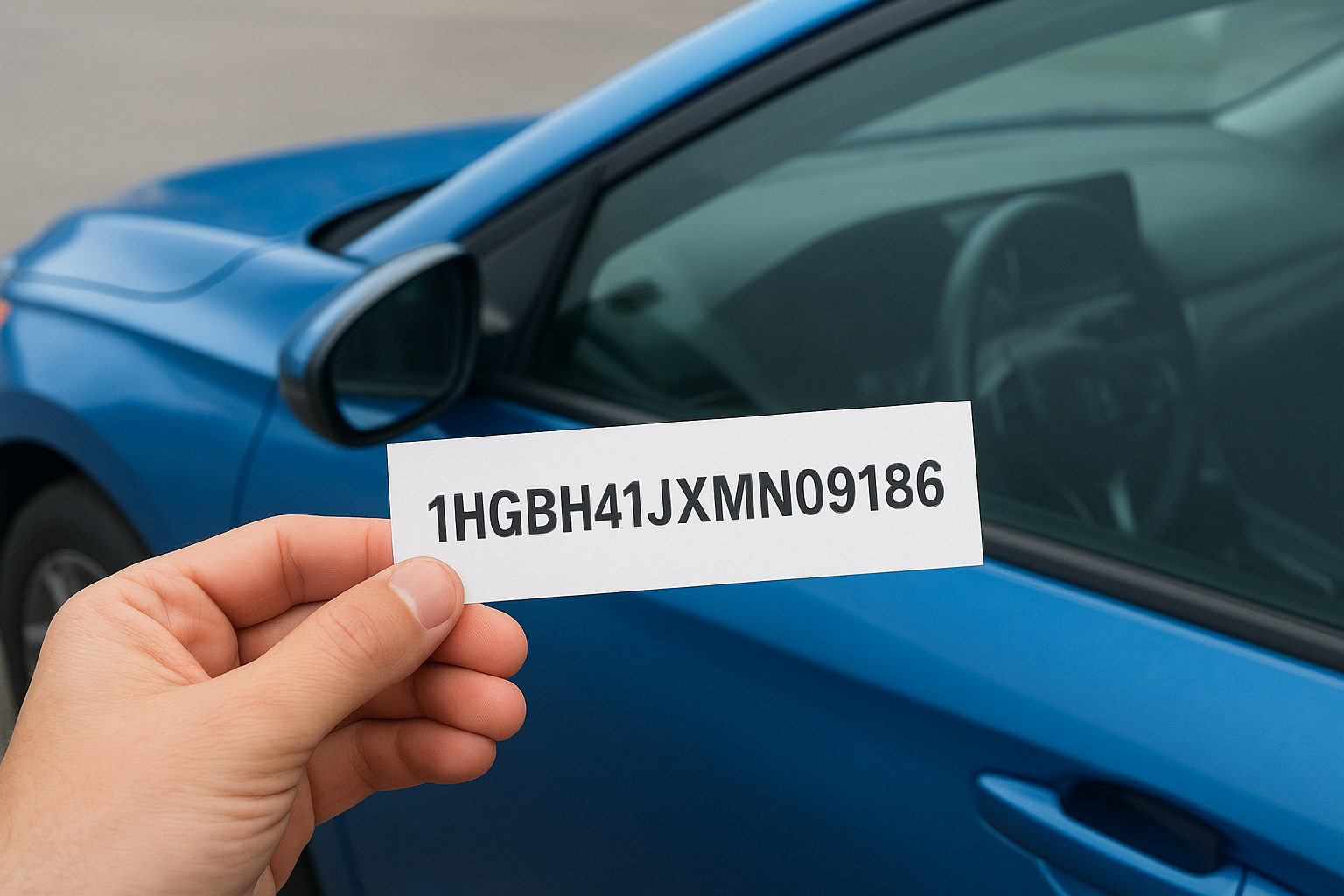
Write down your VIN on paper or take a photo of it before you sit down at a computer, so you don’t have to go back to the car mid-search.
Confirm you have all 17 characters
A valid VIN is always exactly 17 characters and uses both letters and numbers. It never contains the letters I, O, or Q, because those are excluded to avoid confusion with the numbers 1 and 0. If your VIN looks shorter or contains those letters, double-check the source before proceeding.
Valid:   1HGBH41JXMN109186   (17 characters)
Invalid: 1HGBH41JXM109186    (16 characters - recheck your source)
Step 2. Check recalls on Honda’s official site
Honda runs its own recall database at owners.honda.com, which is the most direct way to run a honda recall lookup tied to your specific car. The site pulls records directly from Honda’s repair history, so the remedy status it returns reflects whether your individual vehicle has already been serviced at an authorized dealership, not just whether the recall exists for your model.
How to navigate the Honda owners portal
Go to owners.honda.com and find the “Safety Recall & Service Campaign Lookup” section. You do not need to create an account or sign in. Type your 17-character VIN into the search box and click the button to run the check.
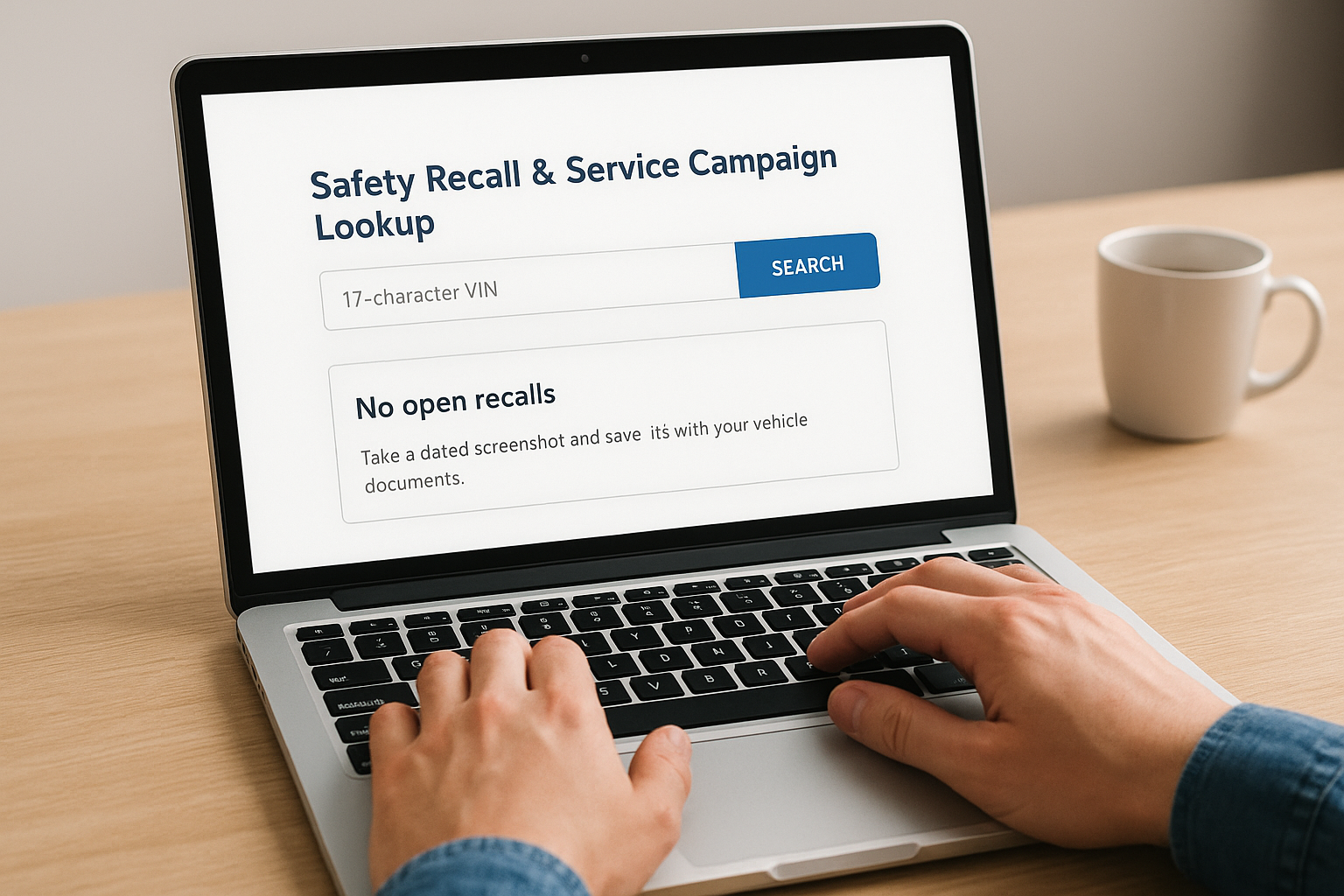
If the results show “No open recalls,” take a dated screenshot and save it with your vehicle documents.
Your results load within seconds and display every active recall linked to your VIN. For each open recall listed, you’ll see the affected component, a plain-language description of the defect, and the current remedy status. Here’s what each status label means:
| Status | What it means |
|---|---|
| Incomplete | Your vehicle still needs the free factory repair |
| Completed | The dealership already performed the fix |
| Remedy Not Yet Available | Honda is still developing a solution |
Step 3. Double-check with NHTSA and save proof
Honda’s portal is your first stop, but running a second check through the NHTSA database gives you an independent confirmation and can surface recalls that Honda’s system may not yet reflect. The National Highway Traffic Safety Administration maintains the federal recall database at nhtsa.gov, and it covers every manufacturer with results that are updated independently of each automaker’s own records.
How to search the NHTSA database
Go to nhtsa.gov and navigate to the “Check for Recalls” tool in the main menu. Enter your 17-character VIN into the search field and submit. NHTSA returns a complete list of open and completed recalls tied to your specific vehicle, including the official campaign numbers you will need when you contact a dealership to schedule repairs.
If NHTSA and Honda show conflicting results, call Honda’s customer service line at 1-888-234-2138 to resolve the discrepancy before driving the vehicle further.
Save your results as proof
After completing your honda recall lookup on both sites, take a dated screenshot of each results page and save them with your vehicle documents. If you are ever in an accident involving a recalled defect, that documented evidence of the recall status can become critical in supporting a legal claim.
Step 4. Schedule the free recall repair and stay safe
Once your honda recall lookup confirms an open recall, contact any authorized Honda dealership to schedule the repair. You do not need to return to the original selling dealer. Any Honda-certified service center is required to complete the recall repair at no charge to you, regardless of how old your vehicle is or how many miles are on it.
Call or book online with your Honda dealer
Call the dealership’s service department directly and tell them you have an open safety recall. Give them your 17-character VIN upfront so they can verify the recall and confirm parts availability before your visit. Most dealers also offer online scheduling through their service portals.
If the dealer says parts are back-ordered, ask them to contact you the moment inventory arrives, and request that confirmation in writing.
What to bring to your appointment
Bring the following items to make your service visit run smoothly. Having the recall campaign number ready removes confusion at the service desk.
- Your vehicle registration or proof of ownership
- A printed or saved copy of your recall results from the NHTSA or Honda portal
- The recall campaign number from your lookup results
After the repair, ask the advisor for written confirmation that the work was completed on your specific VIN.
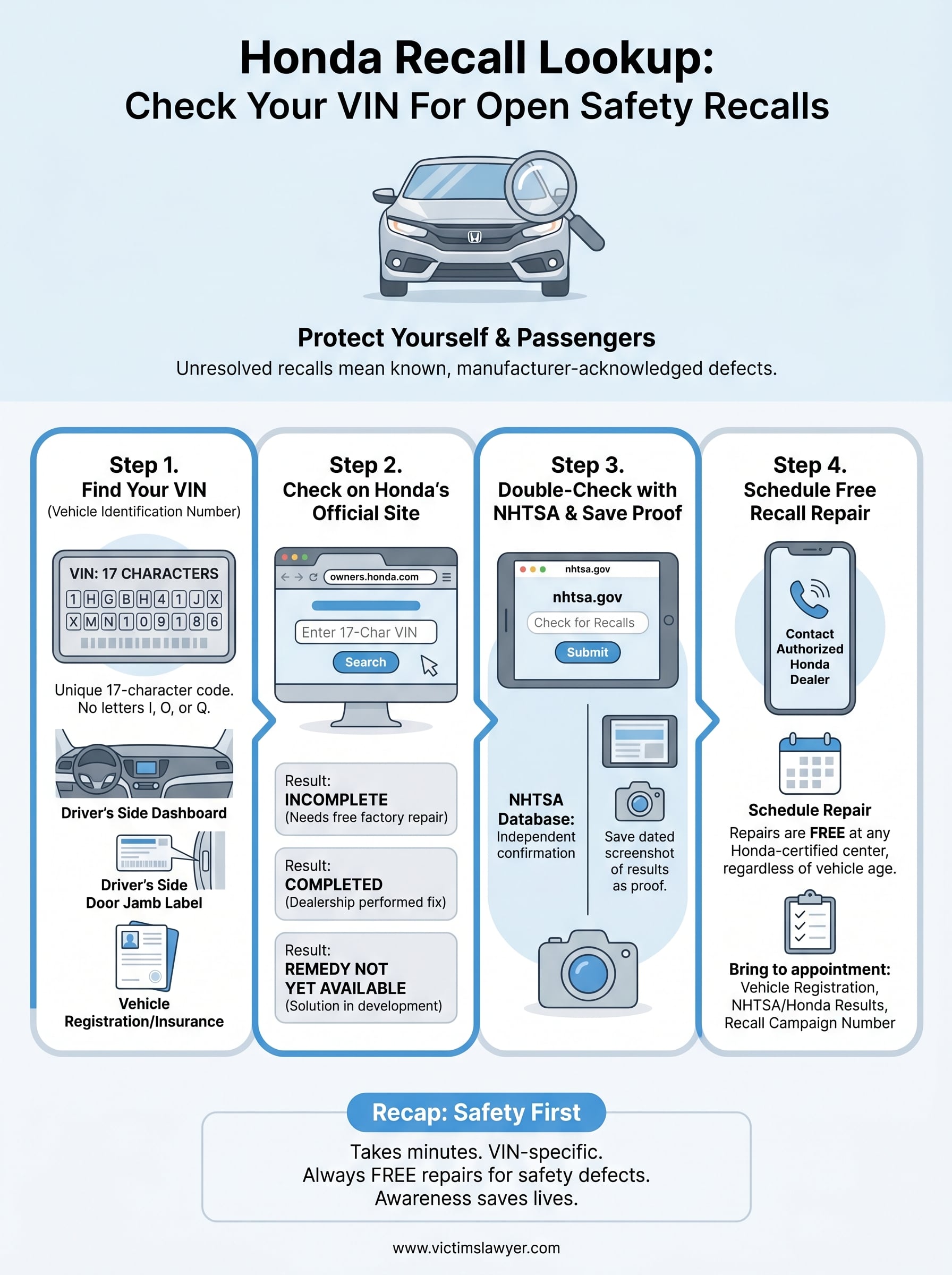
A quick recap
Running a honda recall lookup takes less than five minutes and gives you a clear picture of whether your vehicle has an unresolved safety defect. Start by locating your 17-character VIN on your dashboard, door jamb, or registration. Then check Honda’s owners portal at owners.honda.com, cross-reference the results with the NHTSA database at nhtsa.gov, and save dated screenshots of both pages. If your lookup turns up an open recall, contact an authorized Honda dealership to book a free repair and bring your campaign number to the appointment.
Knowing your recall status is step one. But if you’ve already been in an accident involving a vehicle defect or unresolved recall, that’s a different situation entirely. Manufacturer negligence can support a serious personal injury claim, and you may be entitled to significant compensation. The team at Steven M. Sweat, Personal Injury Lawyers, APC is available around the clock. Contact us for a free consultation today.