 California Accident Attorneys Blog


Delivery trucks from companies like Amazon, UPS, and FedEx are a constant presence on California roads, and when one of these large commercial vehicles causes a crash, the injuries tend to be far more severe than in a typical car accident. If you or someone you love was hit by a delivery truck, finding a delivery truck accident attorney who understands the complexity of these claims is one of the most important steps you can take. These cases often involve multiple liable parties, from the driver to the carrier company to a third-party logistics provider, and sorting out who owes you compensation requires specific legal knowledge.
At Steven M. Sweat, Personal Injury Lawyers, APC, we’ve spent over 25 years representing accident victims across Los Angeles and throughout California in cases just like these. Our firm has recovered hundreds of millions of dollars in verdicts and settlements for people dealing with serious injuries, mounting medical bills, and lost income. We know how aggressively delivery companies and their insurers push back on claims, and we know how to push harder.
This article breaks down what makes delivery truck accident claims different from other vehicle accident cases, what your claim could be worth, and the concrete steps you should take right now to protect your right to compensation. Whether the accident happened yesterday or you’re still weighing your options, the information here will help you understand the process and make a clear-eyed decision about what comes next.
What a delivery truck accident attorney does
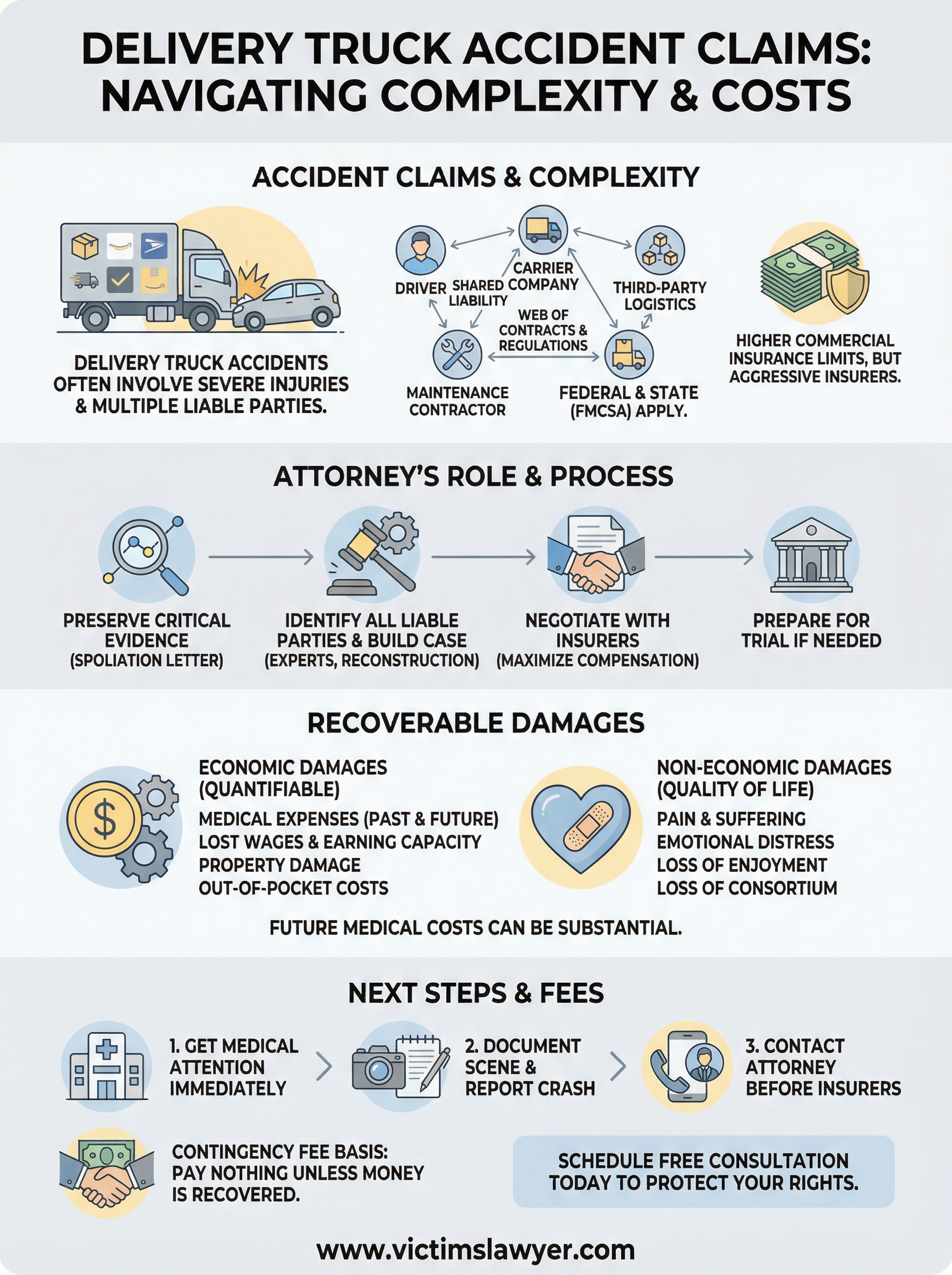
A delivery truck accident attorney handles the legal work involved in holding the right parties accountable after a commercial delivery vehicle injures someone. That sounds straightforward, but in practice it involves a specific set of investigative steps and legal strategies that separate these cases from a standard car accident claim. Understanding what an attorney actually does from the moment you hire them gives you a clearer picture of the value they bring and why trying to handle this type of claim alone puts you at a serious disadvantage.
Building your case from the ground up
From day one, your attorney works to preserve critical evidence before it disappears. Delivery companies are required by federal regulations to maintain certain records, but those records do not stay available indefinitely, and some companies act quickly to protect their interests. Your attorney will send a spoliation letter to the carrier and any related entities, putting them on legal notice that they must retain all relevant evidence, including the truck’s electronic logging device data, GPS records, dispatch logs, and the driver’s communication history.
Beyond the preservation letter, your attorney hires accident reconstruction experts, reviews surveillance footage from nearby businesses or traffic cameras, and collects the driver’s employment history with the carrier. They also obtain the carrier’s safety inspection records and any prior complaints filed against the company. Every piece of evidence goes into building a clear timeline of exactly what happened and why the other party bears responsibility.
The earlier you retain a delivery truck accident attorney, the more likely it is that critical evidence is preserved and not deleted or overwritten.
Identifying every liable party
Most people assume the driver who hit them is the only defendant. In delivery truck cases, that is rarely the full picture. Your attorney investigates the entire chain of relationships involved in the delivery, which can include the driver, the carrier company, a staffing agency that placed the driver, a vehicle maintenance contractor, or even the company that loaded the cargo incorrectly.

Each additional defendant can mean access to additional insurance coverage and a significantly larger pool of potential compensation. California law allows you to bring claims against multiple parties simultaneously, and your attorney knows how to structure those claims so that each defendant is held to their proportional share of responsibility under California’s comparative fault rules.
Negotiating with commercial insurers
Commercial delivery companies carry substantially higher insurance policy limits than private drivers. That sounds like good news, but it also means the insurers assigned to these cases are experienced, well-funded, and motivated to minimize what they pay out. They may contact you early with a settlement offer designed to close your claim before you fully understand the extent of your injuries or your legal rights.
Your attorney handles all communication with those insurers directly. They present your damages in the most complete and well-documented way possible, counter lowball offers with evidence, and push negotiations toward a number that actually reflects what your injuries cost you, now and into the future. Insurance adjusters respond differently when they know a prepared attorney is on the other side of the table.
Taking your case to trial if needed
Most delivery truck accident claims settle before reaching a courtroom, but not all of them do. Some defendants refuse to offer fair value, betting that you will accept less rather than go through the time and stress of a trial. Your attorney must be fully prepared to litigate your case from the moment they take it on.
That preparation changes how insurers and defense attorneys treat your claim throughout the entire process. When the other side knows your attorney is genuinely ready to try the case, they tend to negotiate more seriously at every stage and are far less likely to drag the process out with delay tactics designed to pressure you into settling for less.
Why delivery truck cases get complicated
Delivery truck accident cases carry more legal weight than a standard two-car collision, and the complexity shows up at nearly every stage of the claim. The companies behind these vehicles operate within a layered web of contracts, regulations, and insurance arrangements that creates real obstacles for injured people who try to navigate the process without legal help. A skilled delivery truck accident attorney knows where those obstacles are and how to work through them efficiently.
Multiple companies can share liability
When a delivery truck hits you, the driver is not always employed directly by the company whose logo is painted on the side of the vehicle. Many large carriers classify drivers as independent contractors or use third-party logistics companies to fulfill deliveries. Amazon, for example, uses a network of Delivery Service Partners, meaning the driver who hit you may work for a smaller company under contract with Amazon rather than being an Amazon employee.
This structure creates genuine disputes about who bears legal responsibility for your injuries. Each company involved will argue that the other entity is liable, and sorting out those arguments takes time, discovery, and knowledge of how California employment and agency law applies to contractor relationships.
When liability is disputed between multiple corporate defendants, injured victims who lack legal representation often end up with far less compensation than their case is actually worth.
Federal and state regulations create a complex legal framework
Delivery vehicles that operate across state lines fall under the Federal Motor Carrier Safety Administration (FMCSA) rules, which govern everything from driver hours of service to vehicle inspection requirements. Violations of those rules can strengthen your claim significantly, but identifying them requires knowing which records to request and understanding what a violation looks like in practice.
California also imposes its own commercial vehicle regulations on top of federal requirements. When a crash involves questions about both state and federal compliance, the legal analysis becomes more involved than in a typical personal injury matter.
Commercial insurance policies work differently
A delivery company’s commercial insurance policy is not structured like a personal auto policy. These policies often include multiple layers of coverage, excess policies that kick in at certain thresholds, and specific exclusions tied to how the driver was classified at the time of the crash. Insurance carriers for large commercial operators have dedicated claims teams and defense attorneys on retainer whose sole focus is limiting what the company pays out. Going up against that structure without your own attorney puts you at a serious disadvantage from the start.
What to do after a delivery truck crash in California
The steps you take in the hours and days after a delivery truck crash directly affect the strength of your claim. California’s personal injury statute of limitations gives you two years from the date of the accident to file a lawsuit in most cases, but waiting even a few weeks to act can cost you evidence that may never be recovered. Moving quickly on each of the following steps protects both your health and your legal position.
Get medical attention immediately
Even if you feel relatively okay after the crash, seek a full medical evaluation that same day. Adrenaline routinely masks pain from soft tissue injuries, internal bleeding, and traumatic brain injuries, meaning symptoms that feel minor at the scene can become severe within 24 to 72 hours. More importantly, a documented medical record created on the day of the accident connects your injuries directly to the crash, which is exactly the kind of evidence defense attorneys try to challenge when there are gaps in your treatment timeline.
Delaying medical care is one of the most common reasons insurers reduce or outright deny injury claims.
Document the scene and report the crash
If you are physically able, photograph everything at the scene before vehicles are moved: the delivery truck’s license plate, the company logo or vehicle number, road conditions, traffic signs, skid marks, and your visible injuries. Collect the driver’s name, license number, and insurance information, and get contact details from any witnesses present. Call 911 to get a police report on record, since California law requires reporting crashes that involve injury or significant property damage.

After leaving the scene, write down everything you remember while the details are still clear, including the time, direction of travel, estimated speed, and anything the driver said to you. These personal notes can be valuable months later when memories fade and the other side disputes your account of events.
Contact a delivery truck accident attorney before speaking to insurers
Once you have addressed your immediate medical needs, consulting a delivery truck accident attorney should be your next call. The carrier’s insurance company may reach out quickly with questions framed as routine, but their goal is to gather information that limits your claim. Your attorney handles all insurer communication on your behalf from that point forward. To protect yourself before that call, avoid the following:
- Admitting any fault or apologizing at the scene
- Giving a recorded statement to any insurance adjuster
- Signing any documents the carrier or its insurer sends you
- Accepting any early settlement offer without legal review
How delivery truck accident claims work
Most delivery truck accident claims follow a predictable sequence of stages, even though the timeline and outcome vary based on the severity of your injuries, the number of defendants involved, and how aggressively the carrier’s insurer fights the claim. Understanding the general process helps you know what to expect at each step and why each phase matters to the final value of your settlement or verdict.
The investigation and demand phase
Once you hire a delivery truck accident attorney, the first major phase focuses on gathering evidence and building your claim. Your attorney collects medical records, police reports, witness statements, and commercial vehicle data while also issuing the spoliation letter described earlier. This phase can take several months, largely because your attorney needs a clear picture of your total medical costs before sending a demand to the insurer. Presenting a demand before you reach maximum medical improvement risks locking you into a number that does not account for ongoing treatment, future surgeries, or long-term disability.

When your condition stabilizes, your attorney prepares a formal demand package that documents your injuries, medical expenses, lost earnings, and non-economic losses like pain and suffering. This package goes to the insurance carrier with a demand for a specific dollar amount and a deadline to respond. The carrier then reviews the package and either accepts the demand, issues a counteroffer, or rejects it outright.
A well-prepared demand package backed by strong medical documentation puts you in a far stronger negotiating position than a vague or incomplete one.
Settlement negotiations and litigation
After the demand goes out, the claim enters active negotiation between your attorney and the insurer’s adjuster. The adjuster will typically come back with a figure well below your demand, and your attorney responds with supporting evidence that justifies the number your injuries actually warrant. This back-and-forth can take weeks or several months, depending on how far apart the two sides start and how motivated the carrier is to resolve the claim without going to court.
If negotiations reach a genuine impasse, your attorney files a lawsuit. Filing does not mean the case automatically goes to trial. In fact, the majority of cases settle at some point during litigation, often after depositions are taken and both sides see how the evidence holds up under scrutiny. Your attorney explains the realistic range of outcomes at every decision point so you can choose the path that best protects your long-term financial recovery.
What compensation you can recover
The value of your claim depends on the specific losses the crash caused you. California law allows injured people to seek compensation across two main categories: economic damages and non-economic damages. A delivery truck accident attorney evaluates every cost tied to your injuries, not just the most visible ones, to make sure your claim fully reflects what the accident took from you in both financial and personal terms.
Economic damages
Economic damages are the quantifiable financial losses you can document with medical records, pay stubs, repair estimates, and receipts. Because delivery truck crashes frequently cause serious injuries, these losses can be substantial, reaching well into six or seven figures for victims with long-term care needs. Common economic damages in these cases include:
- Past and future medical expenses, including hospital stays, surgeries, physical therapy, and prescription costs
- Lost wages for the time you missed at work during recovery
- Reduced future earning capacity if your injuries prevent you from returning to your prior role or industry
- Vehicle and personal property damage
- Out-of-pocket costs such as home health care, medical equipment, and transportation to medical appointments
Future medical expenses are often the single largest component of economic damages in serious delivery truck injury cases. If you suffered a traumatic brain injury, spinal cord damage, or another catastrophic condition, your treatment plan may extend for years or even decades. Your attorney works with medical and economic experts to project those costs accurately so the settlement or verdict covers your actual long-term needs, not just what you have spent to date.
Non-economic damages
Non-economic damages compensate you for losses that carry no invoice but are just as real as your medical bills. California law gives injured people the right to recover for physical pain and suffering, emotional distress, loss of enjoyment of life, and loss of consortium for a spouse or domestic partner. These damages acknowledge that a serious crash changes how you live every day, not just how much you spend on medical care.
Non-economic damages in serious truck accident cases regularly exceed economic damages, which makes documenting them with strong evidence just as important as proving your medical costs.
These damages are harder to quantify, and that is precisely why insurance companies push back on them most aggressively. Your attorney supports every non-economic claim with medical records, mental health evaluations, testimony from people who knew you before the crash, and qualified expert witnesses. The stronger that documentation, the harder it becomes for the insurer to undercut what you actually suffered.
How fees and case costs usually work
Most people who need a delivery truck accident attorney assume they cannot afford one, especially when they are already dealing with medical bills and lost income. That assumption stops a lot of injured people from getting the help they actually need. The reality is that personal injury attorneys in California almost always work on a contingency fee basis, which means you pay nothing out of pocket to hire legal representation.
Contingency fee arrangements
Under a contingency fee agreement, your attorney only receives a legal fee if they recover money for you. If the case does not result in a settlement or verdict, you owe your attorney nothing for their time. The fee is calculated as a percentage of your total recovery, typically ranging from 33 percent to 40 percent depending on whether the case settles before or after a lawsuit is filed. Cases that go to trial or require an appeal may carry a higher percentage to reflect the additional work involved. Your attorney explains the exact fee structure before you sign anything, so there are no surprises when your claim resolves.
A contingency fee arrangement aligns your attorney’s financial interest directly with yours, since they only get paid when you do.
What case costs cover
Beyond the attorney’s fee, personal injury cases involve out-of-pocket litigation costs that accumulate over the life of your claim. These costs are separate from the attorney’s fee and typically include fees for obtaining medical records, hiring accident reconstruction experts, retaining medical specialists who provide opinions on your injuries, filing court documents, and paying for depositions. In a complex delivery truck case involving multiple defendants, those costs can reach several thousand dollars or more before a resolution is reached.
Most contingency-based law firms advance these costs on your behalf and then recover them from your settlement or verdict when the case closes. You are not required to write a check for expert fees or court costs while your case is pending. Before you sign a retainer agreement, ask your attorney specifically whether costs are deducted before or after the contingency fee is calculated, since that distinction affects your net recovery. A reputable firm explains this clearly and puts every detail in writing so you understand exactly what your final compensation will look like when the case resolves.
Next steps if you want legal help
If a delivery truck hit you or someone in your family, the window to preserve key evidence and protect your legal rights is narrow. The right time to speak with a delivery truck accident attorney is now, not after you have already given a recorded statement to an insurance adjuster or accepted a settlement offer that does not come close to covering your actual losses. Steven M. Sweat, Personal Injury Lawyers, APC offers free consultations with no obligation, available 24 hours a day, 7 days a week. You pay nothing unless we recover money for you.
Your recovery depends on the decisions you make in the days following the crash. Getting experienced legal representation early gives you the strongest possible foundation for your claim, from evidence preservation through final settlement or verdict. Contact our team today to schedule your free consultation and find out exactly where your case stands.